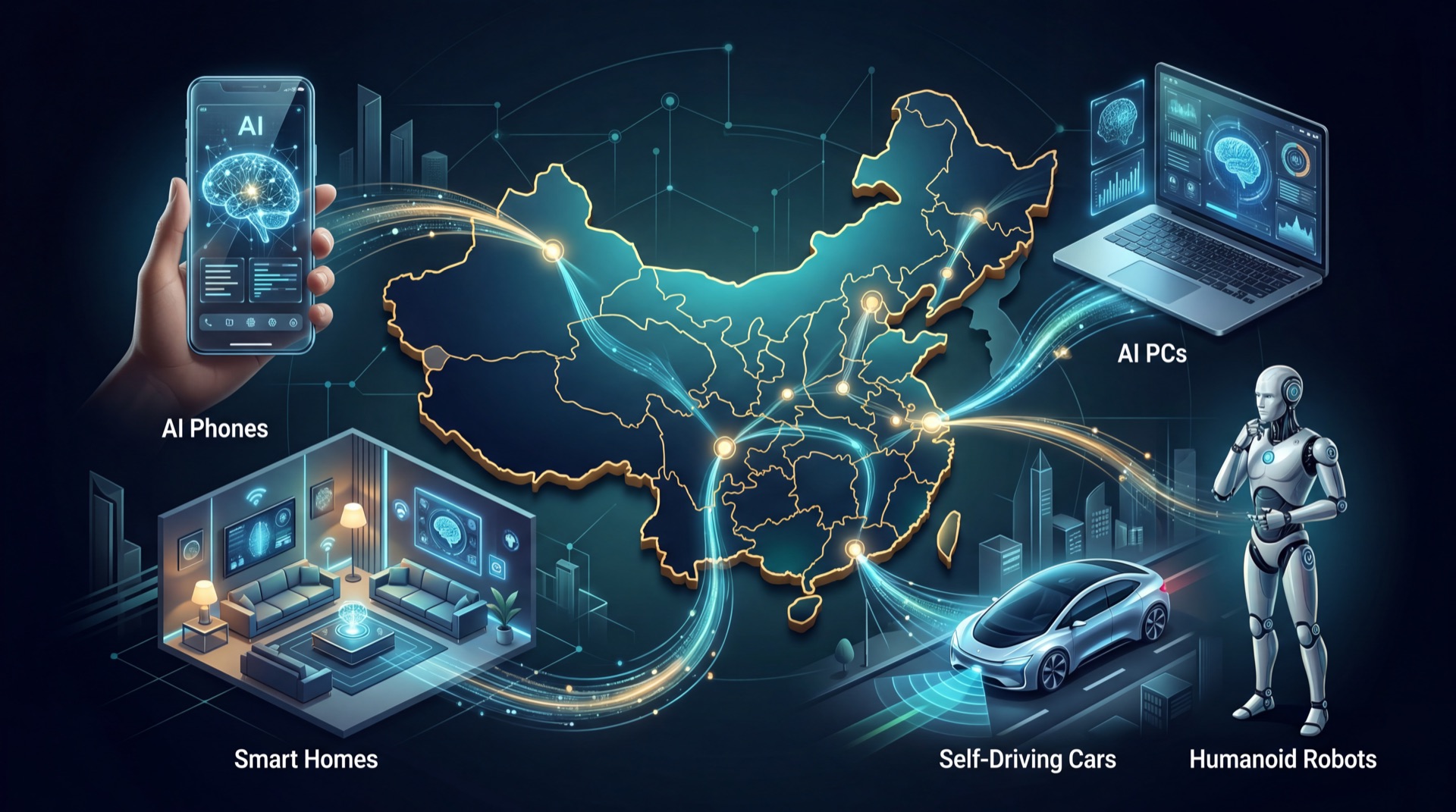
China’s top industry official used a closely watched appearance during the country’s annual parliamentary session on March 5 to lay out a more specific 2026 AI agenda than global readers usually get from broad policy messaging. Li Lecheng, minister of industry and information technology, said China would push AI phones, AI PCs, smart homes, brain-computer interfaces, self-driving cars, and humanoid robots while deepening what he described as a stronger link between AI and manufacturing.
That product list is the real story. Governments often talk about supporting AI in abstract terms. Li’s remarks stood out because they named concrete device and system categories that stretch from consumer hardware to frontier technologies. For English-language readers, that makes this less about a generic policy endorsement and more about how China is signaling where it wants the next wave of AI deployment to happen.
This was a product roadmap signal, not just another AI slogan
According to Xinhua and other Chinese outlets that relayed the remarks, Li said the Ministry of Industry and Information Technology would work in 2026 to improve product supply and help AI PCs, AI phones, and smart-home products better meet consumer demand. He also said the ministry would push next-generation AI products including brain-computer interfaces, self-driving cars, and humanoid robots through continued research and technology iteration.
That matters because it gives the outside market a clearer read on official priorities. Instead of focusing only on large models or cloud infrastructure, the remarks connected AI to devices people buy, machines factories deploy, and autonomous systems that still sit closer to the frontier. In one appearance, China linked everyday AI terminals to some of the most ambitious categories in intelligent hardware.
The bigger push is AI plus manufacturing
Li did not frame the plan as a pure hardware story. He tied it to a broader “AI-plus-manufacturing” drive, saying the ministry would vigorously promote the mutual advancement of AI and manufacturing. That phrasing is important because it suggests Beijing wants AI adoption to be measured not only by model announcements, but by how deeply AI tools and intelligent systems spread through industrial production and real products.
Official figures cited in the same remarks were meant to support that argument. Li said China’s core AI industry exceeded 1.2 trillion yuan in 2025 and that the country had more than 6,200 AI enterprises. He also said the AI application penetration rate among above-scale manufacturing companies had surpassed 30% by the end of 2025.
Those numbers should be treated as official-policy statements rather than independently audited market data. Even so, they help explain the editorial weight of the remarks. The message was not simply that China wants more AI innovation. It was that policymakers believe AI has already become material to the country’s industrial base and should now be pushed further into both consumer products and manufacturing deployment.
Devices, autonomous systems, and humanoids are being grouped into one policy cycle
Another reason the remarks are notable is the way they compress several fast-moving technology tracks into one official frame. AI phones and AI PCs sit in the current consumer-device race. Smart homes extend that logic into the connected-home market. Brain-computer interfaces represent a more experimental frontier. Self-driving cars and humanoid robots push the story into autonomous and embodied systems.
That combination is useful for global readers because it shows China is not signaling a single-bet AI strategy. It is presenting a wider rollout thesis in which devices, industrial applications, autonomous mobility, and humanoid robotics all belong to the same next-stage push.
Li also used the remarks to point to existing momentum in intelligent hardware. According to the official account and relay reports, he said AI glasses, AI phones, and AI PCs were already appearing in large numbers, and that Chinese companies had launched more than 300 humanoid robot models, accounting for more than half of the global total. Those figures, again, should remain clearly attributed to the minister’s remarks, but they reinforce the policy signal that China sees embodied and intelligent hardware as an area worth accelerating rather than merely studying.
Related reading
- How Huawei’s AI Data Platform shows China is building the infrastructure behind enterprise AI
- Why Robot Era’s latest funding round matters for China’s humanoid robotics race
- What Xpeng’s latest G6 launch says about self-driving features moving toward the mass market
The governance line matters too
The speech was not only about growth. Li also said AI development must balance development and security and remain for people, serving people, and under human control. That governance note gives the story a more complete framing than a simple industrial cheerleading piece.
For international coverage, this point matters because it shows the current policy cycle is trying to do two things at once: speed up AI deployment while also emphasizing security, human oversight, and controlled use. The safest editorial approach is not to overread that as a fully detailed regulatory blueprint. There is no standalone implementation document in this workflow that turns the remarks into a complete 2026 action plan. But the line does signal that China’s leadership wants the expansion of AI products and systems to be presented alongside a security and oversight narrative.
What global readers should watch next
The most useful takeaway is that China is becoming more explicit about where it expects AI commercialization to show up next. If these priorities hold, the next stage of China’s AI story will not be limited to model releases or chatbot competition. It will increasingly be told through AI-enhanced consumer devices, industrial adoption, autonomous vehicles, and humanoid robots.
That does not mean every category named by Li will develop at the same speed. Brain-computer interfaces, for example, remain far earlier than AI phones or AI PCs. Humanoid robots still face the familiar gap between demos and scaled deployment. And self-driving cars must still clear technical, commercial, and regulatory hurdles. Even so, the significance of the March 5 remarks is that China has now grouped those categories into one visible 2026 policy signal.
For English-language readers, that is the clearest reason this story matters. China is no longer only saying it supports AI. It is increasingly saying which AI products and intelligent systems it wants to push next.
Bottom line
Li Lecheng’s March 5 remarks are worth watching because they turn a broad AI-growth message into a more concrete list of 2026 priorities. By naming AI phones, AI PCs, smart homes, brain-computer interfaces, self-driving cars, and humanoid robots in the same answer, China’s industry minister offered a clearer map of how Beijing wants AI to move from models and slogans into devices, factories, and autonomous systems.
The strongest reading is not that China has already released a fully detailed implementation plan. It is that the country has sent a high-level but unusually specific signal about where it wants the next phase of AI deployment to land.