Dek: Lei Jun says robots at Xiaomi’s EV factory can already handle simple screwdriving tasks for about three hours, offering one of China’s clearest recent signs that embodied AI is being tested on a real production line.
China’s humanoid-robot story often gets told through stage demos, fundraising rounds, and long-range ambition. What makes Xiaomi’s latest update stand out is that it points to something more concrete: a real factory, a specific task, and a rough operating window.
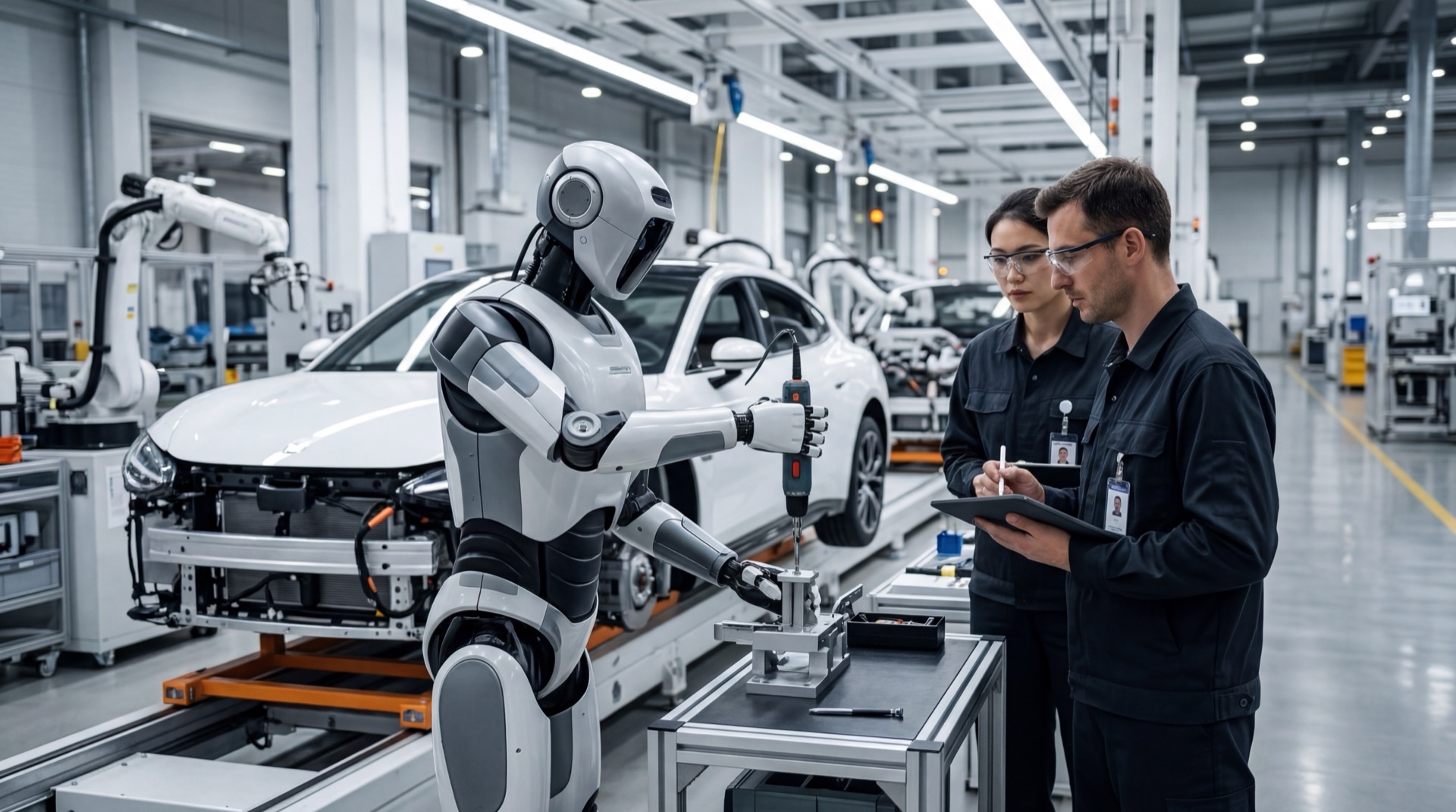
In a March 7 report from Xinhua, Xiaomi founder Lei Jun said robots are already “interning” at Xiaomi’s EV factory. According to the report, the robots can handle simple screwdriving work and operate stably for about three hours at a time. That is still a very early deployment signal, not proof of large-scale automation. But it is one of the clearest recent public datapoints suggesting that China’s embodied-AI push is moving from demo culture toward real manufacturing trials.
For global readers, that matters because EV plants may become one of the first serious proving grounds for humanoid robots. They offer repetitive tasks, structured environments, and manufacturers that are already comfortable iterating quickly on hardware and software.
What Xiaomi actually said
The key facts in the March 7 reporting are fairly narrow, which is exactly why they are useful.
Lei told Xinhua that robots are already “interning” at Xiaomi’s EV factory and can perform simple screwdriving tasks for around three hours. He also said the robots have not yet become formal factory workers, a wording choice that matters. It suggests Xiaomi is still in a test phase rather than broad commercial deployment.
That distinction should not be blurred. The reporting does not identify the exact robot model, the number of units in use, the level of autonomy involved, or whether the system can sustain a full production shift. It also does not support claims that humanoid robots are already replacing human labor at scale inside Xiaomi’s plant.
Still, the update is stronger than a vague promise. A named factory, a named task, and a rough runtime give the story a firmer industrial footing than many humanoid-robot headlines usually provide.
Why an EV factory matters
A car factory is not a random place to test this kind of technology.
Automotive plants are full of repeatable physical tasks, standardized workstations, and tightly managed safety procedures. That makes them a more realistic early training ground for embodied AI than a flashy consumer demo. If a robot can reliably complete a simple fastening job in a production environment, even for only a few hours, that is more meaningful than showing balance, dance moves, or short scripted interactions on a stage.
This is why Xiaomi’s factory-floor signal travels beyond one company. It hints at a broader industrial logic: Chinese EV makers may become natural launchpads for humanoid-robot trials because they combine manufacturing scale, fast iteration cycles, and a strong incentive to automate more of the shop floor over time.
That does not mean the jump from pilot task to wide deployment will be easy. Factories demand consistency, safety validation, uptime, and cost discipline. But the Xiaomi datapoint suggests the conversation is no longer only about whether humanoid robots look impressive. It is increasingly about whether they can survive real operational conditions.
China is trying to turn robot hype into application
Xinhua framed the Xiaomi update inside a much broader industry message.
The report said many delegates at China’s annual parliamentary meetings see 2026 as an important turning point for the robot industry as it moves from technical verification toward application scenarios. That wider framing matters because Xiaomi’s factory example was presented not as an isolated curiosity, but as evidence that the sector is entering a more practical phase.
The same Xinhua report quoted Zhang Jin, president of Siasun Robot & Automation, saying China’s humanoid-robot industry has already moved beyond pure demonstration and is in a critical transition from laboratory prototypes to market-oriented applications. Zhang said Siasun’s more than 4,000 manufacturing enterprise customers provide a wide range of possible use cases. In his view, humanoid robots are likely to land first in industrial settings such as automotive manufacturing, new energy, and 3C electronics, before expanding into higher-risk inspection, emergency response, elder care, and education.
That broader context helps explain why Xiaomi’s screwdriving example matters. It fits a national narrative in which industrial deployment—not just frontier-model performance or eye-catching hardware demos—is becoming the main benchmark.
Why China may have an advantage in this stage
Lei used ambitious language around the bigger picture. According to Xinhua, he said China has already built a first-mover advantage in humanoid robots and that the industry has strong prospects over the next several years.
That should remain clearly attributed to Lei rather than treated as a settled global ranking. Even so, the claim lines up with another point made in the same report: China’s manufacturing scale gives robotics companies unusually rich training and deployment conditions.
Jia Shaoqian, chairman of Hisense, said China’s large manufacturing base and application scenarios provide a unique foundation for the robot industry. He argued that in the next phase—when the contest is less about eye-catching motion and more about useful work—embodied intelligence could become a differentiated path for Chinese companies.
That may be the most important strategic takeaway for English-language readers. China is increasingly framing AI competition not only as a race for better models, but also as a race to put intelligent systems into physical settings where they can do measurable work. Factories are an obvious place to test that thesis.
What not to overstate
This story is interesting precisely because it is concrete. It would be easy to weaken it by exaggerating.
The available reporting supports saying that robots are already being tested at Xiaomi’s EV factory and can handle a simple fastening task for around three hours. It does not support saying that Xiaomi has achieved full humanoid-robot deployment on its production lines. It also does not support claims that China has already solved the economics, reliability, or safety challenges of large-scale embodied-AI adoption.
The word “interning” is useful here because it captures the stage of the story. These robots are being tried, observed, and judged inside a real industrial environment. They are not yet being presented as full members of the workforce.
That also means readers should watch for the next harder signals: longer operating windows, more complex tasks, clearer throughput gains, larger fleet sizes, and whether manufacturers begin discussing cost and return on investment rather than only technical promise.
Why global readers should care
Humanoid-robot news can sometimes feel detached from actual industry. Xiaomi’s update makes the topic more legible.
If Chinese automakers start treating humanoid robots as factory tools rather than PR props, that could reshape how the sector is evaluated worldwide. The key question would shift from who has the most impressive robot video to who can create the most useful deployment pipeline across hardware, software, and manufacturing operations.
That bigger transition is already visible across other parts of China’s tech story. In Jiangsu’s AI Push Shows How China Wants Policy to Reach the Factory Floor, the focus was on how regional policy gets translated into industrial infrastructure and smarter production lines. In Robot Era Hits $1.4B in China Funding Round, the spotlight was on capital flowing into the humanoid-robot race. And in China Maps 2026 AI Push for Phones, PCs, Robots, the broader state-level rollout story linked AI devices, robots, and application ecosystems together.
Xiaomi’s factory-floor test sits at the intersection of those threads. It is a small operational datapoint, but it points toward a bigger question: whether China can turn its manufacturing ecosystem into the real-world sandbox that helps embodied AI scale faster than many global competitors expect.
Bottom line
Xiaomi’s latest robot update is best read as an early factory trial, not a breakthrough claim of mass deployment. The important part is not that Lei Jun talked about robots in general. It is that he tied the story to a real EV factory, a specific shop-floor task, and a rough three-hour runtime.
That does not mean humanoid robots are about to become standard factory workers. But it does mean the story has moved one step closer to measurable industrial reality—and that may be the signal worth watching.