Dek: Chinese state media are framing industrial agents as the next phase of the country’s AI story, tying a January policy plan to factory-floor ROI claims from Midea, Haier Smart Home, and new IDC adoption data.
China has spent the past year generating AI headlines around chatbots, cloud platforms, and model competition. The more interesting shift now is that official coverage is pushing the conversation toward the factory floor.
On March 9, both Xinhua and Economic Information Daily highlighted industrial agents as a new growth engine for Chinese manufacturing. The key point is not that Beijing unveiled a brand-new policy that morning. It did not. The stronger angle is that state media are now foregrounding a policy plan released in January and pairing it with company case studies and adoption data to argue that China’s AI race is moving from demo culture toward industrial execution.
That framing matters because it gives the story three things international readers can immediately understand: a national target, real-world enterprise claims, and an explicit return-on-investment argument.
The policy target is concrete enough to travel
According to the March 9 reports, a January action plan issued by China’s Ministry of Industry and Information Technology and seven other agencies set several headline targets for 2027. The plan calls for:
- 3 to 5 general large models to be deeply applied in manufacturing;
- 1,000 high-level industrial agents;
- 100 high-quality industrial datasets for industrial use;
- 500 typical application scenarios.
That target package is useful because it turns a broad “AI+manufacturing” slogan into something more measurable. It suggests Beijing wants AI deployment in factories to be tracked through actual tools, data assets, and use cases, not just through general talk about model capability.
The March 9 coverage also connected the story to the March 5 government work report, which called for deeper expansion of “AI+” and faster rollout of intelligent terminals and agents. Read together, the message is clear: China wants agents to be seen not only as consumer-facing assistants, but also as operational software that can sit inside R&D, production, supply chains, and back-office workflows.
Why industrial agents are being pitched as more than another AI buzzword
The official-media narrative is trying to answer a specific question that has hovered over enterprise AI for months: can these systems do more than impress people in a chat window?
That is where the IDC numbers cited in the reports become important. Du Yanze, a senior research manager at IDC China, told Economic Information Daily that industrial agents are becoming a core lever for “AI+manufacturing” because they are shifting from passive tools into digital workers that can execute tasks more autonomously.
The adoption data attached to that claim is what gives the story weight. According to IDC’s 2025 survey of Chinese industrial enterprises, the share of companies already using large models and agents rose from 9.6% in 2024 to 47.5% in 2025. The share using them across multiple functions such as R&D, manufacturing, and supply chain rose from 1.7% to 35%.
Those figures should still be treated as survey data rather than proof of uniform nationwide deployment. But they are strong enough to support a broader editorial point: in China’s official narrative, AI is no longer being sold only as a frontier-model contest or a consumer-app race. It is increasingly being sold as software that must justify itself in throughput, uptime, lead times, and procurement budgets.
The proof points official media chose to emphasize
The most telling part of the March 9 coverage is the selection of case studies. Xinhua and Economic Information Daily did not lean on vague ministry rhetoric alone. They centered the story on familiar manufacturing names and on operational metrics that map directly onto business value.
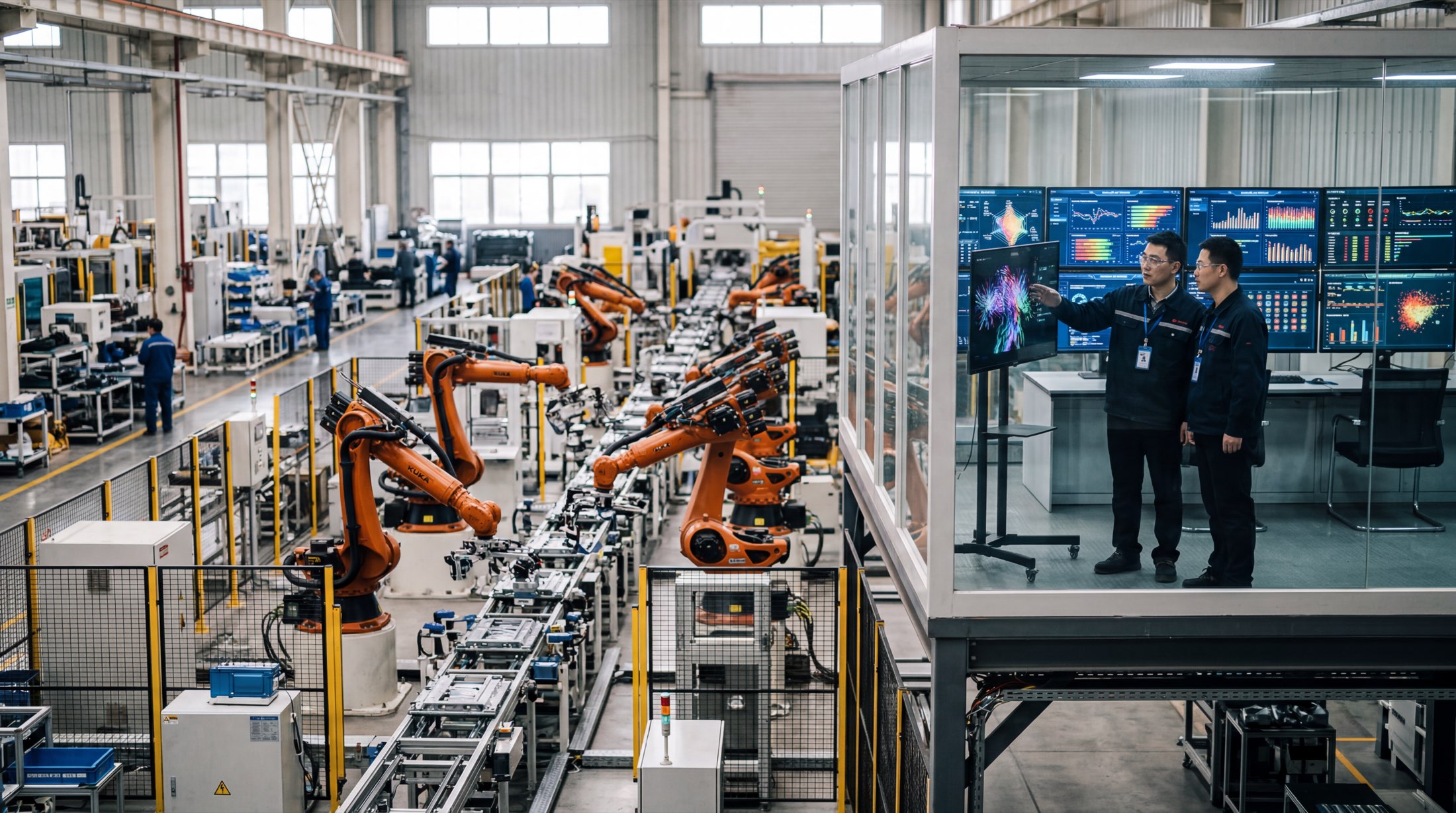
Midea said its agent matrix now covers the full value chain, including R&D, manufacturing, supply chain, marketing, and management, with 158 core scenarios already in place. According to the reports, the company said industrial agents used in areas such as equipment maintenance and tooling can raise overall equipment effectiveness (OEE) by 30% and double inspection efficiency. In the supply chain, Midea said agents helped shorten end-to-end delivery cycles by 39% and reduce inventory-turnover days by 30%.
Haier Smart Home was used as a second flagship example. The reports said the company’s internal “super agent” push has helped extend AI across the organization, with claimed gains including a 90% increase in R&D efficiency, a 10% reduction in procurement costs, and an 80% increase in office efficiency.
The correct way to use those numbers is with attribution. They are company-stated results relayed by Chinese media, not independent third-party audits. Still, that does not make them unimportant. It shows what kind of evidence China’s policy and media system now believes is necessary to make the industrial-agent story persuasive: not just model capability, but operational savings and measurable workflow improvements.
China’s AI story is moving closer to the factory ROI question
That is what makes this story more interesting than a standard policy recap. The real argument is that China’s AI push is trying to graduate from “Can we build advanced models?” to “Can those models and agents improve manufacturing economics?”
That broader direction fits several recent China tech stories at once. Jiangsu’s AI Push Shows How China Wants Policy to Reach the Factory Floor focused on regional policy turning into industrial infrastructure and smart production lines. Huawei Launches AI Data Platform to Push Enterprise AI Beyond Model Hype argued that enterprise deployment depends on retrieval, memory, and inference plumbing rather than model headlines alone. And Pointer-CAD Shows China’s AI Race Moving Into 3D Design showed how large models are already being extended into specialized engineering workflows.
Industrial agents sit neatly at the intersection of those threads. They depend on infrastructure, on domain-specific software, and on enterprises being willing to pay for automation that can actually improve margins or speed.
The rollout story is promising, but it is not universal yet
The March 9 reports are also useful because they do not pretend the scale-up problem has been solved.
IDC said China’s industrial-enterprise AI spending could approach RMB 90 billion by 2028, implying that the sector is moving from a concept-investment phase toward a more scalable deployment phase. But the same reporting also stressed the barriers: computing and deployment costs, weak data foundations, inconsistent industrial standards, integration headaches, security risks, and the fact that many manufacturers, especially smaller ones, remain under profit pressure.
Du Yanze’s quoted warning is especially important. He argued that the most urgent near-term challenge for “AI+manufacturing” is still more on the market side than on the technology side. In plain English, that means many companies may like the AI story in theory while still being cautious about paying for it in practice.
That is exactly why the official media emphasis on Midea and Haier matters. China’s industrial-agent narrative needs visible ROI examples because the market has become more demanding. “AI is exciting” is no longer enough. The stronger claim now has to be “AI can cut lead times, reduce waste, and make factory operations more efficient.”
Bottom line
China did not launch a brand-new industrial-agent program on March 9. What happened is arguably more revealing: official media chose this moment to elevate industrial agents as a central storyline in the country’s next phase of AI deployment.
With a 2027 target of 1,000 industrial agents, a supporting set of model, dataset, and use-case goals, and ROI-heavy examples from companies such as Midea and Haier Smart Home, the story being told is that China wants AI to prove itself inside manufacturing, not just inside chat interfaces.
That does not mean the rollout is already broad, frictionless, or evenly distributed across the country’s industrial base. It does mean the terms of the debate are changing. In China’s current AI narrative, the next meaningful test is no longer only who has the best chatbot. It is who can make AI agents useful enough to matter on the factory floor.