Dek: WeRide and Geely’s Farizon say they plan to deliver 2,000 upgraded, purpose-built Robotaxi GXRs by 2026, pushing China’s robotaxi story away from pilot-zone headlines and toward production cadence, cost-down targets, and global fleet math.
China’s robotaxi conversation has often been dominated by permits, demo zones, and arguments over which operator has the larger public-road footprint. WeRide’s latest announcement with Geely’s Farizon points in a different direction. The headline number is not a mileage figure or a regulatory milestone, but a production-and-delivery target: 2,000 upgraded Robotaxi GXRs by 2026.
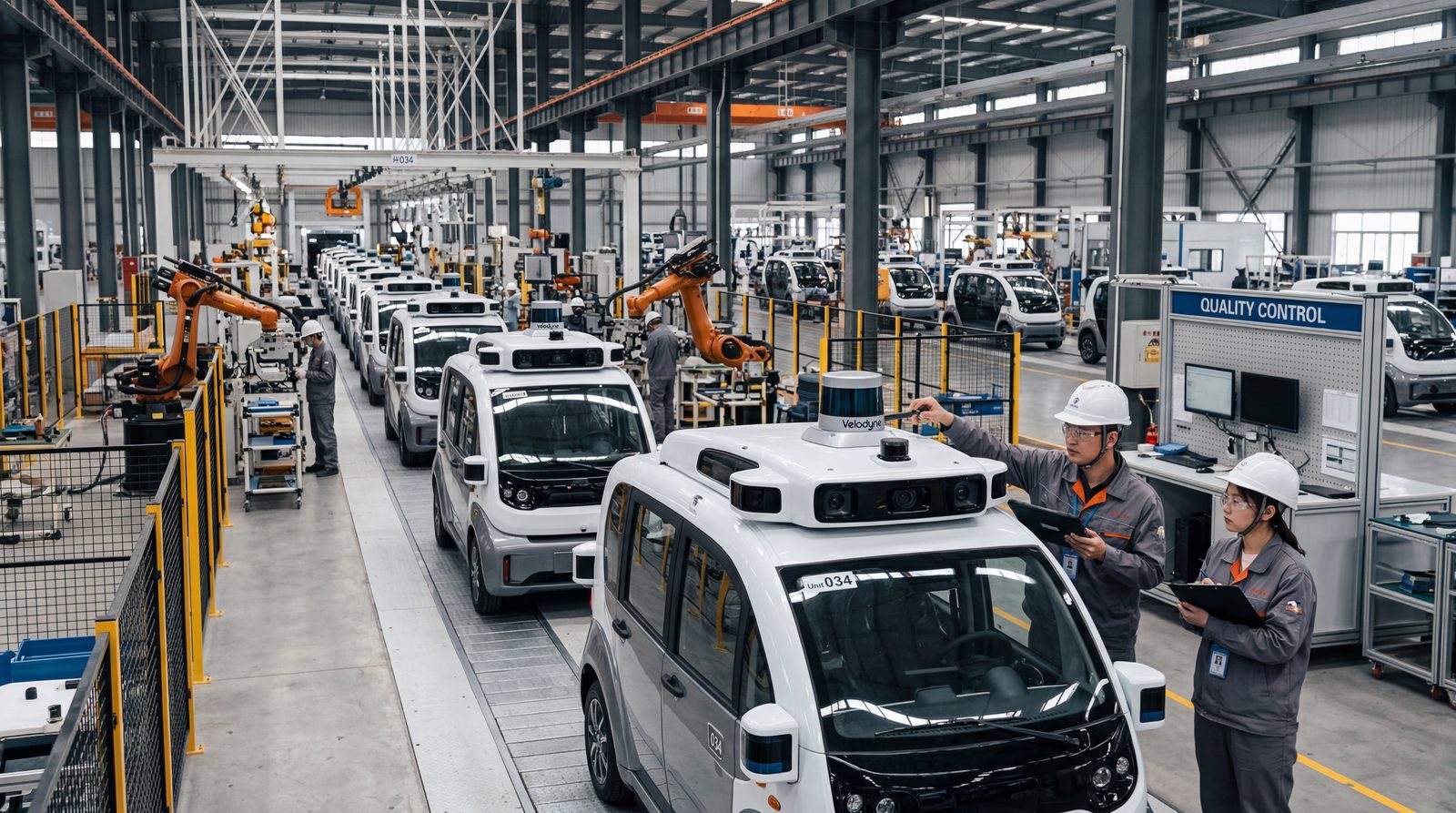
In a March 8 press release carried via GlobeNewswire and relayed by Chinese media on March 9, WeRide and Zhejiang Farizon New Energy Commercial Vehicle Group, the commercial-vehicle arm of Geely, said they had expanded their strategic cooperation and unveiled an upgraded version of the purpose-built, factory-installed, mass-produced Robotaxi GXR. The companies said they plan to deliver 2,000 of the vehicles to domestic and overseas markets by 2026.
That is the editorial boundary that matters most: this is a delivery plan, not a statement that 2,000 vehicles have already been built or deployed. But even as a plan, it is one of the clearest recent signals that China’s robotaxi story is being framed less as a collection of pilot fleets and more as a manufacturing-scale business.
What the companies actually announced
The core facts in the current source chain are straightforward.
WeRide and Farizon said the upgraded Robotaxi GXR will officially roll off the production line in the third quarter of 2026. They also said the two sides expect to deliver 2,000 units by 2026 and place them into both China and overseas markets.
The companies tied that rollout to a broader global commercialization push. In the same release, WeRide said its global Robotaxi fleet stood at 1,023 vehicles as of January 2026. It also said its operating fleet is expected to exceed 2,600 vehicles this year as the GXR rollout advances.
Just as importantly, the announcement is about an upgraded purpose-built vehicle rather than a generic passenger car fitted with a self-driving stack after the fact. WeRide said the new GXR uses its latest GEN8 autonomous driving system, built around the company’s Sensor Suite 8.0. According to the company, the hardware package includes a thousand-line primary lidar that lifts point-cloud detail by 17 times and extends detection range to 600 meters.
Those technical claims help explain why the companies are presenting this as more than another cooperation signing. The message is that the vehicle platform, the autonomy stack, and the factory plan are being packaged together as one commercialization story.
Why the 2,000 target matters more than the ceremony
A robotaxi press event, by itself, is not unusual. The more interesting part of this announcement is the way the numbers are arranged.
The companies are not only talking about where the vehicles might run. They are also talking about how many, how fast they can be built, and how cheaply they might be produced. That is a more industrial framing than the one global readers usually get in robotaxi coverage.
Many autonomous-driving stories still focus on route expansion, testing permissions, or whether a city has allowed fully driverless rides in another district. WeRide and Farizon are trying to shift the conversation toward delivery math. If the plan holds, the 2,000-unit figure would represent a major increase relative to WeRide’s previously disclosed 1,023-vehicle global Robotaxi fleet.
That is why the announcement matters even if every number remains forward-looking for now. It suggests that China’s leading robotaxi players increasingly want to be evaluated not only as software companies or policy winners, but as operators with access to a scalable manufacturing backbone.
The real signal is manufacturing cadence and cost reduction
The most valuable lines in the source material may not be the fleet targets at all. They may be the manufacturing metrics.
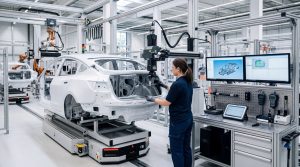
WeRide said that by using Farizon’s AI-enabled drive-by-wire chassis, supply-chain resources, and production management system, the assembly time for a single vehicle can be reduced from one hour to under 10 minutes. The company also said total vehicle cost for the upgraded model could fall by another 15%.
Those are unusually concrete claims for a robotaxi story. They matter because the global debate over autonomous mobility is no longer only about whether a vehicle can drive itself safely enough in a pilot zone. It is also about whether a company can produce enough units, at a low enough cost, to make commercial service economically plausible.
This is where the WeRide-Farizon announcement becomes more than a China mobility headline. It starts to look like a manufacturing-efficiency story with autonomous driving attached.
That broader pattern is already visible in Westwell’s IPO Filing Update Spotlights China’s Industrial AI and Driverless Logistics Push, where the core signal was not consumer hype but operational deployment in industrial transport, and in BYD Says Flash Charging and Battery Swaps Can Coexist in China’s EV Refueling Race, where the competitive story was really about infrastructure logic rather than a single vehicle launch.
The GXR update pushes that same idea into robotaxis: the sector is increasingly being judged by industrial cadence, system integration, and cost-down potential.
This is also a global rollout story
The partnership is not being pitched as a China-only fleet buildout.
In its March 8 release, WeRide said the GXR already operates fully driverless commercial Robotaxi services in Guangzhou, Beijing, and Abu Dhabi. The company also said it offers public passenger services in Dubai and Riyadh, plans to start fully driverless operations in Dubai later this month, and expects public service in Singapore to open on April 1, 2026 after a trial phase.
That matters because it gives the story an angle international readers can immediately understand. This is not only about winning one more Chinese city permit. It is about whether a Chinese autonomous-driving company can pair manufacturing support at home with multi-market deployment abroad.
It also helps explain why the companies keep using language such as large-scale global commercialization rather than simply talking about local expansion. The intended narrative is not “we added more robotaxis to one city.” The narrative is “we are building a platform that can scale across China, the Middle East, Southeast Asia, and eventually Europe.”
For 1M Reviews readers, that makes the story more compelling than a routine cooperation brief. It places robotaxis inside a broader China mobility trend in which companies are trying to move from experimentation to repeatable rollout. That same transition-from-concept-to-factory logic also showed up in GAC Says Its GOVY Flying Car Entered Trial Production in Guangzhou, where the key shift was from futuristic rendering to production timing.
What not to overstate
This is exactly the kind of story that becomes weaker if the verbs get too aggressive.
The current source set supports saying that WeRide and Farizon plan to deliver 2,000 upgraded Robotaxi GXRs by 2026. It also supports saying the vehicle is scheduled to roll off the production line in Q3 2026, that assembly time is expected to drop to under 10 minutes, and that vehicle cost could decline by 15%.
It does not support saying the companies have already completed 2,000 deliveries, that all 2,000 vehicles are guaranteed to enter service on the same timetable, or that large-scale profitability has already been solved.
The same caution applies to the fleet-expansion narrative. WeRide’s statements about a fleet surpassing 2,600 vehicles this year and building toward tens of thousands by 2030 are forward-looking corporate targets. They are useful because they show how management wants the market to understand the company’s trajectory. They should not be rewritten as finished outcomes.
That distinction is important because robotaxi commercialization everywhere still faces hard constraints: regulation, safety validation, city-by-city operations, and the economics of running large fleets. The WeRide-Farizon announcement addresses one side of the equation — manufacturing scale and unit economics — but it does not eliminate the others.
Bottom line
WeRide and Geely’s Farizon have not delivered 2,000 Robotaxi GXRs yet. What they have done is arguably more revealing: they have put 2,000 planned deliveries, Q3 2026 production timing, sub-10-minute assembly, and 15% cost reduction into the same robotaxi narrative.
That is why the announcement matters. It suggests China’s robotaxi race is increasingly being framed not as a contest of pilot fleets alone, but as a contest over who can turn autonomous driving into a manufacturable, lower-cost, globally deployable transport product.
Sources
- WeRide press release via GlobeNewswire: https://ir.weride.ai/news-releases/news-release-details/weride-and-geely-farizon-deliver-2000-purpose-built-robotaxi
- China Daily: https://www.chinadaily.com.cn/a/202603/09/WS69ae7821a310d6866eb3cc20.html
- CnEVPost: https://cnevpost.com/2026/03/09/weride-geely-farizon-to-build-2000-robotaxis-2026/
- Sina Finance: https://finance.sina.com.cn/stock/bxjj/2026-03-09/doc-inhqkhip3658325.shtml
- 36Kr: https://www.36kr.com/newsflashes/3715199640105348