Dek: Nexperia China said on March 9 that a self-developed 12-inch platform has achieved small-batch production of bipolar discrete devices, while trade-media coverage added that the same platform has completed new ESD-device performance verification and that a Schottky rectifier made on it has passed AEC-Q101 automotive qualification.
Most semiconductor headlines are either about cutting-edge logic or geopolitical conflict. This one is more grounded, but that is exactly why it matters.
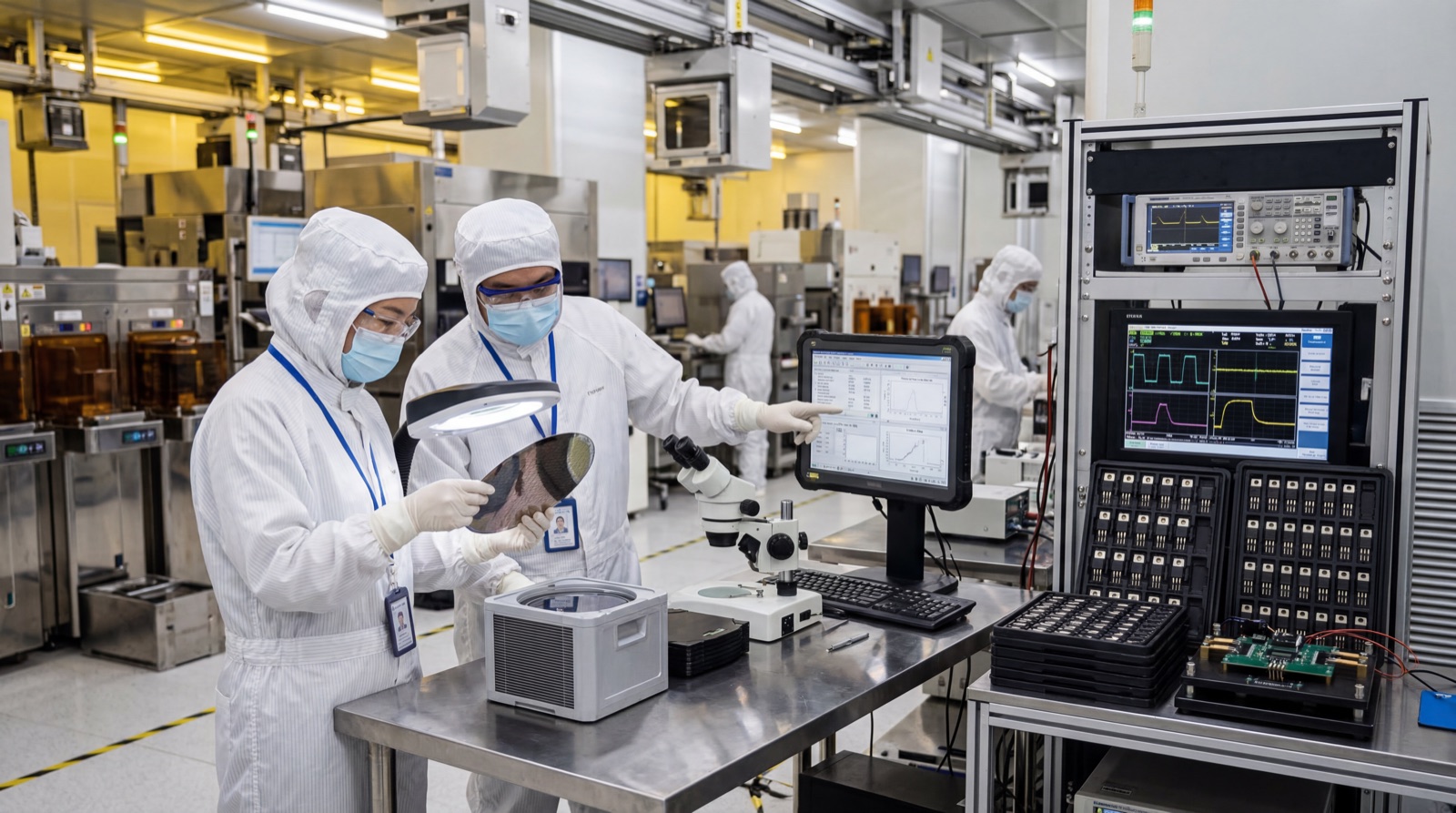
According to March 9 reports from National Business Daily, EET China, and Sina Finance, Nexperia China said it has achieved small-batch production of 12-inch bipolar discrete devices on a self-developed 12-inch platform. Trade-media coverage added two more details that make the story more interesting for industry readers: the same platform reportedly completed performance verification for a new ESD protection device, and a Schottky rectifier produced on the platform has passed AEC-Q101 automotive qualification.
The cleanest way to read this development is not as proof that China has already completed large-scale semiconductor substitution, nor as evidence that one company has suddenly transformed the global supply chain. It is a narrower and more useful signal: part of China’s mature-node manufacturing base appears to be moving toward automotive-grade discrete-device production on 12-inch wafers, with at least some early validation work now publicly referenced.
What the company actually said
The most firmly supported claim in the current public record is straightforward.
National Business Daily, citing the company’s official WeChat account, reported that on March 9 Nexperia China announced that its self-developed “12-inch platform” had successfully achieved small-batch production of 12-inch wafer bipolar discrete devices. That is the core fact. It supports writing this as a manufacturing milestone tied to discrete-device output, not as a rumor, an internal roadmap leak, or a purely conceptual R&D announcement.
EET China’s March 9 trade-media coverage repeated that same core point and added that the platform had also completed performance verification for a new ESD protection device. The same source further said that a Schottky rectifier manufactured on the platform had passed AEC-Q101, a widely cited automotive stress-test qualification standard for discrete semiconductors.
Taken together, the public source chain supports three carefully framed points:
- Nexperia China said it has achieved small-batch production of 12-inch bipolar discrete devices.
- Trade-media reporting linked the same platform to additional device validation work, including a new ESD protection device.
- Trade-media reporting also connected the platform to automotive-grade qualification, specifically via an AEC-Q101-certified Schottky rectifier.
That is already meaningful. But it still requires disciplined wording. The public record does not disclose production capacity, named customers, shipment scale, revenue contribution, or a full product roadmap for the platform.
Why the 12-inch detail matters
That broader supply-chain sensitivity is part of why China Warns Nexperia Dispute Could Renew Chip-Supply Risk resonated with automotive and power-device watchers earlier this week.
For readers outside China, the 12-inch detail is what gives the story more than local-company significance.
Discrete semiconductors may not receive the same public attention as advanced AI chips, but they sit deep inside modern industrial and automotive systems. Rectifiers, protection devices, and other power- and signal-related components are foundational building blocks across vehicles, chargers, industrial equipment, consumer electronics, and power-management systems.
That makes wafer size relevant. In the industry, moving more mature-node device production onto 12-inch wafers is often associated with better scale economics, process consistency, and manufacturing efficiency than smaller-wafer lines can offer. That does not automatically mean superior commercial results. But it does mean a 12-inch manufacturing milestone in discrete devices deserves attention, especially when automotive-grade qualification enters the conversation.
In other words, this is not just a “chip news” item. It is a datapoint about whether China-based manufacturing is moving further up the reliability and scale curve in a part of the semiconductor stack that global supply chains still depend on every day.
Why the automotive angle matters more than the headline alone
The automotive signal here is easy to miss if the story is reduced to a wafer-size headline.
The EET China report’s references to AEC-Q101 qualification and ESD-device verification suggest that the platform is not being framed only as a lab success or a generic manufacturing announcement. It is being linked, at least in early public reporting, to the much stricter quality and reliability expectations that come with automotive electronics.
That matters because automotive semiconductors are not judged only by whether they work in a demo. They are judged by durability, consistency, qualification pathways, and the ability to hold performance under long operating cycles and harsh conditions.
If the trade-media characterization is borne out by future disclosures, the story becomes more than a narrow production update. It becomes a sign that China-based mature-node semiconductor manufacturing is trying to translate wafer-scale process progress into automotive-usable discrete-device output.
That is a more interesting international angle than “China made another chip breakthrough.” It speaks instead to a slower and more practical question: who can reliably build qualified device categories that actually go into cars and industrial hardware?
This is a mature-node manufacturing story, not an advanced-node victory lap
That contrast looks even sharper when set beside A Shenzhen Startup Says Its AI Agent Ported DeepSeek-OCR-2 to Huawei Ascend in 38 Minutes, another recent China-tech milestone centered on software adaptation rather than mature-node device manufacturing.
Another reason the story travels is that it fits a part of the semiconductor market that often gets less attention than it deserves.
Global technology coverage tends to focus on leading-edge nodes, AI accelerators, and export-control flashpoints. But much of the real economy still runs on mature-node chips and devices: power semiconductors, analog components, sensors, controllers, and discrete devices that keep vehicles, appliances, chargers, industrial systems, and factory hardware operating.
That is why this Nexperia China milestone matters more than a typical corporate update. It suggests that a China-based operation is not only manufacturing at the mature-node layer, but is trying to push that work toward 12-inch-scale, automotive-grade discrete-device production.
That does not make it a decisive turning point for the entire semiconductor industry. It does, however, make it relevant to readers tracking the real manufacturing layers underneath the more glamorous chip narrative.
What not to overstate
This is exactly the kind of semiconductor story that gets weaker when it is exaggerated.
The current public reporting supports saying that Nexperia China announced small-batch production of 12-inch bipolar discrete devices on a self-developed platform. It also supports attributing to trade-media coverage the claims that the same platform completed new ESD-device performance verification and that a Schottky rectifier produced on it passed AEC-Q101 qualification.
The current public record does not support saying that:
- the platform has already entered full-scale mass production;
- Nexperia China has disclosed a broad customer list or major commercial contracts tied to the platform;
- China has already completed a nationwide supply substitution in this device category;
- the company has revealed specific capacity figures, shipment volumes, yield metrics, or revenue impact;
- this single milestone means China’s mature-node device sector has already rewritten the global semiconductor order.
Those are the boundaries that matter most in English-language coverage. The stronger formulation is that this is a measured manufacturing and qualification signal, not a finished geopolitical or commercial conclusion.
Why global readers should care
That same deployable-systems lens also appears in China’s AI+Manufacturing Push Targets 1,000 Industrial Agents by 2027, where the focus is less on splashy announcements than on production-ready capability.
For global readers, the value of this story is not hype. It is texture.
The semiconductor conversation has been dominated by advanced logic, AI compute, and export controls for so long that it is easy to overlook the layers where manufacturing resilience is often built more quietly. Discrete devices are one of those layers.
If China-based operations are making progress in 12-inch discrete-device manufacturing and pairing that progress with early automotive-grade qualification, that matters to anyone following auto electronics, industrial hardware, charging infrastructure, or supply-chain resilience. It is a reminder that semiconductor competition is not only about the most advanced node on earth. It is also about who can steadily improve the reliability, scale, and qualification level of the devices that feed everyday hardware systems.
That is especially true in automotive electronics, where the bottleneck is often not publicity but dependable supply.
Bottom line
Nexperia China’s March 9 announcement should be read as a cautious but meaningful manufacturing signal.
The core public fact is that the company said its self-developed 12-inch platform has reached small-batch production of bipolar discrete devices. Related trade-media coverage adds that the same platform has also been tied to new ESD-device verification and an AEC-Q101-qualified Schottky rectifier, which together point toward automotive-grade relevance.
That does not mean large-scale commercialization has already been fully disclosed. It does not prove China has solved semiconductor substitution in this category. But it does suggest that one part of China’s mature-node semiconductor base is moving in a direction global industry readers should watch closely: from process capability toward qualified, automotive-usable discrete-device production on 12-inch wafers.
Sources
- National Business Daily: https://www.nbd.com.cn/articles/2026-03-09/4285207.html
- EET China: https://www.eet-china.com/mp/a479252.html
- Sina Finance: https://finance.sina.com.cn/roll/2026-03-09/doc-inhqkxfk6912098.shtml