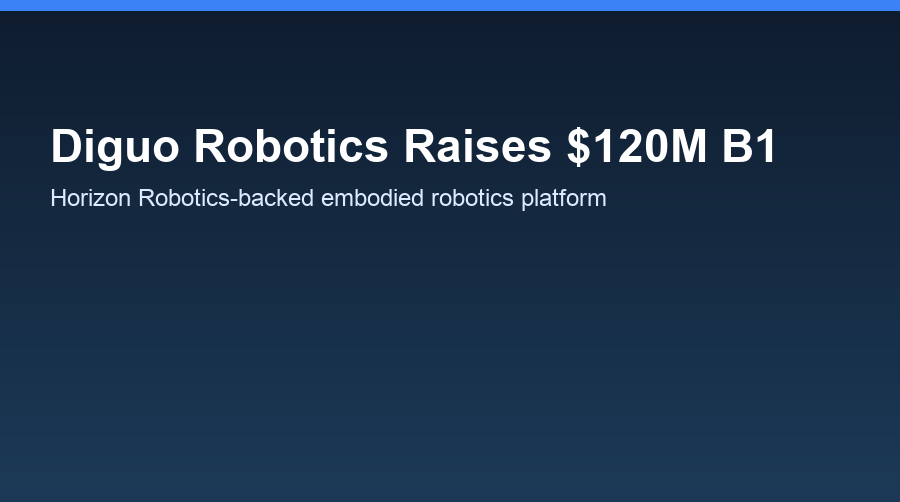
Diguo Robotics, a robotics subsidiary of China’s Horizon Robotics, said on March 16, 2026 that it has closed a $120 million B1 round led by a mix of industrial and financial investors. Synstellation Capital, Didi, and Meituan Longzhu participated, alongside strategic and financial backers that also joined as follow‑on investors. The deal comes after a reported $100 million Series A in 2025, bringing the two rounds to roughly $220 million. The funding underscores how mobility and local‑services giants are positioning themselves for the next phase of embodied robotics, not just autonomous driving software.
Deal snapshot and investor mix
The company’s announcement puts the B1 round at $120 million, with participation from Synstellation Capital, Didi, and Meituan Longzhu, plus multiple strategic and financial investors that reportedly increased their commitments as follow‑ons. In China’s startup market, an investor roster that blends mobility platforms and local‑services capital is a signal that the commercial upside is not confined to hardware sales; it also points to downstream deployment opportunities in logistics, delivery, and service scenarios. The round follows a reported $100 million Series A in 2025, making the two‑round total about $220 million.
A platform‑style robotics company in a crowded field
Diguo positions itself as a robotics platform company tied to Horizon Robotics, a China‑based autonomous‑driving chip and software supplier. That relationship matters because Horizon already has a footprint in automotive AI and edge inference, and a robotics platform can potentially reuse parts of that stack for perception, planning, and control across non‑automotive environments. While the company has not disclosed detailed product specifications in the public reports, the “platform” framing suggests it is aiming beyond a single robot SKU toward an ecosystem of hardware partners and application developers.
Why industrial capital is leaning in
The presence of Didi and Meituan Longzhu signals a practical interest in deploying robotics at scale. Didi operates a massive ride‑hailing and mobility network, while Meituan’s businesses span local delivery, on‑demand retail, and services. For both, robotics can translate into cost compression and service reliability in last‑mile delivery, micro‑fulfillment, or indoor logistics. The B1 round size and the strategic investor mix suggest that robotics is increasingly viewed as a long‑term infrastructure play rather than a short‑term pilot, especially in markets where labor costs and delivery volumes are both rising.
China remains the world’s largest robot market
Market context reinforces the logic of these bets. The International Federation of Robotics (IFR) reported in its World Robotics 2025 data that China installed about 295,000 industrial robots in 2024, accounting for 54% of global installations, and that the operational stock exceeded 2 million units. Those numbers highlight why industrial capital is building exposure to the robotics supply chain and platform layer now: the installed base is already massive, and additional demand is expected as factories continue to automate and service‑sector use cases expand.
Funding momentum in embodied robotics
The speed of Diguo’s fundraising is also notable. A $100 million Series A in 2025 followed by a $120 million B1 in early 2026 implies a rapid scale‑up phase, which often coincides with accelerated hiring, deeper supply‑chain commitments, and more aggressive go‑to‑market efforts. For a platform‑oriented robotics company, that capital is typically used to strengthen core robotics stacks, secure component supply, and build field deployments that prove reliability across different environments.
Competitive pressure and the importance of deployment proof
The embodied‑intelligence category in China is increasingly competitive, with startups, automotive suppliers, and robotics incumbents all vying for position. In this setting, funding alone does not guarantee leadership; execution is measured in deployments, unit economics, and the ability to support multiple applications without heavy customization. Industrial investors will likely push for pilots that can be replicated across large customer bases, especially in logistics, warehousing, and service robots where utilization rates can be tracked and optimized.
What changed, and what could happen next
What changed is the scale and composition of capital flowing into Diguo: a $120 million B1 round with strategic backers from mobility and local services on top of a $100 million Series A. That pairing signals a shift from pure technology validation toward commercial deployment and ecosystem building. Next to watch are concrete rollouts tied to Didi and Meituan’s operational networks, plus any signals about partnerships with hardware manufacturers or integrators. If those partnerships materialize, the company could move from a platform narrative to sustained, revenue‑generating deployments across China’s rapidly expanding robotics market.
Related: Mind Robotics raises $500M Series A at ~$2B valuation
Sources
- 36Kr coverage: https://eu.36kr.com/zh/newsflashes/3725010751355273
- Caixin report: https://companies.caixin.com/2026-03-16/102423441.html
- CLS coverage: https://www.cls.cn/detail/2314117
- Sina Finance report: https://finance.sina.com.cn/stock/vcpe/2026-03-16/doc-inhrcxww2852950.shtml
- IFR World Robotics 2025 data: https://ifr.org/ifr-press-releases/news/global-robot-demand-in-factories-doubles-over-10-years