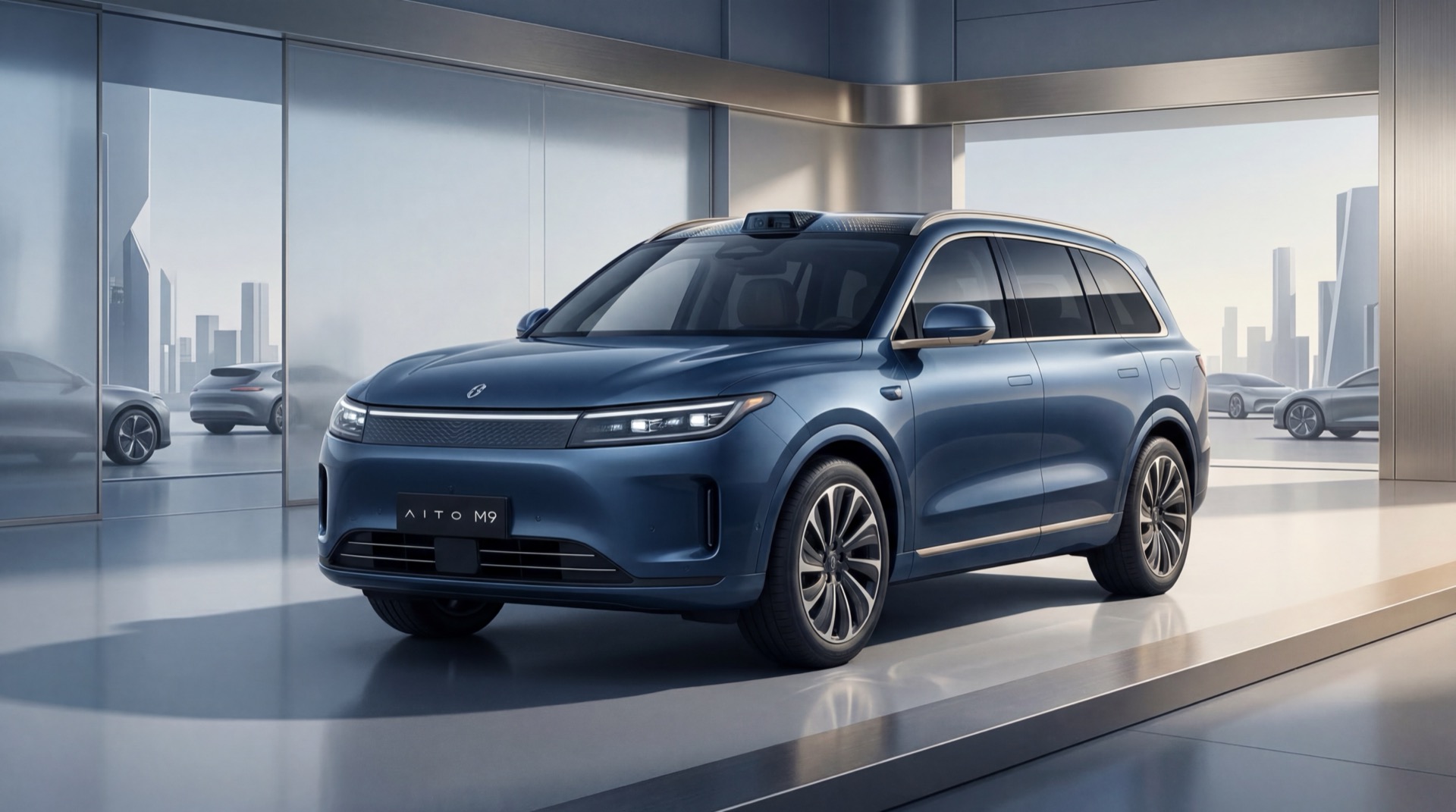
China’s Ministry of Industry and Information Technology (MIIT) published the 405th batch of its vehicle product catalog on March 13, and the filings point to a refreshed Aito M9 under Huawei’s HarmonyOS Intelligent Mobility (HIMA) program. The entry shows larger body dimensions, non-hidden door handles, and Huawei’s 896‑line dual‑optical‑path, image‑level LiDAR sensor (IT之家). The same batch includes Huawei‑linked Shangjie Z7 and Z7T filings, signaling a broader portfolio (Tencent News). The disclosure arrives as February 2026 new‑energy vehicle (NEV) retail and wholesale volumes came in at 464,000 and 723,000 units, respectively, highlighting a more competitive premium environment (CADA).
What the MIIT filing shows
The MIIT catalog is a compliance step rather than a launch announcement, but it offers early visibility into production‑ready specifications. According to IT之家, the updated Aito M9 is listed at 5285 × 2026 × 1845 mm with a 3125 mm wheelbase. That is up from the current model’s 5230 × 1999 × 1800 mm size and 3110 mm wheelbase, indicating a clear dimensional expansion. For a flagship SUV, those changes typically translate into more cabin space and revised packaging, both important factors in the premium‑family segment.
Why the size and hardware changes matter
Beyond the size increase, the filing shows a switch to non-hidden door handles, a design choice that can improve usability in cold or wet conditions. More strategically, the M9 is listed with Huawei’s 896‑line dual‑optical‑path LiDAR, which signals a significant sensor upgrade for its driver‑assistance stack. IT之家 highlights the LiDAR as a key point of the update, and the spec suggests Huawei continues to prioritize hardware‑defined differentiation in its premium vehicles.
Powertrain and 800V hints
Powertrain data further underline the performance positioning. PCauto reports front and rear motor outputs of 220 kW and 277 kW with a combined system output of 497 kW. The filing retains both range‑extended and pure‑electric versions, and the range‑extended variant is listed with 60 kWh and 75 kWh battery options plus an 800‑volt high‑voltage platform. The 800V architecture is a notable upgrade because it typically enables faster charging and improved efficiency, attributes that premium buyers increasingly expect.
How MIIT listings hint at launch cadence
MIIT’s public catalog functions as a pre‑sale compliance step in China: vehicles must appear in the bulletin before mass production or official sales approvals. Autohome’s roundup of the 405th batch highlights the M9 filing alongside a wider mix of new or updated models, suggesting automakers are using the spring window to refresh lineups ahead of mid‑year sales pushes. For readers, these filings provide the earliest credible cues on dimensions, powertrain specs, and hardware changes while pricing and trim naming remain undisclosed. In short, the catalog does not confirm a launch date, but it shows that the underlying configuration is now regulator‑ready.
Huawei’s expanding model matrix
The same MIIT batch includes Shangjie Z7 and Z7T entries tied to the Huawei ecosystem, reinforcing a strategy of spreading Huawei’s software and sensor stack across multiple partner marques. Tencent News and other Chinese outlets point to these filings as evidence of a widening Huawei‑linked lineup, which helps create scale for Huawei’s in‑car operating system and perception hardware. For the market, this means Huawei is moving beyond a single flagship model to a multi‑segment presence.
Market context: NEV growth cools
The filing lands amid a softer monthly snapshot for China’s NEV market. CADA’s data show February 2026 NEV retail sales at 464,000 units and wholesale volume at 723,000 units. While those numbers still represent a large market, the slower pace increases competitive pressure, especially in the premium SUV segment where hardware and software differentiation are critical. A larger M9 with upgraded LiDAR and 800V readiness fits the playbook of using tangible tech upgrades to defend pricing and consumer attention.
What changed, and what could happen next
What changed is that the Aito M9’s MIIT filing confirms a size increase, a LiDAR upgrade, and continued high‑output powertrain options, while Huawei‑linked Z7/Z7T filings point to a broader model matrix. What could happen next is a formal product reveal that clarifies trims, pricing, and the extent of driver‑assistance capabilities enabled by the 896‑line LiDAR platform. If Huawei and its partners push these updates to market quickly, the premium NEV SUV race in China could see a faster refresh cycle in the months ahead.
Related coverage
- Lantu Dreamer Champion Edition Launches at RMB 309,900 With Huawei ADS 4
- Huawei-Backed Qijing GT7 Set for March 17 Debut
Sources
Core sources:
– https://www.ithome.com/0/928/929.htm
– https://www.pcauto.com.cn/nation/5119/51198510.html
– https://news.qq.com/rain/a/20260315A0394U00
– https://www.cada.cn/Trends/info_91_10455.html
– https://chejiahao.autohome.com.cn/info/24980765
Word count (English body): 768