China launches hydrogen application pilot with RMB 16B cap per city cluster and 2030 cost targets
China’s Ministry of Industry and Information Technology (MIIT), Ministry of Finance (MOF), and National Development and Reform Commission (NDRC) issued a joint notice on March 16, 2026 (MIIT Notice [2026] No. 59), launching a national “hydrogen comprehensive application” pilot. The program will select city clusters via an open, competitive bidding mechanism, run for four years, and rely on a reward‑based fiscal subsidy model. Central funding for a single city cluster is capped at RMB 16 billion, and the notice sets 2030 targets including end‑use hydrogen prices below RMB 25/kg (with RMB 15/kg in advantaged regions) and a fuel‑cell vehicle (FCV) fleet doubling from 2025 levels to 100,000 units.
How the pilot is structured
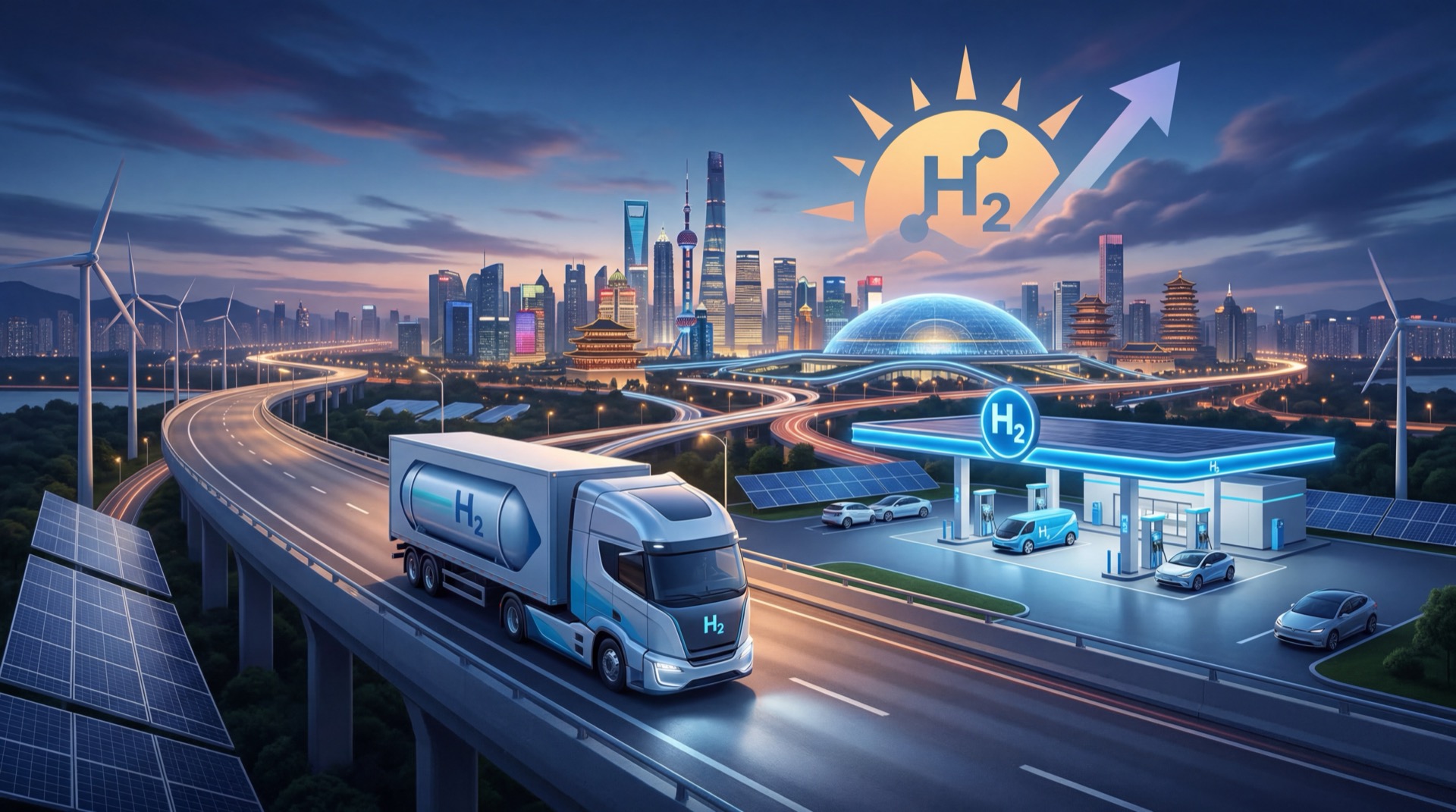
The notice emphasizes city clusters as the pilot unit rather than single municipalities, signaling that cross‑regional coordination is required. It also underscores “multi‑scenario, large‑scale application” and full‑industry‑chain coordination across production, storage, transport, and end‑use—language intended to push beyond single‑project demonstrations. This structure suggests that proposals will be assessed on the ability to integrate hydrogen supply and demand across multiple use cases within a defined urban‑industrial corridor.
Funding model: rewards, not upfront grants
Unlike earlier rounds of sector subsidies, the program adopts a “reward-for-performance” approach—rewards after verified performance. The ceiling of RMB 16 billion per city cluster is a large‑ticket incentive, but it is not guaranteed upfront funding. The four‑year pilot window implies that local governments must show measurable progress during the implementation period to unlock the full benefit, aligning financial support with deployment outcomes.
Cost and scale targets for 2030
The notice’s 2030 cost targets are explicit: average end‑use hydrogen prices should fall to RMB 25/kg or lower, with RMB 15/kg as a stretch goal in regions with favorable resource or infrastructure conditions. It also calls for the national FCV fleet to double relative to 2025 and “strive” toward 100,000 vehicles, anchoring the policy in a measurable adoption goal. These targets implicitly set a bar for cost‑reduction pathways and utilization rates for hydrogen infrastructure built during the pilot.
Implications for the hydrogen supply chain
By mandating city‑cluster pilots and full‑chain coordination, the policy signals that isolated hydrogen projects will not be enough. Projects must connect production, storage, and distribution to high‑utilization end‑use demand within the cluster to make the RMB 25/kg price target plausible. The requirement for multi‑scenario applications means pilots are likely to prioritize freight, logistics, and industrial use cases that can generate stable offtake volumes over the four‑year window.
What it means for automakers and fleet operators
Recent EV supply-chain momentum — for example, Denza Z9GT’s first deliveries — highlights how policy clarity can accelerate fleet adoption.
The 100,000‑vehicle target and “double‑from‑2025” language provides a clearer demand signal for fuel‑cell vehicle manufacturers and component suppliers, especially those serving heavy‑duty transport. However, because the policy relies on performance‑based rewards, procurement commitments will likely hinge on local governments’ ability to package viable cluster‑level business cases. Fleet operators in pilot regions should expect stronger policy support, while non‑pilot regions may see slower FCV scaling until results are verified.
Competitive selection raises the bar for proposals
The open competitive bidding mechanism means proposals will be judged competitively rather than allocated broadly. Coupled with the RMB 16 billion cap and the four‑year pilot horizon, local governments are incentivized to submit projects with credible cost curves and deployment timetables. This also raises a near‑term question: which city clusters can assemble complete supply chains—production assets, logistics, and end‑use demand—fast enough to justify the reward‑based funding.
Risks and execution challenges
Meeting RMB 25/kg pricing nationwide and RMB 15/kg in advantaged regions requires both scale and utilization, yet hydrogen infrastructure is capital‑intensive and sensitive to demand volatility. The policy’s full‑chain requirement is meant to mitigate this risk, but it also increases the complexity of pilot execution. Over the next four years, success will depend on how quickly pilot clusters can coordinate industry stakeholders, secure offtake contracts, and hit measurable milestones tied to central funding.
What changes next
For broader industrial policy context, see China’s 15th Five-Year Plan emphasis on AI+ and semiconductors.
In the near term, provinces and city clusters are expected to prepare and submit bids under the open competitive bidding framework, with pilot winners shaping China’s hydrogen roadmap through 2030. If the four‑year pilots deliver on cost targets and the 100,000‑vehicle trajectory, hydrogen could move from policy demonstration to commercial scaling in transport and industry. If the targets prove hard to reach, the rollout of fuel‑cell vehicles may remain concentrated in a handful of pilot regions.
Sources
- Ministry of Finance (MOF) notice: http://jjs.mof.gov.cn/tongzhigonggao/202603/t20260316_3985379.htm
- Xinhua coverage: http://www.news.cn/fortune/20260317/4716ef0320e64374a0be5216e1d41586/c.html
- Securities Times: https://stcn.com/article/detail/3679033.html
- 21st Century Business Herald: https://www.21jingji.com/article/20260316/herald/4608abbbbb6207e59652b4ca67616254.html
- CAAM release (industry context): http://www.caam.org.cn/chn/3/cate_38/con_5236999.html