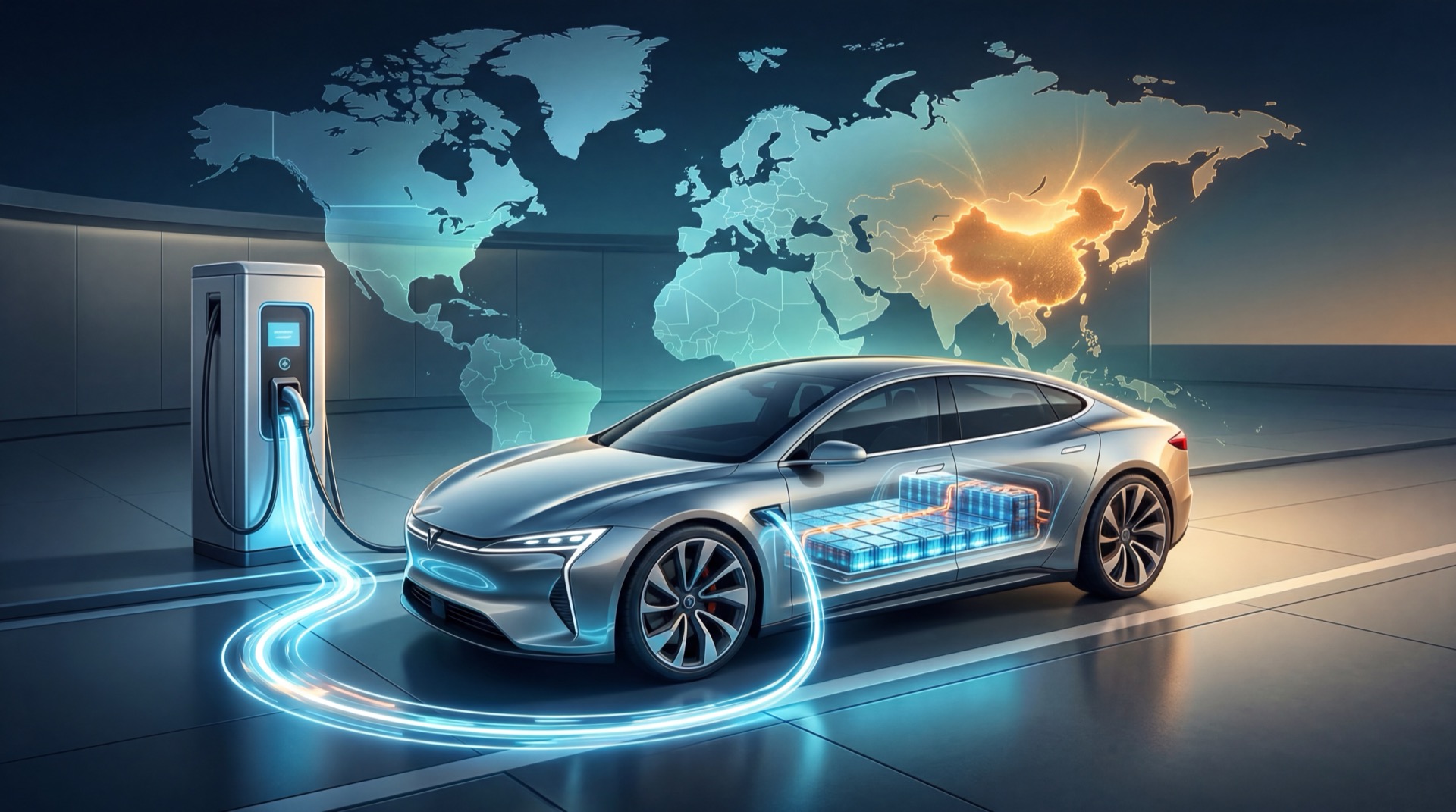
Over March 18-19, two separate but reinforcing signals sharpened China’s position in the EV race. Nikkei Asia reported that Chinese battery makers held more than 70% of global EV battery market share in 2025, up from less than 50% in 2021, with CATL alone at 39.2%. In parallel, BYD’s new 1,500kW flash-charging system was described by multiple auto outlets as capable of taking compatible cars from 10% to 70% in about five minutes. Put together, those developments suggest China is not just exporting more EV components. It is widening its advantage in both battery supply and the charging experience that increasingly defines buyer expectations.
China’s battery lead is no longer a catch-up story
The market-share number is what turns this story from a familiar “China is strong in EVs” narrative into something harder for rivals to dismiss. Nikkei Asia said Chinese battery makers collectively controlled more than 70% of global EV battery share in 2025, compared with less than 50% in 2021. Within that total, CATL alone accounted for 39.2%, a figure that would be commanding even if it came from a nationally mixed industry. That builds on an earlier signal we tracked in CATL’s 2025 annual report, where the company paired record profit with another step up in global share. Coming from a company at the center of China’s battery ecosystem, it shows how concentrated the sector has become around Chinese suppliers.
That concentration matters because EV batteries are not a side component. They shape vehicle cost, range, charging curves, thermal performance and, increasingly, software-driven energy management. Autoblog summarized the same shift in blunter terms by saying China now controls nearly 70% of the world’s EV batteries. The exact wording varies by outlet, but the underlying message is consistent: China’s battery industry is no longer defined by volume manufacturing alone. It is setting the baseline for who can build EVs at scale, and at what cost.
At the same time, high share does not automatically mean easy money. Caixin Global’s March 18 analysis argued that China’s battery champions are gaining power while also facing the pressure that comes with that position, including competition, pricing stress and the cost of staying ahead technologically. That is an important corrective. A 70% global share says China has built the deepest industrial base in the segment. It does not mean every Chinese battery company will enjoy comfortable margins forever. Dominance can still be expensive to defend.
BYD is trying to turn battery know-how into a charging standard
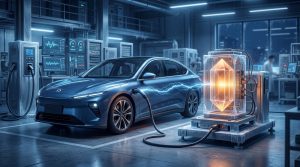
The second signal comes from a different part of the EV stack. While the market-share data tells a supply-side story, BYD’s flash-charging push is about the user experience. According to coverage from The Wall Street Journal, Yahoo Autos, RAC Drive and MarkLines, BYD’s second-generation Blade Battery platform and 1,500kW charging architecture are designed to push charging time down to a point that starts to resemble a gas-station stop rather than a long EV pause. The headline figure repeated across those reports is striking: some compatible vehicles can go from 10% to 70% charge in roughly five minutes, with near-full charging in ideal conditions approaching nine minutes. We have already seen BYD position this benchmark in our earlier coverage of Blade Battery 2.0 and 1,500kW flash charging.
That number matters because it is easy for drivers to understand. Consumers may not care about battery chemistry, pack structure or cell-to-body integration, but they do care about how long they stand at a charger. RAC Drive framed BYD’s system as roughly four to five times faster than the 350kW fast chargers that are still treated as the high end of public charging in many Western markets. Even if real-world conditions vary by vehicle, weather and charger availability, the comparison changes the benchmark. The question stops being whether EV charging can get faster and becomes whether non-Chinese manufacturers can keep pace with the standard Chinese companies are trying to normalize.
There is still a practical catch. A 1,500kW charging claim only becomes a durable competitive advantage if the vehicles, station hardware, cooling systems and local grids can support it at scale. MarkLines’ technical framing is useful here because it pushes the story beyond headline wattage and back into engineering reality. BYD is not just promising a faster plug-in time. It is trying to align battery design, vehicle architecture and charging infrastructure into one integrated proposition. That is much harder to copy than a single catchy launch spec.
Supply power and charging power are different strengths, but they reinforce each other
It is important not to collapse the story into one company, one day or one announcement. The 70%-plus market-share figure comes from annual industry statistics highlighted by Nikkei Asia and related coverage. The five-minute charging story comes from BYD’s separate technology push and the international media attention it drew in the days around March 17-19. They are different developments. But they point in the same strategic direction: Chinese companies are advancing both where batteries come from and how future EV ownership is supposed to feel.
That combination is what makes the story more important than a routine market-share update or another flashy charging demo. If one country dominates cell production, it influences costs, supply security and the pace of manufacturing scale-up. If companies from that same country also begin setting the expectations for charging speed, they start shaping the consumer standard too. The Wall Street Journal’s framing that America is still trying to catch up captures the international implication. China is not only supplying a bigger share of the EV stack. It is trying to define what “good enough” looks like across multiple layers of the product.
For global automakers, that creates a more difficult competitive map. Competing with Chinese EV companies no longer means matching one strength at a time. It may require finding alternatives to a supply chain that already accounts for more than 70% of global EV battery share while also responding to consumer headlines built around 1,500kW systems and five-minute charging claims. That is a tougher challenge than simply launching another EV model with acceptable range and software. The battlefield is moving underneath the vehicle itself, into batteries, charging curves and the industrial systems that support both.
The lead is real, but keeping it will take more than headlines
There are at least two reasons not to read this as a finished story. First, Caixin’s reporting makes clear that Chinese battery leaders are operating under real commercial pressure even while they expand their global footprint. Large market share can coexist with weaker pricing power, heavier capital spending and a constant need to invest in the next chemistry, the next production process and the next overseas manufacturing foothold. A dominant position is valuable, but it can also become a treadmill.
Second, the charging story is only fully meaningful if it survives rollout. BYD’s five-minute headline is powerful because it translates into everyday language, but public fast-charging systems outside China are still largely built around lower power levels. That means the rest of the world faces an infrastructure question as much as a vehicle question. If BYD and other Chinese players can deploy enough compatible charging sites, the user-experience advantage becomes tangible. If rollout is slow or fragmented, the technology remains impressive but less disruptive than the marketing suggests.
What changed, and what could happen next
What changed this week is that China’s EV advantage became easier to measure on two fronts at once. The battery-share story gave the market a hard industry statistic: more than 70% global share in 2025, with CATL at 39.2%. The BYD charging story gave that industrial strength a consumer-facing symbol: five-minute charging as a new performance target. Together, those signals move the conversation beyond whether China can build competitive EVs. The more relevant question now is whether competitors can avoid building against standards that Chinese companies increasingly set.
What could happen next is a two-track race. One track is industrial: rivals will try to reduce dependence on Chinese battery supply, localize production and protect margins as CATL tries to defend a 39.2% global position and other Chinese battery makers protect the broader 70%-plus lead. The other is experiential: automakers and charging providers outside China will be pushed to respond if buyers start treating BYD’s reported five-to-nine-minute charging window as a realistic expectation rather than a laboratory stunt. If China can keep both tracks moving — retaining battery share while rolling out truly usable megawatt-class charging — it will not just have a lead in EVs. It will have more influence over how the next phase of the EV market is designed.
Sources
- Nikkei Asia — China’s EV battery makers widen lead to over 70% global share (2026-03-18)
- Caixin Global — For China’s Battery Giants, Power Comes With a Price (2026-03-18)
- The Wall Street Journal — China Has Five-Minute EV Charging. America Is Trying to Catch Up (2026-03-18)
- RAC Drive — BYD’s ‘flash charging’ can charge an EV in five minutes – and it’s coming to the UK (2026-03-18)
- MarkLines — BYD: 2nd Generation Blade Battery and Fast Charging Technology (updated around 2026-03-19)