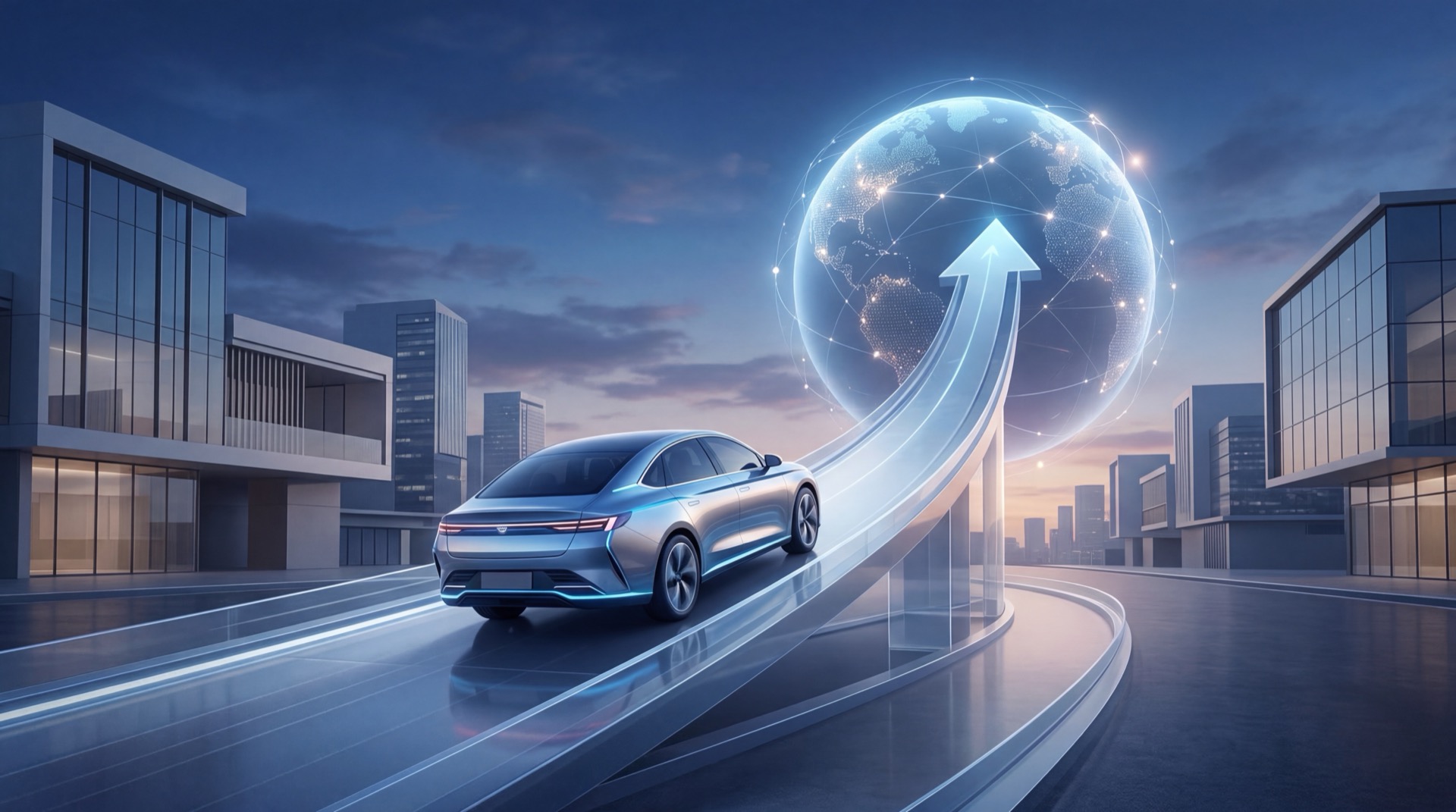
Geely Automobile used its March 18 annual-results release to do more than publish another strong China auto earnings report. The company said 2025 revenue rose 25% to 345.23 billion yuan, then set a much more revealing 2026 target: 640,000 overseas vehicle sales, roughly 50% above last year’s overseas total of about 420,000 units. Geely also set a 3.45 million total-sales target and a 2.2 million new-energy-vehicle goal for the year. The significance is that one of China’s biggest automakers is now tying export growth, EV scale and stronger finances into a single global expansion plan.
The earnings report gave Geely room to be more aggressive abroad
The financial backdrop matters because this was not an export target announced in isolation. Geely said 2025 revenue reached 345.23 billion yuan, while annual net profit edged up to 16.85 billion yuan from 16.81 billion yuan a year earlier, according to Morningstar’s Dow Jones report. Gross margin improved to 16.6% from 15.9%, and the company sold more than three million vehicles in 2025, a record for the group. It also said new-energy-vehicle sales, including battery EVs and plug-in hybrids, nearly doubled to 1.7 million units. Those numbers give the overseas target more credibility because they suggest Geely is expanding from a larger and financially stronger base rather than trying to distract from weakness at home.
Gasgoo’s coverage added another useful layer. Excluding non-core items such as foreign-exchange effects, Geely’s core net profit rose 36% to 14.41 billion yuan, while cash climbed 46% to 68.2 billion yuan by the end of 2025. That matters because export drives are expensive. Carmakers need to fund product launches, dealer and service networks, compliance work, shipping, marketing and software localization before overseas volumes reach real scale. A stronger balance sheet does not guarantee success, but it means Geely is entering 2026 with more financial capacity to support an international push than a weaker company would have.
The number that changes the story is 640,000
The most important fact in this week’s announcement is not that Geely wants to “keep expanding overseas.” Chinese automakers say that all the time. The important fact is that Reuters reported Geely had set a 2026 overseas sales target of 640,000 vehicles, about 50% above its roughly 420,000 overseas sales in 2025. That turns the company’s global ambition into a measurable operating target. Investors, competitors and suppliers can now judge Geely against a specific number rather than a vague globalization narrative. That number also lands as China’s broader export machine keeps accelerating, with recent industry data showing EV exports jumped 110% in Jan–Feb.
That figure looks even more meaningful when placed beside the rest of Geely’s 2026 guidance. Morningstar’s Dow Jones report said the company is targeting 3.45 million total vehicle sales this year, including 2.2 million NEVs and 640,000 units in international markets. In other words, Geely is not treating overseas growth as a side project. It is presenting exports, electrification and total scale as part of the same growth engine. The overseas target would amount to roughly 18.6% of the company’s total 2026 volume goal, which is large enough to matter strategically, not just symbolically.
Geely is selling a China-to-world scale story
Bloomberg’s framing, as cited in the source brief, is also worth noticing. It linked Geely’s profit beat with sales that are approaching BYD’s level, reinforcing Geely’s position as one of the few Chinese automakers with the scale to be discussed in the same sentence as the country’s sector leaders. For English-language readers, that is the sharper angle. The story is not simply that another Chinese EV maker had a decent year. It is that one of China’s biggest carmakers is trying to convert domestic scale into durable international growth at a time when the country’s auto industry is becoming more globally consequential.
Morningstar’s report showed that Geely is also trying to broaden that story beyond pure unit sales. It said the company has been emphasizing artificial-intelligence technology, premium brand building and aggressive overseas expansion as a combined strategy. The report also noted that Geely merged Zeekr and Lynk & Co. last year to maximize resources, signaling a stronger push to streamline brands and capital allocation. That kind of restructuring matters because overseas expansion becomes harder when too many brands, product lines and market strategies compete for the same money and management attention.
Technology is part of the export pitch, but execution still decides the outcome
Geely’s 2026 message was not only about sales. Gasgoo reported that on March 17, at Nvidia’s GTC conference, Geely said its Super Eva and Haohan G-ASD 4.0 systems were entering mass production. Nvidia also said it would deepen collaboration with Geely on Level 4-ready vehicles using the DRIVE Hyperion platform. That is relevant because Geely does not want to be understood abroad as a company shipping volume alone. It wants to position itself as a Chinese automaker that can package intelligent driving, software and higher-value vehicles into its export story, reinforcing the same autonomy-and-scale narrative highlighted when Nvidia said BYD and Geely were adopting DRIVE Hyperion for future Level 4-ready programs.
That technology angle helps, but it does not replace the more difficult operational work. Gasgoo said Geely is preparing another major product year in 2026, with launches spanning mainstream and luxury segments, as well as internal-combustion and new-energy models. More models and more intelligent-driving features give the company more to sell, but they also raise the challenge of deciding which brands travel best, which price points can survive abroad, and where margins remain attractive after distribution and compliance costs. The overseas target therefore matters not only as a headline but as a test of whether Geely can translate product breadth into a repeatable global channel strategy.
The timing matters in China’s EV race
This is also why the announcement matters beyond Geely itself. Many China EV headlines over the past year have focused on domestic price competition, local subsidy dynamics or the market dominance of BYD. Geely’s update points to another front in the race: the companies with enough scale, enough cash and enough product depth to turn overseas markets into a serious second engine of growth. Record 2025 sales of more than three million vehicles, plus a 2026 goal of 2.2 million NEVs, show that Geely is trying to scale in China and abroad at the same time rather than choosing one over the other.
That shift could have broader industry consequences. If Geely can raise overseas sales from roughly 420,000 vehicles to 640,000 in a year while still pushing total sales to 3.45 million, it strengthens the idea that leading Chinese automakers are moving from export opportunism to more systematic international expansion. That would matter for suppliers, software partners, logistics providers and rival carmakers trying to judge whether China’s EV competition is still mostly domestic or increasingly global. In that sense, Geely’s target is a company-specific number with sector-wide implications.
What changed, and what the market should watch next
What changed this week is that Geely turned a general globalization narrative into a hard public benchmark. Instead of telling investors that overseas business remains important, it said the number out loud: 640,000 units in 2026. It paired that with record revenue, a stronger gross margin, record 2025 sales and a 2.2 million NEV target. That combination moves the story from aspiration to execution. Geely is effectively saying it believes the financial base, product pipeline and brand structure are now strong enough to support a much bigger export step.
What happens next will determine whether the market treats March 18 as a routine earnings-day confidence display or as a more important turning point in China’s auto globalization story. The key things to watch are whether overseas deliveries actually begin tracking toward the 640,000 mark, whether NEV growth stays strong enough to support the 2.2 million target, and whether Geely’s intelligent-driving and premium-brand push improves pricing power outside China. If those pieces line up, this announcement may be remembered as the moment Geely stopped looking like a domestic heavyweight with growing exports and started looking like a Chinese automaker trying to build durable worldwide scale.
Sources
- HKEX — Geely Automobile Holdings Limited 2025 Annual Results Announcement
https://www1.hkexnews.hk/listedco/listconews/sehk/2026/0318/2026031800369.pdf - Reuters — “Geely targets 640,000 overseas car sales in 2026”
https://www.reuters.com/world/asia-pacific/geely-targets-640000-overseas-car-sales-2026-2026-03-18/ - Nikkei Asia — “Geely Auto plots major export drive in 2026 as profit growth slows”
https://asia.nikkei.com/business/automobiles/geely-auto-plots-major-export-drive-in-2026-as-profit-growth-slows - Bloomberg — “Geely Profit Beats Estimates as Sales Approach Those of BYD”
https://www.bloomberg.com/news/articles/2026-03-18/geely-profit-beats-estimates-as-sales-approach-those-of-byd - Morningstar / Dow Jones — “Geely Auto Annual Profit Flat Despite Stronger Sales”
https://www.morningstar.com/news/dow-jones/20260318123/geely-auto-annual-profit-flat-despite-stronger-sales