Voyah began trading in Hong Kong on March 19 through a listing by introduction covering 885,381,529 H shares under stock code 7489, according to HKEX filings, which also made clear that no new shares were issued and no fresh funds were raised in the process. That detail matters because it changes how the debut should be read. This was not mainly a capital-raising event. It was Dongfeng Motor’s attempt to give its premium electric-vehicle brand a cleaner standalone market identity at a moment when China’s state-backed carmakers are trying to prove they, too, deserve premium EV valuations tied to software, smart driving and higher-end branding.
The structure says more about valuation than financing
The most important fact in Voyah’s Hong Kong debut is the one that sounds least dramatic at first: this was a listing by introduction rather than a conventional IPO. HKEX documents dated Feb. 13 said the company would list 885,381,529 H shares on the main board under stock code 7489 and explicitly noted that no shares were being issued pursuant to the introduction. In other words, Dongfeng was not tapping public markets for new money on day one. It was doing something more strategic. By floating Voyah separately in Hong Kong, Dongfeng was asking investors to look at the premium EV business on its own terms rather than as one more unit buried inside a much larger state-owned auto group.
That distinction matters because traditional state-owned automakers often struggle to win the kind of valuation narrative that private EV startups or consumer-tech challengers can command. A separate listing does not automatically fix that problem, but it does create a new arena in which investors can judge the business by premium-brand growth, software partnerships, overseas reach and intelligent-driving roadmaps rather than by the slower-moving image of a legacy parent group. Seen that way, the no-new-money structure is almost the point. Dongfeng wanted price discovery, brand separation and a cleaner capital-market story before it wanted fresh proceeds.
Dongfeng is trying to prove a state carmaker can tell a premium EV story
Voyah’s latest numbers give Dongfeng enough operating evidence to make that pitch plausible. CnEVPost reported that Voyah generated 34.86 billion yuan in revenue in 2025, earned 1.02 billion yuan in net profit, delivered 150,169 vehicles and posted a gross margin of 20.9%. Those figures do not put Voyah in the same league as the biggest Chinese EV champions by scale, but they do help answer a more basic investor question: is this a real business or just a branding exercise? The answer is that Voyah is no longer a PowerPoint story. It has reached a point where profitability, deliveries and margin can all be used as factual anchors in a market pitch.
That is important because it lets Dongfeng position Voyah as something more ambitious than a premium sub-brand inside a giant industrial group. Gasgoo said shareholder approval for the Hong Kong plan cleared the way for what it described as one of the first central state-owned premium new-energy vehicle stocks listed in Hong Kong. The symbolism matters. China’s central state-backed automakers do not want to leave the premium-intelligent-EV narrative entirely to newer private-sector names. Voyah’s debut is part of a broader effort to show that a state group can also build a premium EV brand that speaks the language of margin, software and intelligence instead of only manufacturing scale.
Huawei is becoming the software layer in Voyah’s upscale pitch
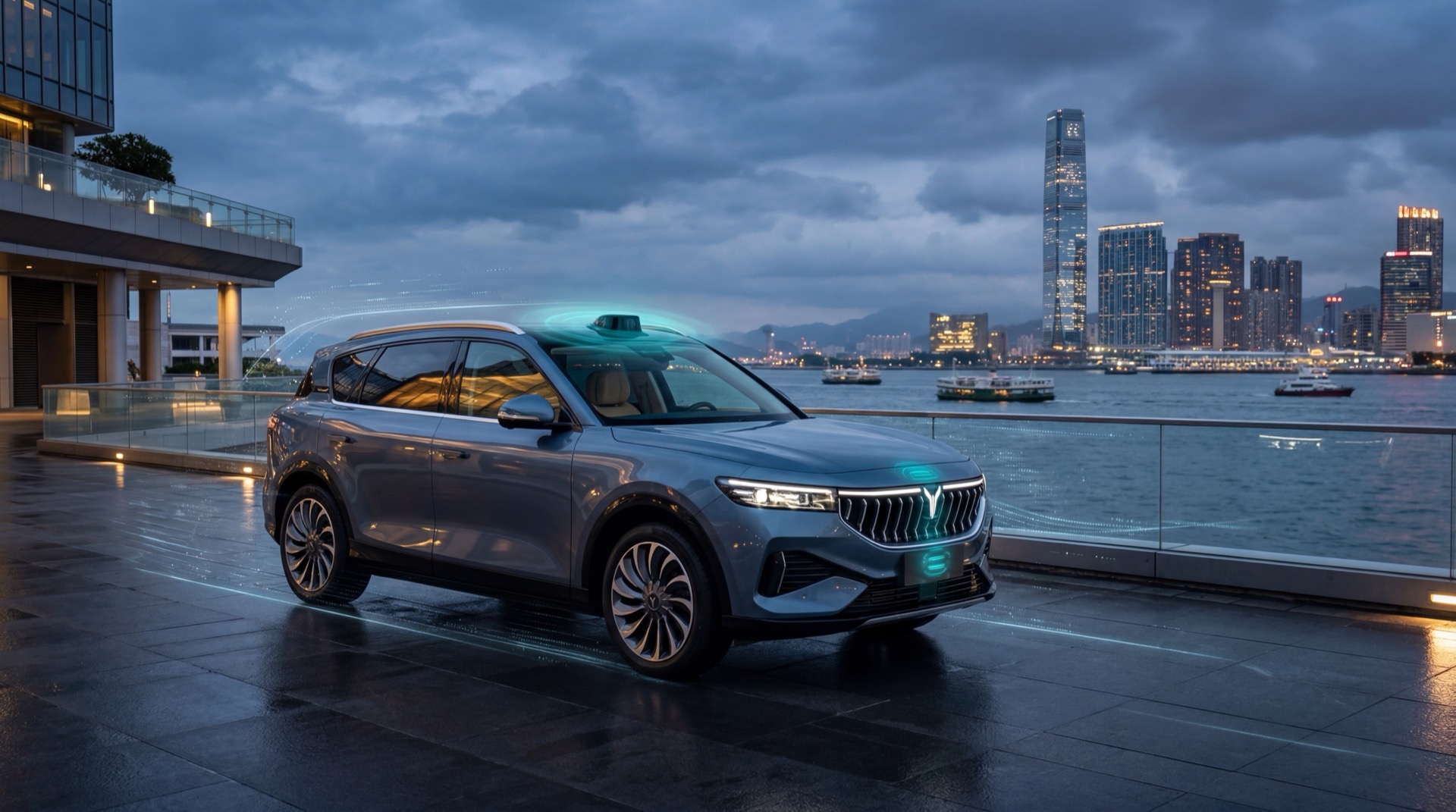
The technology side of Voyah’s story is where the Hong Kong listing becomes more interesting for international readers. The source brief makes clear that Huawei’s software and smart-driving ecosystem has become one of the main pillars of Voyah’s premium push. Gasgoo reported that the Dreamer Champion Edition is being positioned with Huawei Qiankun ADS 4.1 and HarmonyOS 5, while CnEVPost said Voyah used the March 19 bell-ringing occasion to showcase the Taishan X8 with four LiDAR units, Huawei ADS Ultra and a new intelligent cockpit.
That combination is strategically important because it suggests Voyah does not want to market premium-ness through cabin materials or badge prestige alone. It wants to sell the idea that a state-backed Chinese automaker can compete in the upper end of the EV market by pairing vehicle hardware with one of China’s strongest intelligent-driving and cockpit software stacks. In practice, that makes Voyah’s story look less like a traditional auto listing and more like a hybrid pitch built on brand plus software layer.
It also reflects a wider shift in China’s premium EV market. More brands are effectively being judged not just by battery range or launch cadence, but by which smart-driving ecosystem they can credibly plug into. Huawei benefits from that shift because it becomes the intelligence layer shared across multiple upmarket vehicle programs. Voyah benefits because Huawei gives it a faster route to a premium-tech identity than it might have if it had to build every part of the stack internally and persuade investors to wait years for proof.
That software-layer logic is already spreading across China’s premium EV market, as we noted in Huawei and GAC launch Aistaland as GT7 pushes their smart-car alliance into premium EV territory, where Huawei’s stack was positioned as a shared upgrade path rather than a one-off feature for a single launch.
Hong Kong investors are being asked to price a state-backed premium EV brand like a tech-enabled car business
That does not mean the market accepted the story without hesitation. CnEVPost reported that Voyah’s shares came under pressure during their debut session, with the stock at one point falling to HK$7.02 and the company’s market capitalization hovering around HK$26 billion. That early trading reaction is useful because it shows investors are not automatically willing to price every China EV listing as a high-growth technology narrative. The Hong Kong market appears willing to listen, but still cautious about what multiple a central state-backed premium EV brand deserves.
That caution is rational. Listing by introduction created visibility, but not a fundraising milestone that could be framed as overwhelming capital-market demand. Voyah also remains materially smaller than national champions such as BYD, and its high-end positioning still has to prove it can scale sustainably. Meanwhile, Huawei-backed smart driving is a strong narrative asset, but it is not a guarantee of investor enthusiasm on its own. The core market question is whether software-enabled premium positioning can produce a durable valuation premium for a brand that still comes from a traditional state auto system.
The overseas angle gives Dongfeng another reason to use Hong Kong
Hong Kong also matters because Voyah’s story is not purely domestic. ChinaEVHome said the brand has already entered more than 40 countries and regions, giving Dongfeng a useful internationalization angle to add to the capital-markets narrative. A Hong Kong listing helps on that front because it creates a more globally legible platform for a brand that wants to look outward, not only inward. Even without raising fresh cash immediately, the listing can improve visibility with overseas investors, partners and customers who may read a Hong Kong presence as a form of governance and disclosure credibility.
That international framing also helps explain why Dongfeng would separate Voyah now. If the company wants its premium EV arm to be seen as a Chinese intelligent-vehicle brand with export ambitions, then a Hong Kong listing can function as both a branding tool and a future financing option. The message is less “we needed cash today” and more “we want the market to start valuing this business differently before the next stage of expansion.” For a premium EV brand that is trying to mix state backing, smart driving and overseas ambition into one story, Hong Kong is a more natural stage than a purely domestic listing route.
What changed, and what could happen next
What changed on March 19 is that Dongfeng turned Voyah into a more visible capital-market test of whether China’s state-backed automakers can win premium EV valuations with the same kinds of arguments that helped private-sector EV names: intelligent-driving capability, software partnerships, premium-brand separation and international ambition. The listing structure itself was the clearest signal. Because no fresh money was raised, investors were pushed to focus less on proceeds and more on why Dongfeng wanted Voyah judged independently in the first place.
What could happen next is a wider push by traditional Chinese automakers to use separate premium brands, software alliances and offshore capital platforms to argue for higher valuations than their parent groups typically receive. Voyah’s early share-price pressure suggests that argument is not yet fully won. But the company has already changed the frame. Hong Kong investors are no longer being asked only whether a state-owned automaker can build EVs. They are being asked whether a profitable premium EV arm with 150,169 annual deliveries, Huawei-backed smart-driving ambitions and a footprint in more than 40 overseas markets can be priced as part car company, part intelligent-mobility story. That is a much more consequential question, and Hong Kong is now the market where Dongfeng has chosen to test it.
Sources
- HKEX — LISTING BY WAY OF INTRODUCTION OF 885,381,529 H SHARES OF RMB1.00 EACH (2026-02-13)
- HKEX — VOYAH Automotive Technology Co., Ltd. Articles of Association (2026-03-18)
- CnEVPost — Dongfeng’s EV unit Voyah makes Hong Kong stock market debut (2026-03-19)
- TMTPOST — Voyah to be Listed in Hong Kong on March 19 (2026-02-13)
- ChinaEVHome — Dongfeng-Backed Voyah Seeks Hong Kong Listing, Trading Set for March 19 (2026-02-13)