Xiaomi said on March 19 that its refreshed SU7 lineup will start at RMB219,900, only about 1.9% above the previous base price, while adding standard roof-mounted LiDAR, broader safety upgrades and chassis improvements across the range. Follow-up coverage on March 20 added another early market signal: Gasgoo reported 15,000 locked orders in 34 minutes. Taken together, those details make this more than a routine model update. They suggest China’s electric-vehicle war is shifting away from a simple price-cutting contest and toward a harder question: which companies can add more visible hardware, safety and perceived value without squeezing their margins too aggressively.
The headline is not just that Xiaomi updated the SU7, but how little it charged for the upgrade
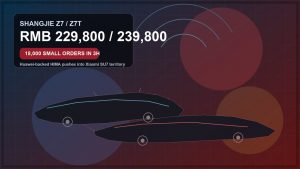
China’s car market has become so conditioned to headline-grabbing discounts that the easiest way to read this launch would be as another pricing story. But the more revealing detail is how restrained the pricing move was. Xiaomi’s official release priced the refreshed SU7 Standard at RMB219,900, with the Pro at RMB249,900 and the Max at RMB303,900. Bloomberg, SCMP and other coverage all converged on the same core comparison: the new base model is only about RMB4,000 more expensive than the prior version, roughly a 1.9% increase. That is small enough to keep the product commercially aggressive, but large enough to show Xiaomi is not trying to win only by cutting price again.
That pricing discipline matters because it changes the frame of the story. Reuters described the updated SU7 as a direct challenge to Tesla in China, especially the Model 3. But the challenge is not only that Xiaomi wants to stay cheaper or match Tesla feature by feature. The stronger signal is that Xiaomi is trying to redefine value inside the Chinese EV market. Instead of asking buyers to focus only on the sticker, it is asking them to notice how much extra hardware now comes with a nearly unchanged entry point.
Standard LiDAR turns the SU7 into a more visible specs play
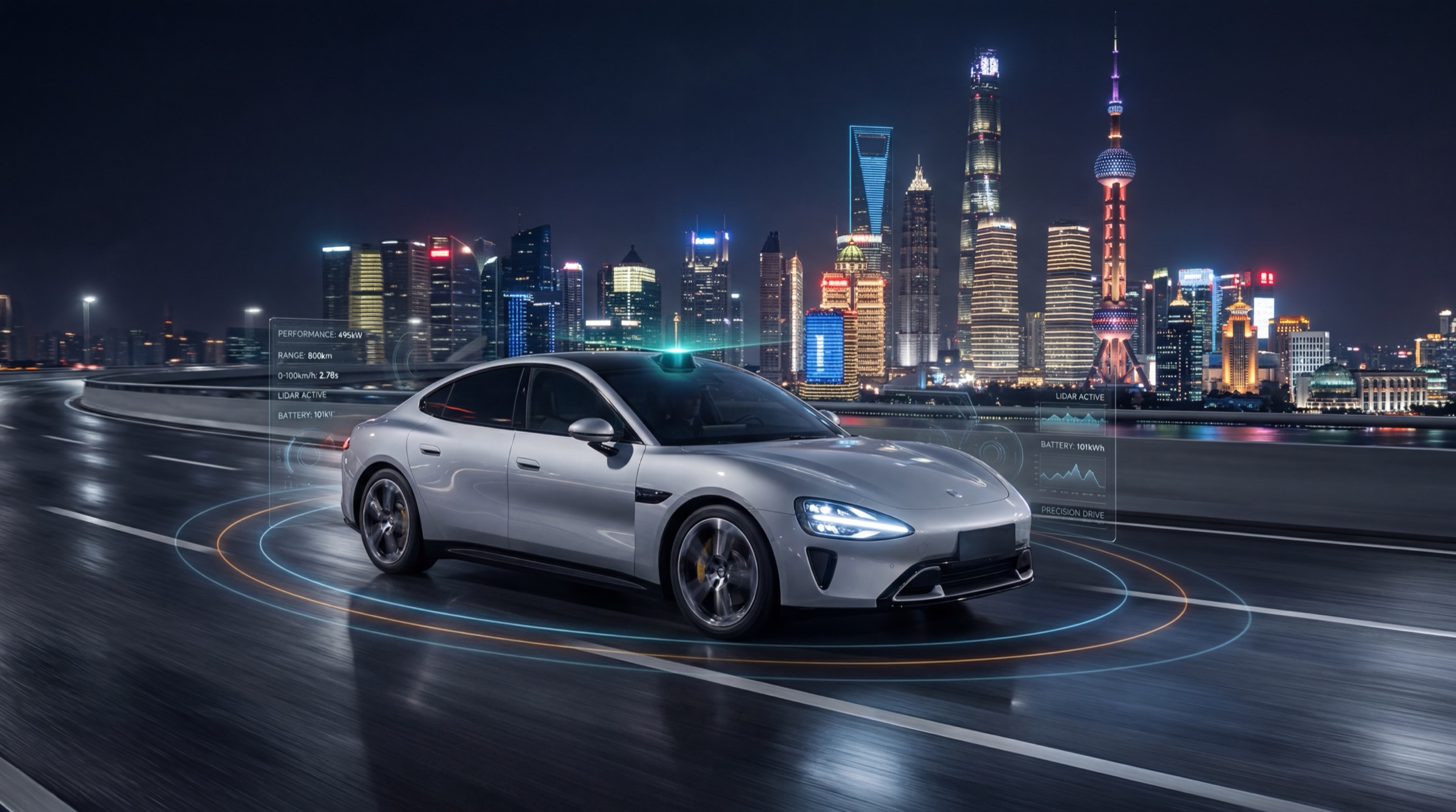
The most important product hook is standard LiDAR across the range. In many markets, LiDAR is still treated as an upper-tier autonomous-driving feature or a premium trim differentiator. Xiaomi is using it as a mainstream visual and technological signal. CarNewsChina reported that the refreshed SU7 lineup adds standard roof-mounted LiDAR, while also lifting output to as much as 680 hp in the top version and offering CLTC range of up to 902 kilometers. CnEVPost and Xiaomi’s own release reinforced the message that this was a broad-based refresh, not a cosmetic update.
That matters because the hardware tells a different story from the old China EV narrative of pure discounting. Xiaomi is effectively presenting the SU7 the way a consumer-electronics company might present a smartphone refresh: more sensors, better visible specs, more safety, stronger performance and just enough pricing restraint to make the upgrade feel obvious. For English-language readers, that framing is especially useful because Xiaomi is not entering autos as a legacy manufacturer trying to protect an old product hierarchy. It is behaving like a technology brand trying to win attention by compressing premium-looking features into a mass-market price band.
Safety and compliance are becoming part of the competition too
Reuters added another important detail that should not get buried under the LiDAR headline. The report said the refreshed SU7 uses mechanical door handles and emphasized compliance with upcoming Chinese safety rules. That may sound like a smaller feature note, but it expands the significance of the launch. China’s EV race is no longer just about acceleration figures, range or digital features. Safety presentation and regulatory compliance are becoming more visible parts of the product argument as the market matures and as scrutiny over EV design choices increases.
This helps explain why Xiaomi’s update reads as more strategic than a typical annual refresh. The company is not simply throwing in one flashy sensor to boost marketing appeal. It is building a package around LiDAR, safety, chassis tuning and visible hardware upgrades, then presenting that package at a price increase small enough to look consumer-friendly. In other words, Xiaomi is trying to make the SU7 feel more complete rather than merely more powerful.
Early orders show heat, but they do not settle the demand story
The first market reaction was strong. Gasgoo reported that Xiaomi locked in 15,000 orders within 34 minutes of launch. That gives the article an important second-layer data point because it shows the update was not met with indifference. There was enough demand momentum to validate the product proposition at least in the first burst after launch.
Still, this number needs careful treatment. Locked orders within 34 minutes are an early enthusiasm signal, not proof of steady long-term demand, delivery execution or durable pricing power. China’s EV market has repeatedly shown that launch-night momentum and quarter-by-quarter sales performance are not the same thing. The safer interpretation is that Xiaomi successfully generated immediate buyer interest with its formula of modest price movement plus visible specification upgrades. Whether that converts into sustained deliveries and healthier unit economics will take more time to judge.
The real tension is whether Xiaomi can keep adding hardware without damaging margins
This is where Bloomberg’s framing becomes important. The publication highlighted investor concern over profit pressure even as Xiaomi sharpened its EV push. That concern is logical. Adding LiDAR as standard, raising safety specifications, improving the chassis package and keeping prices nearly flat may be good for consumer appeal, but it also invites an obvious financial question: who absorbs the cost?
That is why this story works better as a specs-and-margins story than as a simple launch brief. Xiaomi wants to show that it can behave differently from rivals that rely on blunt discounts. But a more hardware-heavy strategy does not eliminate the margin problem. It just moves the battleground. Instead of asking whether Xiaomi can sell more cars by cutting price, investors will ask whether it can defend enough gross profit while turning the SU7 into a more obviously high-value product. In that sense, the refreshed SU7 is a test of whether China’s EV leaders can turn product escalation into a more sustainable competitive tool than constant sticker cuts.
Xiaomi is also showing how a Chinese tech company thinks about cars differently
There is a broader China angle here that makes the piece stronger for an international audience. Xiaomi is not only another EV maker. It is one of China’s best-known consumer-technology companies, and that heritage shapes how it builds and markets the SU7. The refreshed model looks like a case study in bringing consumer-electronics logic into autos: visible feature stacking, headline-friendly hardware, controlled pricing and a launch designed to make buyers feel they are getting more than the number on the price tag suggests.
That matters because it reflects a wider shift inside China’s auto market. Competition is becoming less about who can survive a temporary price war and more about who can continuously turn engineering, software, safety and supply-chain discipline into a superior value package. Xiaomi’s March 19 launch does not prove that it has solved that challenge. But it does show how Chinese tech companies are trying to compete in cars: not by pretending margins do not matter, but by trying to make higher-spec products feel so compelling that a small price increase still looks like a bargain.
What changed, and what comes next
What changed this week is that Xiaomi offered a clearer picture of where China’s EV competition is heading. The refreshed SU7 did not arrive as the cheapest possible answer to Tesla. It arrived as a near-flat-priced upgrade built around standard LiDAR, more visible safety positioning, chassis improvements and an early order burst of 15,000 locked units in 34 minutes. That combination suggests the market is entering a phase where perceived hardware richness may matter as much as headline discounting.
What comes next is the harder part. Xiaomi now has to show that the launch heat turns into real deliveries, that the refreshed SU7 can keep pressure on Tesla and domestic rivals, and that the added hardware does not turn the business into a margin sacrifice story. The safest way to read this launch is as a meaningful refresh rather than a fully new category-defining model. But even with that caution, the signal is strong: China’s EV war is becoming less about who cuts price the most and more about who can pack in more technology, more safety and more value without losing financial discipline.
Related reading on 1M Reviews
- Xiaomi Tied an $8.7 Billion AI Pledge to Its Refreshed SU7 Launch as China’s EV War Turned Into an AI Capex Race
- Xiaomi Sets March 19 Launch for Next-Gen SU7, Highlighting 902 km Range and High-Voltage Platform
Sources
- Xiaomi — Xiaomi Introduces New-Generation Xiaomi SU7 Series: The Driver’s Car for a New Era (2026-03-19)
- Reuters — China’s Xiaomi unveils upgraded SU7 prices, challenging Tesla (2026-03-19)
- Bloomberg — Xiaomi Prices New SU7 Sedan Just 2% Higher to Sharpen EV Push (2026-03-19)
- CarNewsChina — Xiaomi SU7 new-gen launched with up to 680 hp, starts at 31,870 USD in China (2026-03-19)
- SCMP — Xiaomi’s new-generation SU7 launch sparks fresh EV fight with Tesla in China (2026-03-20)
Editorial caveats: Treat the refreshed SU7 as a meaningful update, not proof that Xiaomi has permanently reset the China EV market. Treat the 15,000 locked orders in 34 minutes as an early demand signal, not proof of sustained delivery momentum. Keep the core tension explicit: Xiaomi added standard LiDAR and broader upgrades while raising the base price by only about 2%, but that still leaves open how much margin pressure the strategy may create.