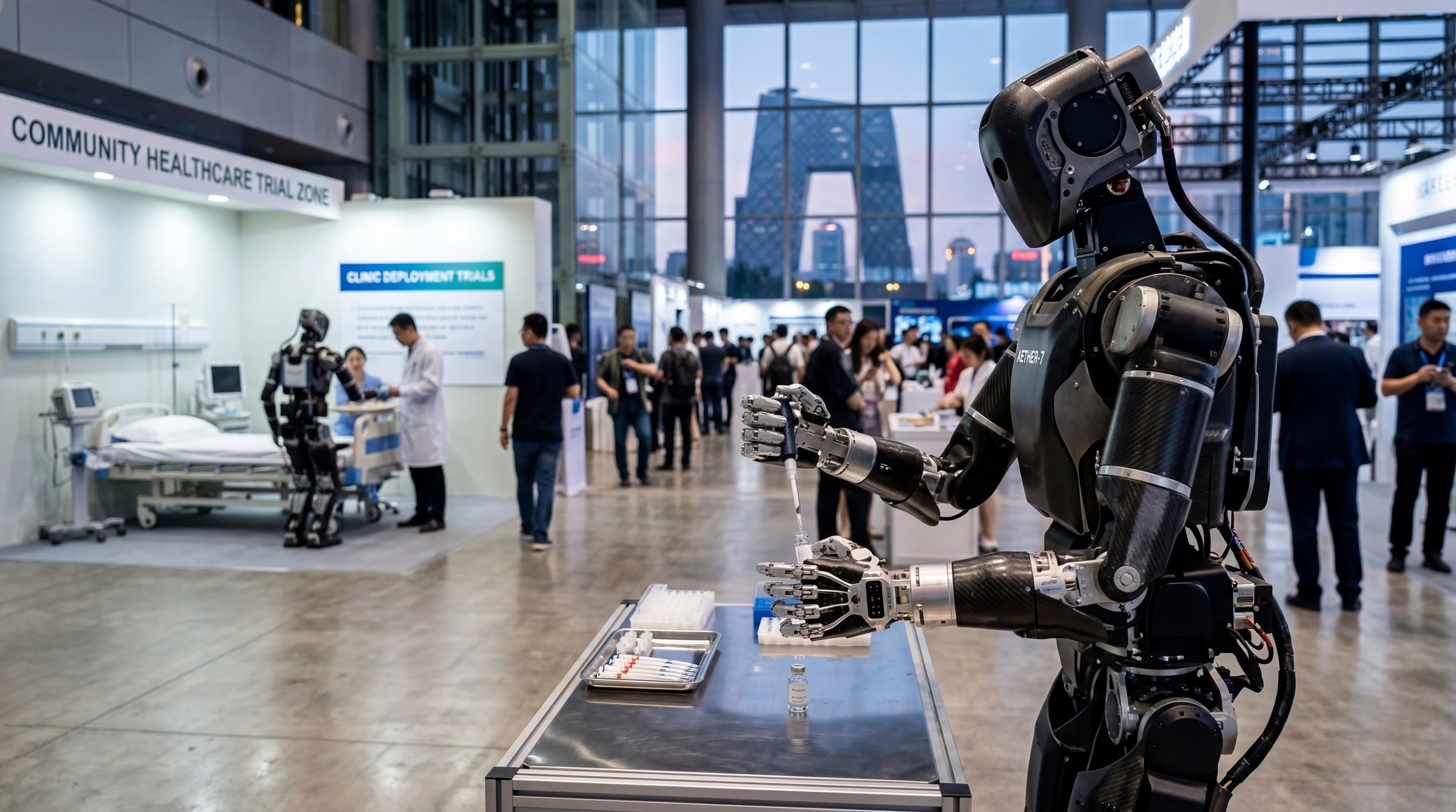
Beijing used AI Show 2026, held March 18-20 at the China International Exhibition Center’s Chaoyang venue, to argue that China’s next AI phase will be judged by deployment rather than demos. Local and industry coverage from the three-day event highlighted humanoids, a 38-degree-of-freedom dexterous hand and a traditional Chinese medicine diagnostic robot slated for gradual trials in Beijing community hospitals and TCM hospitals over the next two to three years. With hundreds of exhibitors on site and more than 30,000 professional visitors reported on day one, the message was clear: Beijing wants embodied AI to move out of the show hall and into factories, elder care and neighborhood healthcare.
This expo carried a city-level policy message
People.cn’s March 16 preview confirmed that AI Show 2026 was organized by the Beijing Artificial Intelligence Society, the Beijing Internet of Things Intelligent Technology Application Association and Beijing Henghui International Exhibition Co., and that it would run from March 18 to 20 at the China International Exhibition Center’s Chaoyang hall. Coverage then diverged on scale. The preview carried a 200-plus brand figure. China Daily’s December preview used a much larger 450-plus brand and 50,000-plus professional visitor estimate. Beijing Daily’s March 20 report said about 450 exhibitors showed up. That discrepancy is exactly why the safest wording is hundreds of exhibitors, not one fixed tally. But whichever count you use, the signal is the same. Beijing did not stage the event as a niche lab fair. It staged it as an ecosystem forum with an industry conference, wide procurement exposure and investment matchmaking around robots, AI software, IoT hardware and applied systems.
China Economic Net’s on-site report, republished by NetEase, said more than 30,000 professional visitors came on the first day and that more than 75% were industry decision makers or technical experts. That matters more than headline foot traffic. A hall full of casual visitors can generate viral clips; a hall dominated by buyers, integrators, hospital contacts and industrial specialists can generate pilots. At the event, Beijing Artificial Intelligence Society chairman Li Xiaoli described the sector as moving from a “technology breakthrough period” into an “industrial deployment period.” That formulation helps explain the real purpose of AI Show 2026. Beijing wanted to show that embodied AI is not only about better motion control or flashier demos. It wanted to show that the city can bundle technical exhibitors, policy sponsorship, industry contacts and deployment venues into one commercialization pipeline.
The machines on display were chosen to tell a work story
The robot lineup made that framing visible. Beijing Daily highlighted Unitree’s G1 humanoid, the Go2 quadruped and Deep Robotics’ Lynx M20 wheeled-legged robot, all shown as systems that can cross obstacles and work in complex environments. Those products matter because they map neatly onto industrial inspection, logistics and hazardous settings such as mines and transport corridors. The expo therefore did not present movement ability as entertainment alone. It framed locomotion as the base layer for work in places where labor is risky, repetitive or hard to staff. In China’s industrial-policy language, that is the moment embodied AI stops looking like a lab trophy and starts looking like part of a broader push for new productive capacity.
The clearest example was the Y-Hand M2 dexterous hand, which the China Economic Net report described as a 38-degree-of-freedom bionic hand. According to company representative Hu Zheqi, the system can perform 33 categories of human-like dexterous manipulation with a success rate above 96%, and he positioned it for industrial, elder-care and medical scenarios. Those performance metrics and any “world’s highest DOF”-style positioning should be treated as company claims from the show floor, not as independently verified benchmarks. Even so, the commercial pitch matters. Beijing was not using a dexterous hand to illustrate abstract research progress. It was using it to argue that robots are getting closer to useful fine-motor work, the missing link between spectacular mobility demos and economically meaningful deployment.
Healthcare is the most revealing part of the story
Healthcare is what makes this event more than another robotics roundup. The same China Economic Net report said a traditional Chinese medicine, or TCM, diagnostic robot is being prepared for gradual trials in Beijing community hospitals and TCM hospitals over the next two to three years. The company behind it said the system was trained on health data from more than 100,000 people and labels from more than 100 TCM experts, and it further claimed diagnostic performance above practitioners with three to five years of experience. The company also said it plans to push for Class III medical-device approval. Again, those performance claims are not independently validated, and the right verbs are “said,” “planned” and “prepared for trials.” But the verified news value lies elsewhere: Beijing is attaching embodied AI to neighborhood healthcare, elder-friendly voice interaction and future device approval, which makes the robot story far more concrete than yet another humanoid backflip.
That shift matters because community hospitals sit close to daily public services. When a city starts discussing AI robots not just for factories but for community clinics and traditional Chinese medicine hospitals, it is widening the deployment map. Beijing is effectively testing whether robotics can move into high-frequency service settings where aging populations, frontline staffing pressure and standardization demands can all support adoption. That does not mean a clinically proven rollout already exists. It does mean the city’s AI narrative is becoming operational: not only who can build a machine, but who can fit one into real institutions, procurement processes and frontline workflows.
Beijing is trying to compress the path from prototype to pilot
That is why the most important actor here may be Beijing itself rather than any single vendor. The event was organized by city-linked industry associations, supported by a dense local ecosystem of researchers, startups, hospitals and industrial users, and paired with forums such as the 2026 AI Application and Robotics Innovation Industry Conference and an industry investment matchmaking session. One dexterous-hand company explicitly said Beijing had supported it through industrial policy, funding support and project matching. Taken together, those details suggest a city trying to compress the path from prototype to pilot. The competitive advantage is not just better hardware. It is the ability to line up labs, capital, buyers, regulators and test sites faster than rival ecosystems can.
This is what makes AI Show 2026 a city-level commercialization story rather than a vendor story. Recent China technology headlines have been dominated by frontier models, AI-agent adoption frenzies or large-company AI spending. This expo points to a different layer of competition. The question is whether a local ecosystem can turn embodied AI into a practical service stack. Beijing’s wager is that if it can connect research capability, public-sector support, procurement channels and pilot environments, then the gap between a prototype on a stage and a tool in a hospital or factory can shrink.
Why this matters for China’s AI competition
The broader implication is that China’s AI competition is no longer only about frontier models, chip restrictions or giant capex pledges from internet platforms. Those stories still matter, but AI Show 2026 pointed to another contest: who can operationalize robots fastest in factories, mines, elder-care facilities and community healthcare. Beijing is trying to present embodied AI as deployment infrastructure. That is a different kind of ambition from releasing a new model or staging a viral demo. It is closer to building a municipal stack for commercialization, where exhibition halls, procurement networks, policy sponsorship and pilot institutions all reinforce one another.
That framing also makes the story relevant outside China. International audiences have seen plenty of humanoid footage, but the harder question is always what happens after the clip ends. Beijing’s answer is that the next phase of competition will be decided by local deployment density: how quickly a city can turn robotics into repeatable use cases. If Beijing can show working pilots in hospitals, elder care and industrial environments, it will have something more durable than demo culture. It will have a template for city-led commercialization. If it cannot, AI Show 2026 will remain just another well-produced expo.
What changed, and what comes next
What changed this week is not that China suddenly proved mass-market robot adoption. It did not. What changed is that Beijing publicly packaged humanoids, dexterous manipulators and medical robots as near-term deployment tools, not just as symbols of technical ambition. What comes next will determine whether that narrative holds: hospital trials, regulatory progress, industrial procurement, reliability data and evidence that pilot projects can survive beyond the exhibition cycle. Until those signals arrive, the careful takeaway is that Beijing has made embodied AI a city-level commercialization story. In 2026, that may be more important than any single robot demo on the show floor.
That deployment framing also fits alongside Digua Robot Raises USD 120M Series B1 to Scale a Full-Stack Embodied-Intelligence Platform in China, Unitree Files for a Shanghai IPO to Fund Humanoid AI and Factory Expansion, China Approves First Invasive BCI Device for Hand Function and China’s 15th Five-Year Plan boosts AI Plus, semiconductors, because together they show how China’s robotics and healthcare-adjacent AI story is being pushed through funding, manufacturing scale, policy support and clinical-use pathways rather than demo clips alone.
Sources
- People’s Daily Online — AI Show 2026 Beijing Artificial Intelligence and Robotics Expo to open on March 18 (2026-03-16)
- China Daily — AI Show 2026 Beijing Artificial Intelligence and Robotics Expo to open in March (2025-12-09)
- Beijing Daily / Jingbao — Stand firm on the new high ground of AI competition (2026-03-20)
- China Economic Net via NetEase mirror — AI Show 2026 highlights industrial innovation and deployment momentum (2026-03-20)
- Robotsci — AI Show 2026 Beijing AI and Robotics Expo to open in March (2026-03-02)
Editorial caveats: Treat the dexterous-hand performance metrics, “highest DOF” positioning and the TCM robot’s claimed diagnostic edge over doctors with three to five years of experience as company or show-floor claims, not independent validation. Treat the planned hospital rollout as a trial timeline, not proof of large-scale medical deployment. Because preview and live reports use different participation counts, use “hundreds of exhibitors” unless citing a specific source directly.