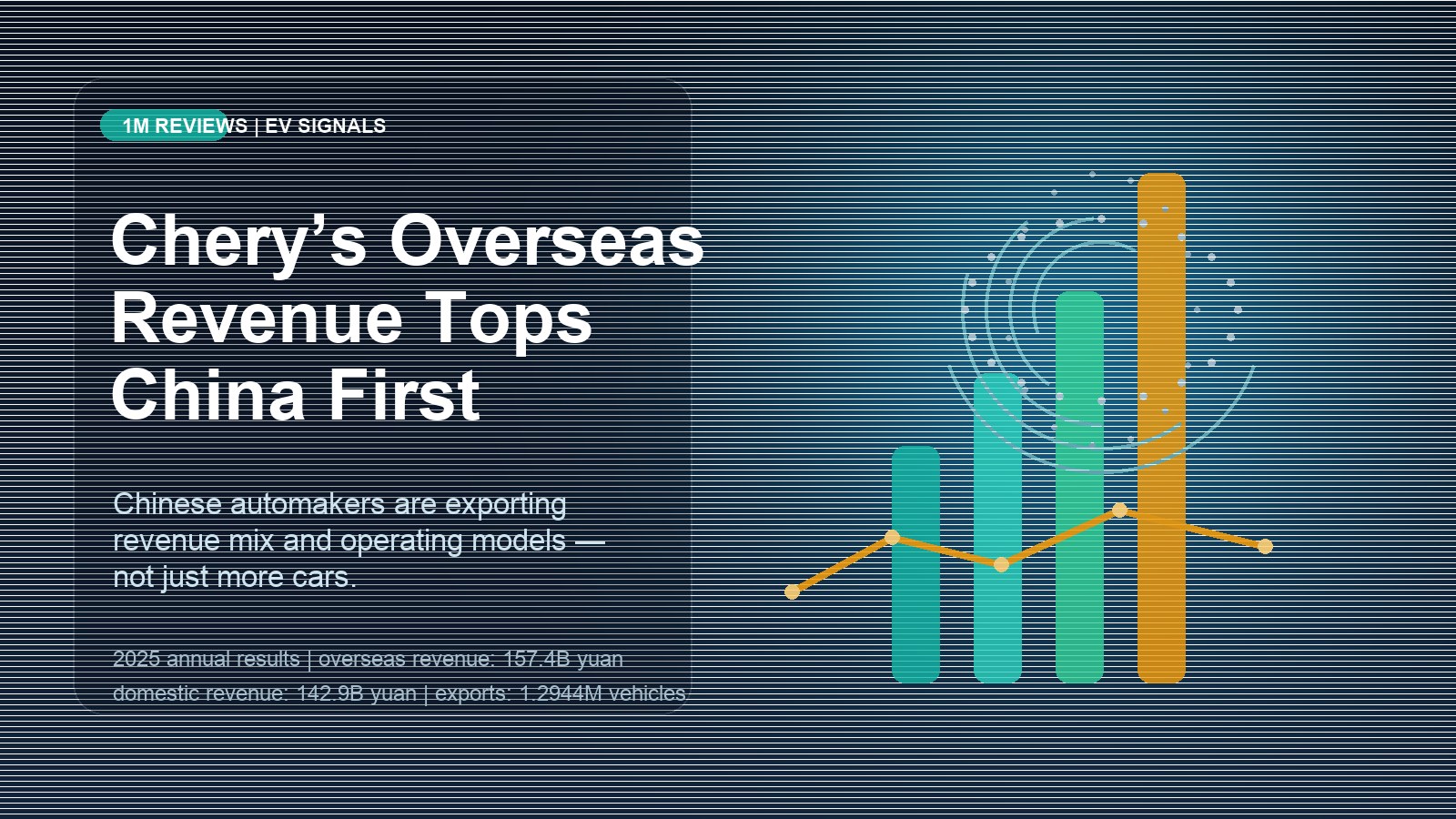
On March 18, Chery Automobile said in its 2025 annual results that revenue from overseas markets reached 157.419 billion yuan, exceeding its 142.868 billion yuan domestic revenue for the first time. That matters beyond one earnings release because it shows China’s auto globalization story is starting to move from export volume into revenue mix. Chery also reported 300.287 billion yuan in total revenue, 19.507 billion yuan in net profit, and 1.2944 million vehicle exports, suggesting its overseas business is becoming a central growth base rather than just a channel for shipping more cars out of China.
The real headline is the revenue split, not just another strong earnings year
A Chinese automaker posting record revenue is no longer enough, by itself, to surprise global readers. What makes Chery’s latest filing stand out is the structure of that revenue. In the Hong Kong filing, the company said revenue from “other countries/regions” came to 157.419 billion yuan in 2025, above the 142.868 billion yuan it recorded from the PRC market, including Hong Kong, Macau, and Taiwan. That is a more meaningful signal than the top-line figure of 300.287 billion yuan because it suggests overseas demand is no longer supplementary to Chery’s China business. It is large enough to reshape the company’s operating center of gravity.
That distinction matters for how English-language readers should frame the story. For years, the dominant narrative around Chinese automakers abroad has been simple: they were exporting more vehicles, often at aggressive prices, and using scale to gain share in overseas markets. Chery’s numbers suggest that at least for one of China’s biggest carmakers, globalization is becoming more than a shipment story. It is becoming a revenue structure story, where overseas markets can outweigh the domestic market in the income statement itself.
Recent 1M Reviews coverage has tracked adjacent layers of that shift through Geely’s export-led revenue push, Europe’s coming wave of Chinese electric truck competition, and Audi’s China-only E7X strategy, all of which show Chinese carmakers moving from simple shipment growth toward market-specific operating models.
Export volume and revenue mix are now reinforcing each other
The second reason this result matters is that Chery’s export scale and revenue mix are moving in the same direction. The company said exports reached 1.2944 million vehicles in 2025, up 33.2% year over year and equivalent to 49.2% of total sales. Overseas revenue, however, accounted for 52.4% of total revenue. That gap does not automatically prove that every overseas vehicle is more profitable than every domestic one, but it does show Chery’s international business is carrying more weight than a pure volume statistic would suggest.
That is an important shift because export booms can be misleading if they are built mainly on low-margin selling. Revenue share is not the same thing as profit share, but it is still harder to dismiss. When overseas markets account for more than half of revenue while export deliveries account for just under half of unit sales, the implication is that Chery’s global business is doing more than clearing inventory abroad. It is becoming part of the company’s earnings base.
Chery’s broader 2025 results reinforce that point. Net profit rose 36.1% year over year to 19.507 billion yuan, while new-energy-vehicle sales rose 72.5% to 826,500 units and NEV revenue climbed 66.3% to 98.023 billion yuan. Those figures matter because they show Chery is not relying on a single product category or a one-quarter export spike. It is growing volumes, extending its overseas footprint, and scaling its NEV business at the same time.
Europe and right-hand-drive markets show this is not only an emerging-market story
The global significance of the result becomes clearer when paired with Chery’s regional expansion data. Chinese and industry media, citing company disclosures and management remarks, said Chery’s Europe sales rose by more than 200% in 2025 and that the company had entered 16 European countries including the UK and Italy. Media reports also said right-hand-drive market sales grew by more than 100%.
Those details matter because they widen the story beyond a familiar reading of Chinese automakers shipping cars mainly into lower-barrier emerging markets. Europe remains one of the most scrutinized and politically sensitive battlegrounds for Chinese car brands, while right-hand-drive expansion opens another layer of localization complexity in engineering, distribution, and regulation. If Chery is growing quickly in both areas, the company is not just exporting finished products. It is learning how to adapt product planning and go-to-market execution across very different regions.
Management’s “local for local” language is arguably the most important analytical clue in the entire story. According to China Economic Net’s summary of Chery management remarks, the company sees long-term overseas growth as requiring localized manufacturing and supply chains that can support local employment and tax contribution. That moves the conversation away from a narrow export surge and toward something more consequential: Chinese automakers are increasingly trying to build regional operating systems, not just overseas dealer networks.
This milestone is real, but it is not the same as proof of permanent overseas dominance
A careful reading still requires restraint. The overseas-versus-domestic revenue comparison is based on revenue by customer location. That is not the same thing as a full breakdown of where Chery manufactures vehicles, where it books profit, or how resilient those regional earnings are under changing tariffs, exchange rates, and local competition. The safest interpretation is that overseas markets generated more revenue than the domestic market in 2025, not that Chery has already secured an unassailable overseas profit moat.
That caveat matters even more because 2025 should be treated as a milestone year, not as final proof of a locked-in long-term trend. Chery’s management and media recaps point to stronger overseas profitability and improving scale, but public regional profit disclosure still appears limited. Investors and industry watchers will still need to see whether this revenue mix can hold up in 2026 if trade barriers rise, price competition intensifies, or localization spending weighs on margins.
There is also a second caution inside the NEV story. Chery’s NEV business expanded quickly in 2025, but source materials indicate NEV gross margin improved to 8.8% while still trailing the margin profile of internal-combustion vehicles. That means the company should not yet be framed as having fully solved the profitability model for every part of its transition. The more defensible conclusion is that overseas expansion and a broader product mix are increasingly supporting Chery’s earnings base.
What changed, and what comes next
What changed this week is that Chery offered one of the clearest data points yet that China’s car export boom is evolving into a more mature global business model. The company did not just ship 1.2944 million vehicles abroad. It generated more revenue overseas than at home, while also pushing into Europe, expanding in right-hand-drive markets, and talking openly about local manufacturing and supply chains. That is a very different signal from the earlier phase of China auto globalization, when the main question was whether Chinese brands could sell more cars abroad at all.
What comes next is more demanding. If Chery and its peers can turn overseas scale into sustained regional revenue, localized production, and steadier profitability, the next chapter of China’s auto rise will look less like an export wave and more like the construction of multinational operating platforms. If they cannot, this year will still stand as an important marker: the point at which one major Chinese automaker showed that globalization was beginning to rewrite its revenue mix, not just its shipping volumes. Either way, the center of the story has moved. China’s carmakers are no longer only exporting vehicles. They are starting to export a business model.
Sources
- HKEX — Chery Automobile Co., Ltd. Annual Results Announcement for the Year Ended 31 December 2025 (2026-03-18)
- Gasgoo — Chery posts record 2025 results as EV surge and global push fuel growth (2026-03-18)
- CnEVPost — Chery posts 34.6% profit jump in 2025 on strong sales (2026-03-18)
- China Economic Net — Chery revenue tops 300 billion yuan as overseas business accounts for more than half (2026-03-20)
- CarbonCredits — Chery Hits Record Earnings as It Bets Big on NEVs, Overseas Sales, and Clean Energy (2026-03-19)
Editorial caveats: Treat the overseas-versus-domestic comparison as revenue by customer location, not a complete breakdown of production footprint or regional profit. Do not overstate 2025 as proof that Chery has already locked in durable overseas profit leadership. Keep the stronger claim narrower: Chery’s global expansion is increasingly reshaping its revenue base and operating logic.