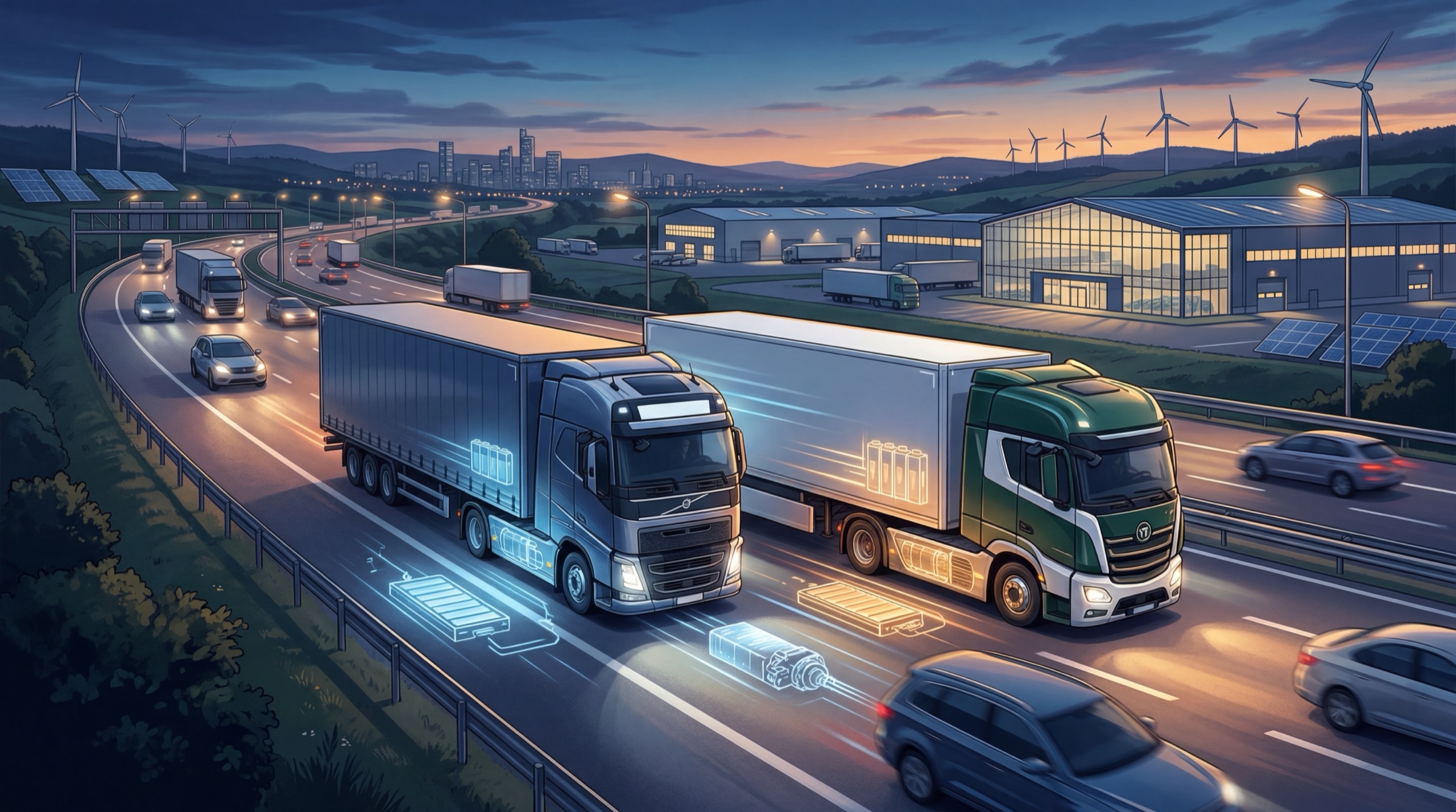
More than half a dozen Chinese electric heavy-truck makers, including BYD, Geely-owned Farizon, Sany, Sinotruk, Windrose and SuperPanther, are preparing to enter Europe in 2026, according to a March 10 Reuters report and follow-up industry coverage. Some expect to price battery-electric rigs as much as 30% below Europe’s roughly €320,000 average, a potentially disruptive move in a market where electric trucks still represented only 4.2% of EU truck sales in 2025. The immediate pressure is on Europe’s incumbents: if Chinese suppliers can translate their battery, drivetrain and development-speed edge from passenger EVs into freight, Europe’s slow and expensive truck electrification cycle could face a faster, cheaper challenger.
This is not simply another China passenger-EV price war
It is tempting to read this as one more chapter in the broader China-versus-Europe EV story, but that framing is too shallow. Passenger cars are sold to consumers and can win attention through styling, financing and showroom momentum. Heavy trucks are bought by fleets that care about total cost of ownership, charging downtime, payload, maintenance coverage and residual value. That makes the current China push more significant, not less. If Chinese brands can compete in long-haul freight, they are exporting not just lower prices but an industrial system built around batteries, e-drivetrains, rapid engineering cycles and supply-chain control.
The market backdrop explains why this matters now. China Daily, citing Reuters and industry participants, said zero-emission heavy-duty trucks account for about 29% of sales in China, compared with just 4.2% of truck sales in the European Union in 2025. Europe’s electric truck market is therefore still early, expensive and under-scaled. In that kind of market, whoever can cut costs first can do more than win orders; they can reshape the pace of adoption itself.
The real story is the spillover of China’s EV manufacturing model into freight
That is why this should not be reduced to a headline about Chinese brands undercutting European rivals by around 30%. Price is only the most visible symptom. The deeper issue is that Chinese truck makers are trying to carry over the competitive logic that already worked in passenger EVs: lower battery costs, vertically connected component supply, faster product iteration and a willingness to localize manufacturing when needed.
Reuters’ reporting, echoed by Automotive World and China Daily, points to exactly that combination. Industry voices cited in those reports said some Chinese entrants believe they can bring electric heavy trucks to Europe at prices well below the regional average. China Daily also highlighted China’s broader strengths in batteries, motors and electronic control systems. In other words, the advantage is not a one-off discount. It is the result of industrial depth.
Windrose is the clearest example of how that depth can look in product form. According to China Daily and Automotive World, its Global E700 offers about 670 kilometers of range and around 35-minute charging, while Reuters-linked industry commentary said the truck reached major regulatory approvals in about three years versus a typical electric-truck development cycle closer to seven. Those claims should be treated as attributed industry assessments, not uncontested fact. Even so, they help explain why European incumbents no longer see Chinese competition as a distant possibility.
Europe is facing three different China timelines at once
One reason this story is easy to misread is that not every Chinese brand is at the same stage. The safer way to understand the situation is to separate the wave into three categories.
First, there are brands in the planning-to-enter phase. Reuters identified BYD, Farizon, Sany, Sinotruk, Windrose and SuperPanther among the names preparing European heavy-truck sales in 2026. That is the broad headline and the basis for the “more than half a dozen” framing.
Second, there are brands already laying down localization and support infrastructure. Reuters and Automotive World said BYD plans to make trucks at its existing bus factory in Hungary, while SuperPanther is linked to assembly through Steyr Automotive in Austria. Automotive World also reported that SuperPanther and Sany have signed agreements with Germany’s Alltrucks, giving them access to an established European service footprint. In heavy trucks, that detail matters as much as any launch event, because fleets do not buy vehicles without confidence in repair coverage and uptime.
Third, there are brands that can already point to delivery or certification milestones. ChinaTrucks reported on March 19 that Windrose had begun deliveries in Northern Europe and received EU e5 Whole Vehicle Type Approval from Sweden’s transport authority, allowing broader sale and operation across the bloc. That does not mean Chinese brands have already won Europe. It does mean the story is moving beyond a future tense narrative.
Keeping those stages separate is essential. “Preparing to enter,” “starting delivery” and “having certification” are not interchangeable milestones, and a careful article should not flatten them into one triumphant market-entry claim.
Why Europe’s incumbents are vulnerable now
European truck makers still have formidable strengths. Volvo Group, Daimler Truck and Traton brands benefit from long-standing fleet relationships, financing arms, dealer networks and service organizations that Chinese newcomers are only beginning to match. In heavy trucks, those advantages are real. Freight customers cannot afford extended downtime, and they are less likely than passenger-car buyers to switch brands on novelty alone.
But Europe’s incumbents also face a difficult transition window. Electric heavy trucks remain costly, and industry groups have been pushing policymakers for support measures such as lower road tolls and stronger zero-emission freight incentives. Reuters-linked coverage cited by China Daily and Automotive World makes the pressure clear: fleets want cleaner trucks, but the business case still depends heavily on purchase price, charging speed and operating economics. That creates an opening for lower-cost Chinese entrants precisely when Europe has not yet reached scale.
This is what makes the China challenge in trucks different from a simple tariff or consumer-brand story. The battle is not just about whether a fleet manager likes a new badge. It is about whether China’s cost structure can make freight electrification more commercially viable, sooner, than Europe’s legacy manufacturers expected.
Still, this is not a market victory story
That caveat matters. The current evidence supports a story about preparation, early delivery and industrial positioning, not about dominant market share. Reuters’ March 10 report was the key trigger, but even the latest follow-up material shows a market that is still being set up rather than decisively won. Windrose’s Northern Europe deliveries are notable. Local assembly plans in Hungary and Austria are notable. Service-network partnerships are notable. None of that is the same as proving that Chinese brands can build durable fleet trust across Europe.
There is also regulatory uncertainty. China Daily and industry commentary both note that tariffs, quotas, certification requirements, local rules and possible future industrial-policy barriers could still shape the outcome. Trucks are also more dependent on after-sales execution than passenger cars. A flashy spec sheet may open a door, but a weak parts pipeline can shut it just as quickly.
What changed, and what could happen next
What changed this month is that a scattered set of signals started to look like one coherent trend. Reuters established the headline on March 10: more than half a dozen Chinese electric truck makers are targeting Europe in 2026. China Daily then framed the structural reason Chinese brands think they can compete: a domestic market with higher zero-emission truck penetration, lower-cost supply chains and improving performance. Automotive World showed why incumbents are worried, emphasizing service partnerships, local assembly and product economics. ChinaTrucks added a concrete proof point by reporting that Windrose had begun deliveries in Northern Europe after securing EU e5 WVTA certification.
Put together, those developments suggest that China’s EV export playbook is evolving. It is no longer only about selling more passenger cars abroad or winning a retail price war. It is moving into freight, industrial logistics and transport infrastructure. If 2026 launches turn into repeat orders, and if local assembly and service networks hold up, Europe’s truck market could become the next arena where China’s battery-and-supply-chain advantage changes competitive expectations. If not, European incumbents may still retain their moat through trust, service and operational discipline.
Either way, the ground has shifted. Europe is no longer only asking whether Chinese EV brands can sell cars to consumers. It is beginning to ask whether Chinese manufacturers can help define the economics of decarbonized freight.
That freight-electrification push also fits alongside Zero One Auto Raises 12 Billion Yuan as Capital Races Into China’s New‑Energy Heavy‑Truck Market, China’s EV Battery Makers Top 70% Global Share as BYD’s Five-Minute Charging Raises the Bar and EU Electric Vehicle Prices Drop €1,800 Amid Climate Policy Crackdown and Rising Environmental Pressures, because together they show the cost, supply-chain and policy backdrop behind China’s move from passenger EV exports into Europe’s freight market.
Sources
- Reuters — European freight truck makers brace for wave of low-cost Chinese rivals (2026-03-10)
- China Daily — Europe targeted by electric truckmakers (2026-03-16)
- Automotive World — Europe’s heavy-duty incumbents face a fight for their lives (2026-03-10)
- ChinaTrucks.org — Windrose Starts Delivery of Electric Heavy Trucks in Northern Europe (2026-03-19)
- SuperPanther Europe — Official Europe site (accessed 2026-03-22)
Editorial caveats: Keep “up to 30% cheaper,” “670 km,” “35-minute charging,” and claims about technology or development-speed advantages clearly attributed to Reuters, China Daily or industry coverage. Distinguish carefully between brands that are planning entry, building local assembly/service support, and those already showing delivery or certification milestones. Do not write this as proof that Chinese truck makers have already taken large market share in Europe.