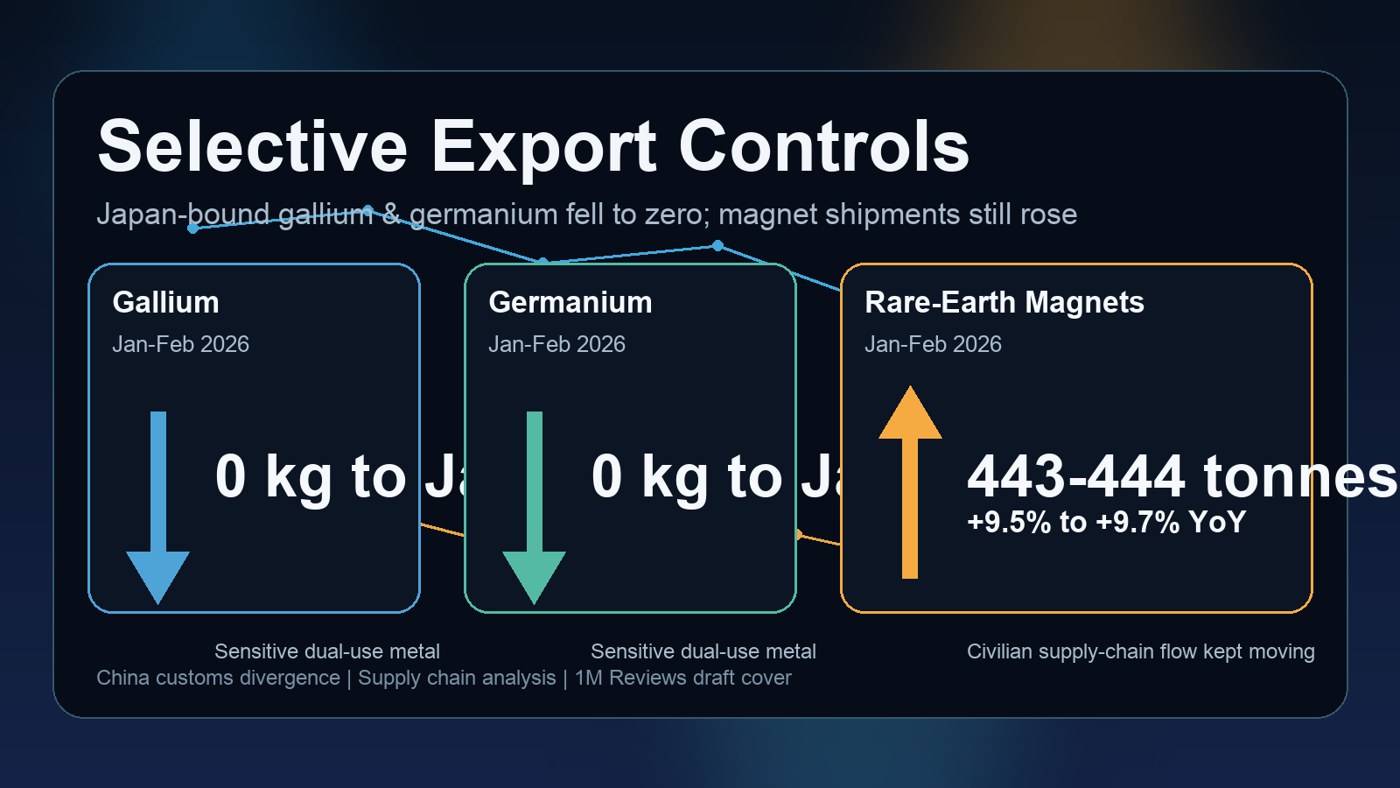
China’s exports of gallium and germanium to Japan fell to zero in January and February 2026, while its rare-earth permanent magnet shipments to Japan still rose about 9.5% to 9.7% year on year to roughly 443-444 tonnes, according to Chinese customs data cited by Reuters, NHK World, Nikkei Asia, SCMP and Metal.com. That split matters because it suggests Beijing is tightening pressure on more sensitive dual-use materials while still allowing meaningful civilian magnet trade to keep moving. The story, in other words, is not a blanket cutoff of everything strategic. It is a selective export-control pattern with sharper pressure on chip-related metals and more commercial continuity in downstream manufacturing.
The real signal is the divergence inside one China customs dataset
The headline is not simply that another China rare-earth story has appeared. It is that the same January-February 2026 customs window produced two very different outcomes for Japan. SCMP, citing Chinese customs data, said China’s gallium exports to Japan fell from 8,007 kg a year earlier to 0 kg, while germanium exports to Japan fell from 400 kg to 0 kg. In the same reporting cycle, Reuters, NHK and Nikkei said China’s rare-earth permanent magnet shipments to Japan still rose to roughly 443-444 tonnes, up about 9.5% to 9.7% year on year. Those numbers are what make the story international: the flows did not tighten evenly.
That distinction becomes even clearer when total magnet trade is added back into the picture. Reuters and Metal.com reported that China’s total exports of rare-earth permanent magnets in the first two months of 2026 reached about 10,762.55 tonnes, up roughly 8.26% from a year earlier. So Japan was not an isolated outlier created by collapsing overall trade. Magnet exports were still expanding at the aggregate level, and Japan’s intake also rose. The sharper message is that Beijing appears willing to squeeze some materials much harder than others, even when those materials sit inside the same broad strategic-minerals discussion.
Gallium and germanium sit closer to the sensitive end of the dual-use spectrum
That policy split makes sense once the material categories are separated. Gallium and germanium are closely tied to semiconductors, optics, infrared systems, radar and other defense-related or high-sensitivity applications. NHK World and Nikkei both framed the latest trade pattern against export-control measures that tightened from January 2026 for some dual-use items involving Japan. When a customs line for gallium goes from 8,007 kg to zero and germanium goes from 400 kg to zero in the same two-month period, the most disciplined interpretation is not that all exports have been permanently banned. It is that highly sensitive materials are facing a much tighter approval and shipment environment.
That is also why the language around the data has to stay careful. January-February 2026 is only a two-month window, not a full-year verdict. “No exports were recorded” or “shipments fell to zero in the first two months of 2026” is the safe formulation. A permanent halt, blanket ban or irreversible cutoff would overstate what the available data show. There could still be licensing lags, shipment timing issues, or rerouting through third countries that do not appear in the country-level snapshots now circulating through Reuters, NHK, Nikkei and SCMP. The data are strong enough to prove a sharp tightening signal. They are not strong enough to prove that China has permanently stopped all such exports to Japan.
Magnets kept moving because the civilian industrial chain still matters
Rare-earth permanent magnets tell a different story because they sit deeper in the civilian manufacturing base. NHK and Nikkei both pointed to their importance in electric-vehicle motors, while the wider supply-chain logic also includes industrial motors, automation equipment and consumer electronics. If China shipped about 443-444 tonnes of those magnets to Japan in January-February 2026, and about 10,762.55 tonnes globally, then the message is not that China has loosened all rare-earth controls. It is that downstream magnet trade linked to civilian industry has not been shut off in the same way as gallium and germanium.
That matters because Japan’s manufacturing exposure is broad and concrete. Electric vehicles, industrial systems and automation hardware all depend on steady magnet availability, while Japanese companies also sit close to advanced semiconductor and optical-material supply chains where gallium and germanium matter more directly. In practice, that means Beijing may be preserving commercial leverage where the manufacturing ecosystem is large, global and harder to replace overnight, while applying more pressure where strategic sensitivity is higher. The result is a differentiated export-control pattern rather than a single yes-or-no switch.
This is still a very China-specific story, not a generic commodity move
The hard China angle remains intact throughout the article. The core facts come from Chinese customs data. The strategic significance comes from China’s position in critical-minerals refining and rare-earth magnet processing. And the policy meaning comes from how Beijing appears to be calibrating flows across different parts of the materials stack. This is not just another commodity-price story or a vague geopolitical headline. It is a China-led signal about how export controls can be applied selectively across metals, magnet materials and end-use categories.
That is also why the story fits an English-language site focused on China technology and industry. Gallium and germanium connect directly to semiconductor materials and high-performance optical systems. Rare-earth permanent magnets connect to EV motors and industrial equipment. Put together, the story sits at the intersection of automotive manufacturing, chip materials and geopolitics. International readers do not need to know every customs code to grasp the bigger point: China is showing that it can tighten pressure at the more sensitive end of the supply chain without fully freezing trade in all downstream industrial materials.
What this means for Japan’s supply chain planning
For Japan, the short-term picture is mixed rather than uniformly negative. The continued rise in magnet shipments suggests there is still room for commercially important flows tied to EVs and industrial systems, which may reduce the risk of an immediate all-out manufacturing shock. But zero recorded gallium and germanium exports in January-February 2026 are harder to dismiss because those metals feed directly into categories tied to semiconductors, optics and defense-related applications. Even if this is not a permanent cutoff, it forces Japanese buyers and policymakers to think more seriously about inventory buffers, supplier diversification and the reliability of future licensing schedules.
The bigger supply-chain lesson is that “critical minerals” should not be treated as one undifferentiated block. Gallium, germanium and rare-earth magnets all sit inside the same broad strategic conversation, but their trade behavior in early 2026 clearly diverged. Japan may still be able to source large volumes of magnets from China for motors and industrial systems, while facing much tighter access to more sensitive upstream materials. That kind of split creates a more complicated planning problem than a simple embargo narrative would suggest, because some production lines can keep running while others face rising uncertainty.
What changed, and what could happen next
What changed in March 2026 is that China’s export-control strategy became easier to read through actual trade flows. The latest customs data do not describe an all-purpose shutdown of critical-minerals exports to Japan. They describe something more calibrated: gallium and germanium shipments fell to zero in the first two months of the year, while rare-earth permanent magnet shipments to Japan still increased and total magnet exports also rose. That combination points to tighter controls on more strategically sensitive dual-use materials alongside continued commercial movement in downstream magnets.
What happens next depends on whether the split persists beyond January and February. If gallium and germanium shipments remain at zero through later monthly releases, the signal of sustained tightening will become harder to explain away as timing or licensing noise. If magnet exports to Japan stay resilient, the case for “targeted controls with civilian carve-outs” will also strengthen. The safest conclusion for now is that Beijing is not relaxing pressure. It is applying pressure more selectively, using differentiated material flows to preserve leverage over semiconductor-linked metals while keeping parts of the EV and industrial magnet trade alive.
Related coverage on 1M Reviews
- China’s 15th Five-Year Plan boosts AI Plus, semiconductors
- China Warns Nexperia Dispute Could Renew Chip-Supply Risk
- Zhejiang, Geely pact to upgrade smart, green auto supply chain
Sources
-
South China Morning Post — main framing source
– https://www.scmp.com/economy/global-economy/article/3347567/china-cuts-exports-two-hi-tech-metals-japan-increases-rare-earth-shipments
– Key takeaway: Places the two headline facts in one narrative by showing that gallium and germanium exports to Japan fell to zero while rare-earth magnet shipments to Japan still rose. -
Reuters — aggregate magnet-export context
– https://www.reuters.com/world/asia-pacific/chinas-exports-rare-earth-magnets-jump-ahead-trump-xi-meeting-2026-03-20/
– Key takeaway: Confirms that China’s total rare-earth permanent magnet exports in January-February 2026 rose to about 10,762.55 tonnes, and helps anchor the Japan shipment comparison. -
Nikkei Asia — Japan supply-chain framing
– https://asia.nikkei.com/spotlight/supply-chain/china-s-rare-earth-magnet-exports-to-japan-rise-despite-controls
– Key takeaway: Adds the Japanese supply-chain lens and reinforces that magnet shipments to Japan rose despite tighter controls elsewhere. -
NHK World — policy-background source
– https://www3.nhk.or.jp/nhkworld/en/news/20260321_01/
– Key takeaway: Adds context that tighter controls affecting some dual-use trade involving Japan took effect from January 2026, and highlights the relevance of magnets to EV motors. -
Metal.com / SMM — customs-detail support
– https://news.metal.com/vn/newscontent/103817603-Chinas-NdFeB-Magnet-Exports-Rise-826-YoY-in-Jan-Feb-2026-Despite-Monthly-Fluctuations
– Key takeaway: Supports the 10,762.55-tonne total export figure and the broader magnet-trade growth backdrop.
Editorial note: The available evidence supports saying that no gallium or germanium exports to Japan were recorded in January-February 2026. It does not support claiming a permanent ban or a full-year trend. Likewise, stronger magnet shipments to Japan should not be overstated as proof that all rare-earth-related trade has been relaxed.