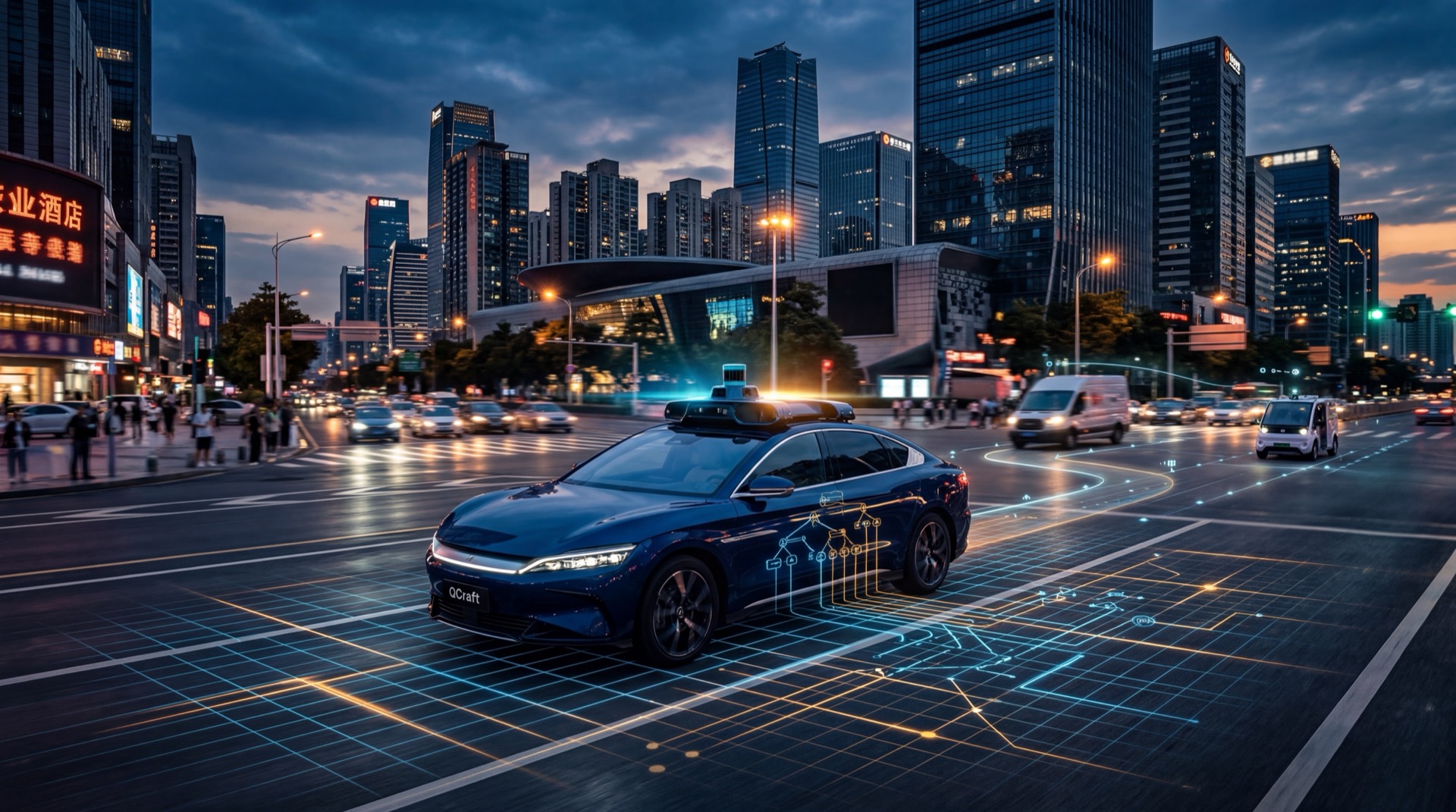
On March 23, Chinese autonomous-driving startup QCraft said it had closed a new $100 million Series D round to fund world models, reinforcement learning, and broader physical-AI development. The financing matters because it arrives alongside concrete production and deployment milestones: more than 1 million vehicles equipped with QPilot, nearly 30 production models already in market, L4 logistics vehicles operating in cities such as Jinhua, Wuhu, and Ningbo, and more than 50 additional vehicle programs planned for 2026. In other words, this is not just another China self-driving fundraising update—it is a marker that autonomous driving is being repositioned as a physical-AI platform story.
This round is important because it changes the narrative, not just the balance sheet
China’s autonomous-driving sector has spent the last several years proving that advanced driver assistance can move from expensive flagship demonstrations into mass-market production programs. That story is still here, but QCraft’s latest round adds a new layer. According to 36Kr Europe, the company is explicitly directing the fresh capital toward “world model + reinforcement learning” research while preparing for a strategic shift toward Level 4 autonomy and more general physical-AI ambitions.
That framing matters. For global readers, “physical AI” is now becoming a catch-all term for AI systems that do not only generate text or images, but perceive, reason about, and act in the physical world through vehicles, robots, or other embodied systems. In China, that language has been spreading fast across robotics, logistics, and intelligent-vehicle startups. QCraft is now trying to claim that autonomous driving is one of the strongest commercial gateways into that broader category.
Unlike many AI narratives, this one already has production anchors
The reason the QCraft story travels better in English than a routine domestic funding brief is that it comes with hard operational numbers. Gasgoo reported that QCraft’s QPilot intelligent-driving system has already surpassed 1 million deployed vehicles. The company says it now works with nearly 10 leading automakers across almost 30 production models, and that in 2026 it expects to add more than 50 new vehicle programs, most of them with urban navigation-on-autopilot, or urban NOA, functions.
Those numbers matter because they separate QCraft from the many AI companies that talk about platform ambition before they have meaningful real-world usage. A million-vehicle deployment base means the company is not trying to build a physical-AI story on top of a pure research lab narrative. It is using mass-production vehicle data, commercial OEM programs, and already-deployed driving systems as the foundation for its next technical push.
That also helps explain why the company keeps arguing that L2++ assisted driving and L4 autonomy should not be seen as two disconnected businesses. QCraft’s pitch is that large-scale production data from passenger vehicles can reinforce more advanced autonomous systems, while L4 operations can feed back into the broader driving stack. Whether or not that loop proves decisive, it is a more concrete commercialization logic than the usual “AI will transform mobility someday” rhetoric.
China’s self-driving competition is moving from ADAS scale to physical-AI positioning
There is a broader industry reason this round matters now. Over the past year, China’s intelligent-driving conversation has often focused on three themes: who can lower hardware cost, who can expand urban NOA beyond premium vehicles, and which OEMs can turn assisted driving into a mainstream selling point. Those questions remain central, but QCraft’s announcement suggests the competitive language is shifting.
Instead of speaking only about assisted-driving penetration, the company is connecting autonomous driving to world models, reinforcement learning, and eventually general physical intelligence, much like the broader vehicle-AI model push highlighted in Li Auto unveils MindVLA-o1 at Nvidia GTC 2026. DealStreetAsia placed the round inside a wider embodied- or physical-AI financing boom in China, noting that startups in the space attracted more than $1.9 billion across 43 deals in the first two months of 2026. That industry backdrop matters because it means investors are no longer looking only for another ADAS supplier with a better cost curve; they are also looking for companies that can claim a future beyond driver assistance.
QCraft is clearly trying to occupy that territory early. Its CEO, Dr. Yu Qian, described autonomous driving as “the best and most direct gateway” into physical-world AI. That is an ambitious claim, but it is strategically smart. In China’s current funding environment, the companies that can connect near-term revenue logic with a bigger AI platform story are likely to attract more attention than those that remain framed as single-function auto suppliers.
The commercial proof points go beyond passenger cars
The other reason this story is worth watching is that QCraft is not limiting the message to passenger-car software. Gasgoo and 36Kr both describe the company’s roadmap as extending into Level 4 logistics vehicles and future robotaxi deployment. Its driverless logistics vehicles have already entered commercial operation in multiple Chinese cities, and the company says it aims to begin small-scale robotaxi pilots in 2026 before moving toward larger-scale deployment in 2027.
That does not mean robotaxi scale is guaranteed, and readers should resist treating timeline targets as finished reality. But it does show the structure of the bet. QCraft wants to present itself not simply as an urban NOA vendor, but as a mobility AI company with one stack that can stretch from production passenger cars to autonomous logistics and eventually robotaxi services.
If that positioning works, it could be important for the next phase of China’s vehicle-AI competition. The country already has fierce rivalry among OEMs, lidar suppliers, chip vendors, and assisted-driving software companies. The next contest may be about who can turn driving data, real-world deployment, and vehicle-scale sensing into a broader physical-AI platform before the narrative becomes too crowded.
The biggest takeaway: capital is following real-world AI claims with operational evidence
The clearest takeaway from QCraft’s new financing is not simply that another Chinese autonomous-driving startup raised money. It is that one part of China’s self-driving industry is trying to rewrite its identity in front of investors and global readers at the same time. The company is pairing a familiar production-vehicle growth story—1 million deployed systems, nearly 30 models, more than 50 new vehicle programs ahead—with a more ambitious argument that autonomous driving is becoming one of China’s most practical routes into physical AI.
That argument is not fully proven yet. The identities of some strategic investors remain undisclosed, a standalone company announcement page was not clearly available in the materials reviewed, and future robotaxi or L4 rollout targets should still be treated as plans rather than delivered outcomes. Even so, the signal is strong enough to matter. China’s autonomous-driving race is no longer being sold only as a smarter ADAS race. With QCraft’s $100 million round, it is increasingly being sold as a real-world AI race moving through production vehicles first.
Sources
- [Independent Tech Media] 36Kr Europe — Qingzhou Secures $100M in Joint Investment from Northern Automobile Manufacturer, Focuses on World Models (2026-03-22): QCraft completed a new $100 million Series D round; funding will go to world models and reinforcement learning; the company is shifting toward L4 autonomy and broader physical AI. Source link
- [Independent Auto Industry Media] Gasgoo — QCraft raises $100 million in new Series D financing to advance Physical AI for autonomous driving, mobility (2026-03-23): QPilot surpassed 1 million deployed vehicles across nearly 30 models, with 50+ new vehicle programs expected in 2026. Source link
- [Independent Finance / Deals Media] DealStreetAsia — QCraft raises $100m to advance physical AI for autonomous driving (2026-03-23): Places the financing inside China’s broader embodied- and physical-AI investment wave. Source link
- [Independent Chinese Media] The Beijing News — QCraft completes $100 million Series D financing (2026-03-23): Independently confirmed the financing amount, R&D direction, and CEO Yu Qian’s physical-AI framing. Source link
Editorial caveat: Some strategic investors were described only as a leading OEM and a leading automotive-electronics supplier, without full public names. No standalone corporate announcement page was clearly identified in the reviewed materials, so financing details should be attributed to media reports. Treat 2026 robotaxi pilots, 2027 scale deployment, and future model-program targets as company plans, not completed milestones.