Dek: A Nature paper from a Zhengzhou University-led team says a millimetre-sized, phase-pure form of hexagonal diamond shows slightly higher hardness than cubic diamond and helps settle a decades-old materials debate.
China has produced plenty of eye-catching science headlines, but this one is stronger than a routine “harder than diamond” claim. The more meaningful part of the story is not just that a research team says it made a tougher carbon material. It is that a Zhengzhou University-led group says it has moved hexagonal diamond — also known as lonsdaleite in many discussions of the material — from a long-disputed and hard-to-isolate form into a millimetre-sized, phase-pure bulk sample.
That matters because the scientific argument around hexagonal diamond has never been only about performance. It has also been about whether the material could be shown convincingly enough, at meaningful size and purity, to count as a distinct and stable carbon phase rather than a mixed or ambiguous structure.
According to a Nature paper titled Bulk hexagonal diamond, published online on March 4 (March 5 in Beijing time), the team synthesized phase-pure hexagonal diamond from highly oriented pyrolytic graphite compressed along the c-axis at elevated temperatures. The paper’s abstract says the resulting bulk material showed slightly higher hardness than cubic diamond as well as high thermal stability.
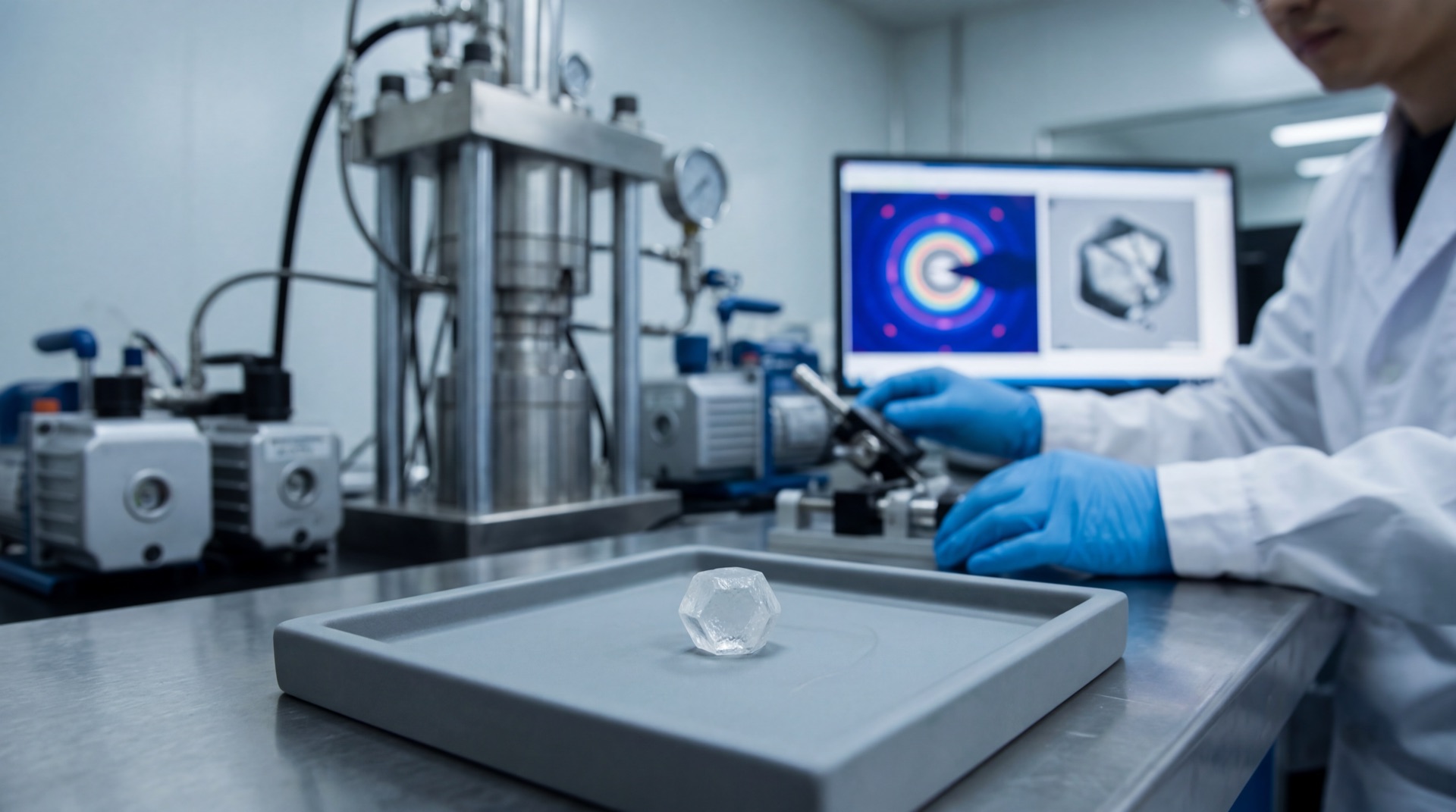
Chinese media coverage, citing the university team, added more process detail. IT Home, relaying information from Zhengzhou University’s School of Physics, said the researchers used 20 GPa of pressure and 1,300°C conditions to produce a millimetre-sized sample. The report also said the work combined synchrotron X-ray diffraction, aberration-corrected transmission electron microscopy, and machine-learning molecular-dynamics simulations to verify the material and map the transformation pathway.
What the paper actually supports
The most defensible version of the story is also the most interesting one.
Nature’s abstract supports three important claims. First, the researchers say they produced bulk, phase-pure hexagonal diamond rather than only nanoscale fragments or mixed-phase material. Second, they say they used structural characterization and theoretical simulation together to confirm the material’s identity and explain the transformation from graphite. Third, they report that the material shows slightly higher hardness than conventional cubic diamond, not merely a speculative theoretical advantage.
That phrasing matters. The paper does not justify turning the story into “China has already commercialized a material that replaces diamond.” What it supports is a more careful but still substantial point: a longstanding debate over whether hexagonal diamond exists as a discrete bulk carbon phase has now been addressed with stronger experimental evidence. Nature’s own abstract says the findings “resolve the long-standing controversy on the existence of HD as a discrete carbon phase” and open a path for future research and practical use.
Why the controversy mattered in the first place
Hexagonal diamond has fascinated researchers for decades because it has been associated with meteorite impacts and long predicted to have exceptional mechanical properties. But fascination is not the same as clean evidence.
For years, the problem was that natural samples were tiny, difficult to isolate, and often tied to extreme impact conditions that are hard to reproduce in a controlled way. That made it difficult to pin down the material’s intrinsic properties with confidence. In other words, the scientific bottleneck was not only whether hexagonal diamond might exist, but whether researchers could produce enough of it, cleanly enough, to characterize it properly.
This is why the new paper lands differently from a simple materials-performance headline. Even if “harder than diamond” is the line most readers will remember, the deeper advance is the combination of sample size, phase purity, and structural verification.
Where practical relevance could emerge
This is the part of the story where writers can easily overstate things.
The public-facing Chinese coverage points to potential use cases in superhard materials, heat management, extreme-environment optical components, and even future semiconductor-related applications. Those are plausible directions. Cubic diamond is already valued for its hardness, thermal conductivity, and wide bandgap, so a hexagonal form with even slightly better hardness and strong thermal stability naturally invites interest from advanced manufacturing and electronics researchers.
But possible downstream relevance is not the same as a production roadmap. Nothing in the currently available public sources shows that bulk hexagonal diamond is ready for low-cost scale-up, near-term mass manufacturing, or immediate substitution into commercial electronics. The right framing for now is that the paper could matter for industrial materials research and advanced electronics over time, especially if the synthesis route proves reproducible and scalable.
Why this travels beyond the lab
For an English-language technology audience, the bigger significance is that this is a deep-tech materials story with strong source support.
It has a top-tier journal, a clearly Chinese research team at the center, a familiar performance hook, and a real scientific dispute underneath the headline. It also broadens the way China’s tech narrative is usually framed. Much of the international conversation about Chinese innovation is dominated by AI models, EV pricing, cloud competition, or consumer hardware. This paper is a reminder that some of the more consequential stories may still come from materials science and enabling technologies that sit further upstream.
On 1M Reviews, that upstream angle also connects naturally to recent coverage of Pointer-CAD Shows China’s AI Race Moving Into 3D Design, Jiangsu’s AI Push Shows How China Wants Policy to Reach the Factory Floor, and BYD Launches Blade Battery 2.0 With 1,500kW Flash Charging. Each of those stories tracks a different part of the route from upstream technical capability to downstream industrial performance, which is exactly why this materials breakthrough is worth watching.
That does not make the result a guaranteed industrial turning point. It does make it a research milestone worth watching.
Bottom line
The Zhengzhou University-led team’s Nature paper is best read not as proof that a new miracle material is ready for the market, but as a much stronger case that bulk hexagonal diamond is real, characterizable, and mechanically impressive.
If the results hold up and the synthesis route keeps improving, the implications could eventually extend well beyond academic curiosity. For now, the key takeaway is already substantial: China’s researchers say they have turned one of materials science’s most debated carbon phases into a bulk sample with performance that appears to edge past conventional diamond.