Dek: A Nature Communications paper from Alibaba’s DAMO Academy and Chinese hospital partners says the MAOSS model lifted high-risk steatotic liver disease detection from 16.6% to 52.4% by combining routine non-contrast CT with common clinical data — but the system is positioned as opportunistic screening and risk stratification, not a standalone diagnosis.
Alibaba’s DAMO Academy has unveiled one of the more concrete medical-AI stories to come out of China this year: a liver-screening model that tries to turn scans patients are already getting for other reasons into an earlier warning system for serious disease progression.
According to March 9 reports relaying a newly published Nature Communications paper, DAMO Academy worked with hospital partners including Shengjing Hospital of China Medical University and Nanjing Drum Tower Hospital on a model called MAOSS. The system combines routine non-contrast CT, serum markers, and other common clinical data to assess liver fat and fibrosis risk in patients with steatotic liver disease, still often referred to in media coverage as fatty-liver disease.
The headline number is what makes the story travel: in retrospective validation, the model raised high-risk patient detection from 16.6% to 52.4%. That is a sharp jump for a disease area where many patients are missed until fibrosis or cirrhosis has progressed further.
But the most important editorial boundary is just as clear. This is not a story about AI replacing radiologists or issuing final diagnoses on its own. It is a story about opportunistic screening and clinical decision support — using already available scans and routine data to flag people who may need closer follow-up.
What MAOSS actually does
The paper’s full title is “Multi-modal AI for opportunistic screening, staging and progression risk stratification of steatotic liver disease.” That framing matters, because it describes the system more precisely than some splashier headlines might.
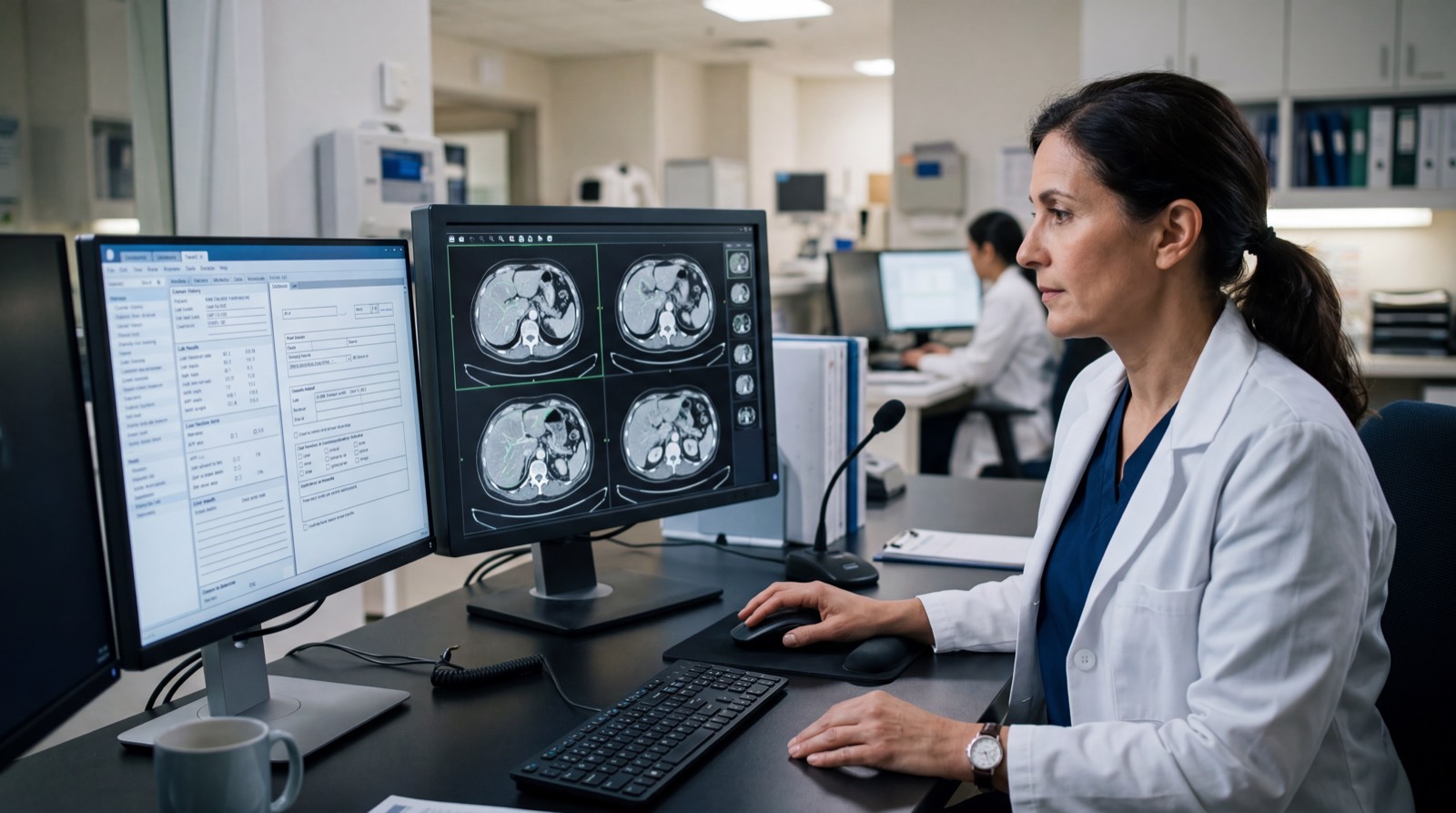
MAOSS stands for Multi-modal AI for Opportunistic hepatic Steatosis Screening. In practical terms, the model is designed to work from non-contrast CT (NCCT) images plus structured clinical inputs such as blood-test indicators and other routine data. Instead of focusing only on whether liver fat is present, it also aims to estimate fibrosis progression risk.
That dual role is why the story is more interesting than a basic image-classification demo. A great deal of liver disease is not caught early enough because specialized tests are costly, unevenly available, or simply not ordered until a clinician already suspects deeper problems. If a model can reliably extract additional risk signals from routine scans that are already in the system, the workflow value could be meaningful.
This is also why the paper repeatedly uses the phrase opportunistic screening. The goal is not to create another premium test that only some patients receive. The goal is to reuse existing imaging opportunities to catch more people who may otherwise stay invisible.
Why the routine-CT angle matters
The paper notes that steatotic liver disease is already highly prevalent globally, and that current screening options all have tradeoffs. Liver biopsy remains the gold standard for some assessments, but it is invasive and impractical for large-scale screening. MRI-based methods can be accurate, but they are also expensive and less accessible. Ultrasound and serum-based pathways are useful but can miss early or higher-risk cases.
Routine non-contrast CT sits in a very different place. It is already widely performed in physical exams, outpatient work, emergency settings, and broader hospital workflows. Historically, however, standard CT has not been used as a strong early detector for steatosis and fibrosis risk. DAMO’s argument is that AI can change that by extracting high-dimensional texture, density, and morphological features that are difficult to read consistently in ordinary practice.
That is the most important real-world hook for international readers. The value proposition here is not “China built another medical model.” It is “China is trying to turn ordinary scans into a better early-warning surface for chronic liver disease.”
The results that matter most
The reported metrics are strong enough to deserve attention, but they need to stay tied to their specific contexts.
First, in external multi-center validation, MAOSS reached an AUC of 0.904 to 0.917 for liver-fat staging. For non-specialist readers, AUC is a common accuracy metric: higher is better, and numbers above 0.9 are generally considered strong in diagnostic-model discussions. The reports compared that with an AUC of 0.709 for radiologists on the same task.
Second, when radiologists used the model as assistance rather than being replaced by it, the reported AUC rose to 0.798. That single comparison is one of the most important facts in the whole story. It suggests the most credible workflow is AI plus clinician, not AI instead of clinician.
Third, the fibrosis-risk signal may be even more important than the steatosis classifier itself. In a retrospective validation involving 1,192 patients with fatty-liver disease, MAOSS identified 52.4% of high-risk patients, while the traditional clinical pathway identified only 16.6%. Reports also said the screening pathway built around MAOSS maintained a negative predictive value of 92.6%, helping preserve a low missed-diagnosis rate.
Fourth, the follow-up data gave the risk score real clinical weight. Patients flagged as high-risk by MAOSS had a 45.5% cirrhosis rate within two years, versus 11.8% for the low-risk group. That does not mean the model predicts every individual outcome with certainty. It does mean the model’s risk stratification appears to map onto materially different progression profiles.
Taken together, those numbers make the study more than an incremental “AI reads scans” story. They suggest MAOSS may be useful precisely because it sits between simple detection and downstream care escalation.
Why this is not an “AI doctor” story
This is the point that needs the most discipline in downstream coverage.
Nothing in the paper summary or the March 9 source chain supports writing this as proof that AI can now replace radiologists, hepatologists, or standard diagnostic pathways. The model is presented as a screening, staging, and risk-stratification tool. Those are important clinical roles, but they are not the same as a final diagnosis.
Even the strongest comparison in the reporting points in the same direction. The physician benchmark improved with AI assistance. That is a clinical-support story.
It is also important not to overstate the deployment status. The available materials support saying the model was developed with major Chinese hospital collaborators, published in Nature Communications, and validated across multiple datasets and settings. They do not support saying MAOSS is already in universal hospital deployment, that it has become a national standard of care, or that it has regulatory approval everywhere relevant.
The defensible framing is narrower and stronger: this is a clinically serious validation signal for China medical AI, centered on earlier risk detection from routine data.
Why this matters for China’s medical-AI story
China has generated no shortage of AI headlines, but many of them still fall into one of two buckets: model competition or consumer-facing feature updates. MAOSS feels different because it sits closer to a real clinical workflow problem.
That is why the DAMO angle matters. Alibaba’s research arm has spent years trying to turn large-scale computing and imaging expertise into healthcare tools. What gives this case extra weight is the combination of hospital collaboration, published validation, and a workflow proposition that does not depend on a futuristic hospital rebuild. The model’s pitch is grounded: use scans and data hospitals already have, and use them earlier and more intelligently.
In that sense, the story fits a broader pattern already visible across China’s AI landscape. We have recently seen AI framed less as a demo category and more as operational infrastructure in pieces such as China’s AI+Manufacturing Push Targets 1,000 Industrial Agents by 2027, Pointer-CAD Shows China AI Entering 3D Design, and Shenzhen’s Futian District Puts “Government Lobster” AI Agents Into Live Public-Service Workflows.
MAOSS extends that pattern into healthcare. Not by claiming autonomous medicine, but by showing how AI may squeeze more usable signal out of existing systems.
Bottom line
Alibaba DAMO’s MAOSS is worth watching because it targets a part of medical AI that actually matters: finding higher-risk patients earlier without requiring a brand-new diagnostic habit from every hospital.
The model’s reported results are strong, the hospital backing is credible, and the Nature Communications publication gives the work more weight than a routine corporate press push. But the real strength of the story lies in staying precise.
MAOSS should be read as a routine-CT screening and risk-stratification tool, not as an AI doctor, not as a final diagnosis engine, and not as proof that broad clinical rollout has already happened. If that boundary is kept intact, this becomes one of the clearest recent signals that China medical AI is moving from flashy possibility toward workflow-level usefulness.
Sources
- Nature Communications: Multi-modal AI for opportunistic screening, staging and progression risk stratification of steatotic liver disease — https://www.nature.com/articles/s41467-026-68414-3 — DOI: 10.1038/s41467-026-68414-3
- Sina Tech relay: https://finance.sina.com.cn/tech/shenji/2026-03-09/doc-inhqizzu7113326.shtml
- IT Home relay: https://www.ithome.com/0/927/187.htm