Dek: Qijing, a new premium vehicle brand backed by GAC and Huawei, says its first model will be called the GT7 and will debut on March 17. The bigger signal is that Huawei is packaging cockpit software, smart-driving hardware, lidar, and chassis control as the operating layer of a new high-end car brand rather than just selling a single point solution.
China’s premium car market does not lack flashy launch teasers. What makes the latest update from Qijing, a new brand backed by Guangzhou Automobile Group (GAC) and Huawei, more interesting is not simply that another model has been named. It is that Huawei’s role is being framed as much deeper than a supplier of one driver-assist module or one infotainment screen.
According to PChome and Bitauto on March 9, Qijing said its first model will be called the GT7 and will make its global debut on March 17. Local media reports also said the vehicle is expected to move toward a June launch and delivery window, while highlighting a hardware stack that includes 896-line lidar, a HarmonySpace cockpit, Huawei’s XMC digital chassis technology, and what the reports described as an L3-capable hardware architecture.
That last phrase is the editorial boundary readers should keep in mind. The current story is not that large-scale consumer Level 3 autonomous driving has already arrived in China. The stronger reading is narrower: Huawei appears to be using Qijing as a new showcase for how far its automotive stack now reaches across the premium-car experience.
What local media actually reported
The factual core of the story is straightforward.
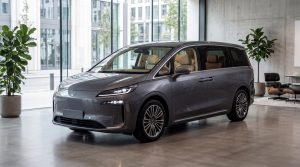
PChome said Qijing officially named its new shooting-brake-style model the GT7 on March 9 and set March 17 for the vehicle’s first public reveal. The same report said the car is expected to be listed and delivered in June, though pricing and the full spec sheet have not yet been disclosed.
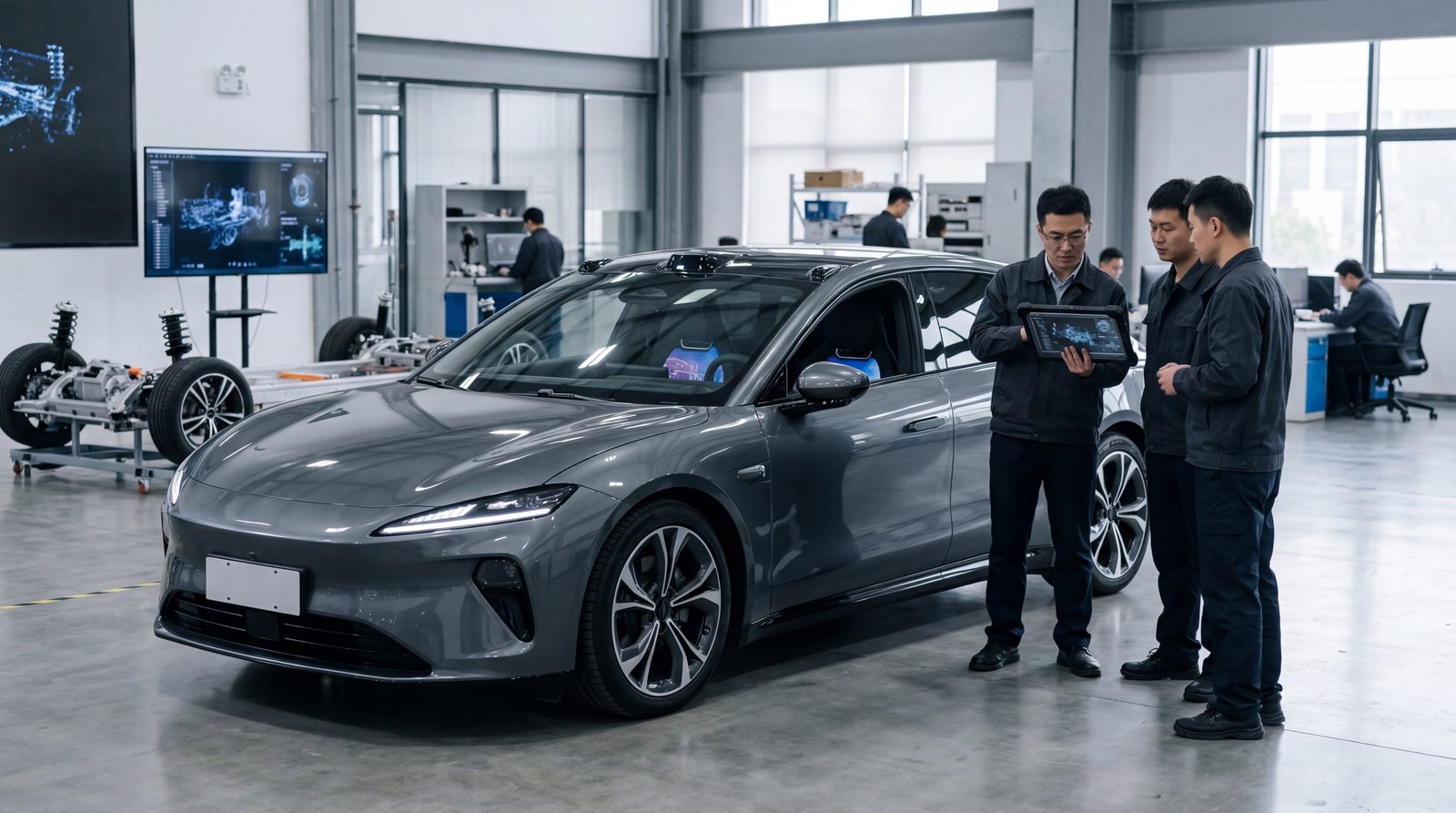
Bitauto relayed the same naming and debut timeline while adding several product details that help explain the model’s positioning. The outlet said the GT7 will carry 896-line lidar on the roof, use Huawei’s latest HarmonySpace cockpit system, and adopt Huawei’s latest Qiankun driver-assistance technology, with hardware that supports an L3-capable architecture.
PChome added that the vehicle will also use Huawei’s XMC digital chassis and support five-dimensional motion vector control through coordination among the vehicle’s three-motor system, suspension, and steering. That gives the car a performance-oriented frame as well as a smart-driving one, although key powertrain details still remain limited in the current public reporting.
Taken together, the current source chain supports a clear launch brief: Qijing has named its first model, fixed a March 17 debut date, and started marketing the GT7 around a premium smart-car stack rather than around price, range, or horsepower alone.
Why this matters beyond one more China car launch
If the GT7 were only another premium model with a new lidar headline, the story would be easy to dismiss as a routine product teaser. The bigger signal is how Huawei’s role is being described.
In many EV stories, technology suppliers remain mostly invisible behind a brand badge. Here, the media narrative is almost the opposite. The selling points being pushed into the headline are not only body style or luxury trim, but Huawei-linked smart driving, cockpit software, chassis control, and high-spec sensing hardware.
That makes Qijing look less like a conventional automaker-buys-components story and more like a case in which Huawei is becoming the operating layer of a premium vehicle brand. In other words, the company is no longer being presented merely as a vendor of ADAS functions. It is increasingly being framed as the provider of the software-and-hardware stack that shapes how the car thinks, feels, and interacts with the driver.
That shift matters for international readers because it says something larger about China’s premium vehicle competition. The race is moving beyond battery size, screen count, or raw acceleration. The new battleground is the full system experience: cockpit software, assisted-driving capability, lidar, chassis tuning, and the ability to bundle them into a coherent premium product. That same shift is visible in BYD Says Flash Charging and Battery Swaps Can Coexist in China’s EV Refueling Race, where China’s EV competition also moved toward infrastructure and user-experience systems rather than a single headline spec.
Qijing gives Huawei another chance to prove that this bundled approach can support not just an established automaker model line, but the launch identity of a fresh high-end brand. A related platform-scale logic also shows up in WeRide and Geely’s Farizon Plan 2,000 Robotaxi GXRs by 2026, where product strategy matters more than one isolated feature headline.
Huawei is trying to sell a full-stack car story
The GT7 story fits a pattern that has become increasingly visible across China’s smart-car market.
Chinese automakers and their technology partners are no longer just talking about isolated features. They are trying to package a whole user narrative: a cabin that feels like a software platform, a driver-assistance stack that signals future upgrade room, and a chassis system that promises more controlled handling in difficult conditions.
That is why the product language around the GT7 is so stacked with system-level claims. The car is not only being described as a stylish shooting brake. It is also being pitched through HarmonySpace, Qiankun, XMC, and 896-line lidar. Each one points to a different layer of the experience, but together they build the case that Huawei wants to own more of the product logic inside premium Chinese vehicles.
For GAC, that positioning could help Qijing stand out in an increasingly crowded field of upscale local brands. For Huawei, it is another opportunity to show that its automotive ambitions extend beyond supplying a useful module to other companies. The company appears to be pushing toward a model in which its technology stack becomes a major reason the vehicle exists in its current form. The wider GAC backdrop also connects with GAC GOVY Flying Car Enters Trial Production in Guangzhou, another sign that the group wants future-facing mobility programs to reinforce its premium-tech narrative.
That does not make Qijing a “Huawei car” in any simplistic sense. GAC remains central to manufacturing, brand execution, and vehicle program delivery. But the public-facing message increasingly suggests a deeper kind of partnership: Huawei as the digital-and-control architecture layer inside a premium mobility product.
The L3 wording needs real caution
This is also where the story can get overstated very quickly.
The current reporting supports saying that local media described the GT7 as using hardware that supports an L3-capable architecture. It does not support saying that Qijing has already delivered large-scale commercial Level 3 autonomy to consumers, or that the regulatory, liability, and real-world deployment questions around Level 3 are already settled.
That distinction matters because the auto industry often uses future-facing architecture language to signal capability before commercial reality fully catches up. A car can be marketed as being built on hardware ready for more advanced functions without those functions being broadly activated, legally approved, or operational in routine public-road use.
The same caution applies to several other details in the current source chain. The June timing, the final powertrain package, the complete pricing structure, and the full trim breakdown are not fully established in the current materials available here. Those elements should stay attributed to the company and local media reports, not rewritten as fully locked commercial outcomes.
In other words, the GT7 is already a meaningful product signal. It is just too early to treat it as proof that every promised capability has arrived in finished market form.
Why global readers should care
For international readers, the most interesting part of the GT7 announcement is not the name itself. It is what the launch suggests about the next stage of Chinese premium-car competition.
Over the past few years, Huawei has become one of the most closely watched players in China’s smart-vehicle ecosystem because it sits at the intersection of consumer electronics, operating systems, connectivity, and assisted driving. The Qijing GT7 adds to that story by showing how Huawei-linked technology is being used to define a brand from day one.
That is a stronger signal than a simple parts-supply deal. It suggests China’s premium car market is increasingly organized around who controls the software stack and the vehicle brain, not only who assembles the shell.
If Qijing can turn the GT7 from teaser-stage branding into a product that actually delivers on its cockpit, sensing, chassis, and assisted-driving promises, Huawei’s automotive role will look even less like a side business and more like a foundational layer in China’s premium mobility market.
Bottom line
Qijing has not yet revealed the full GT7 story, and the current public record still leaves key commercial details open. But the March 9 update is still important.
It gives Huawei and GAC a fresh premium-vehicle headline tied to a concrete March 17 debut date, a reported June market window, and a stack of attention-grabbing product claims centered on 896-line lidar, HarmonySpace, XMC, and L3-capable hardware.
The cleanest takeaway is not that consumer Level 3 driving has already arrived. It is that Huawei is increasingly trying to position itself as the software, sensing, and control layer of a new premium car brand — and Qijing’s GT7 may be one of the clearest recent examples of that strategy moving into public view.