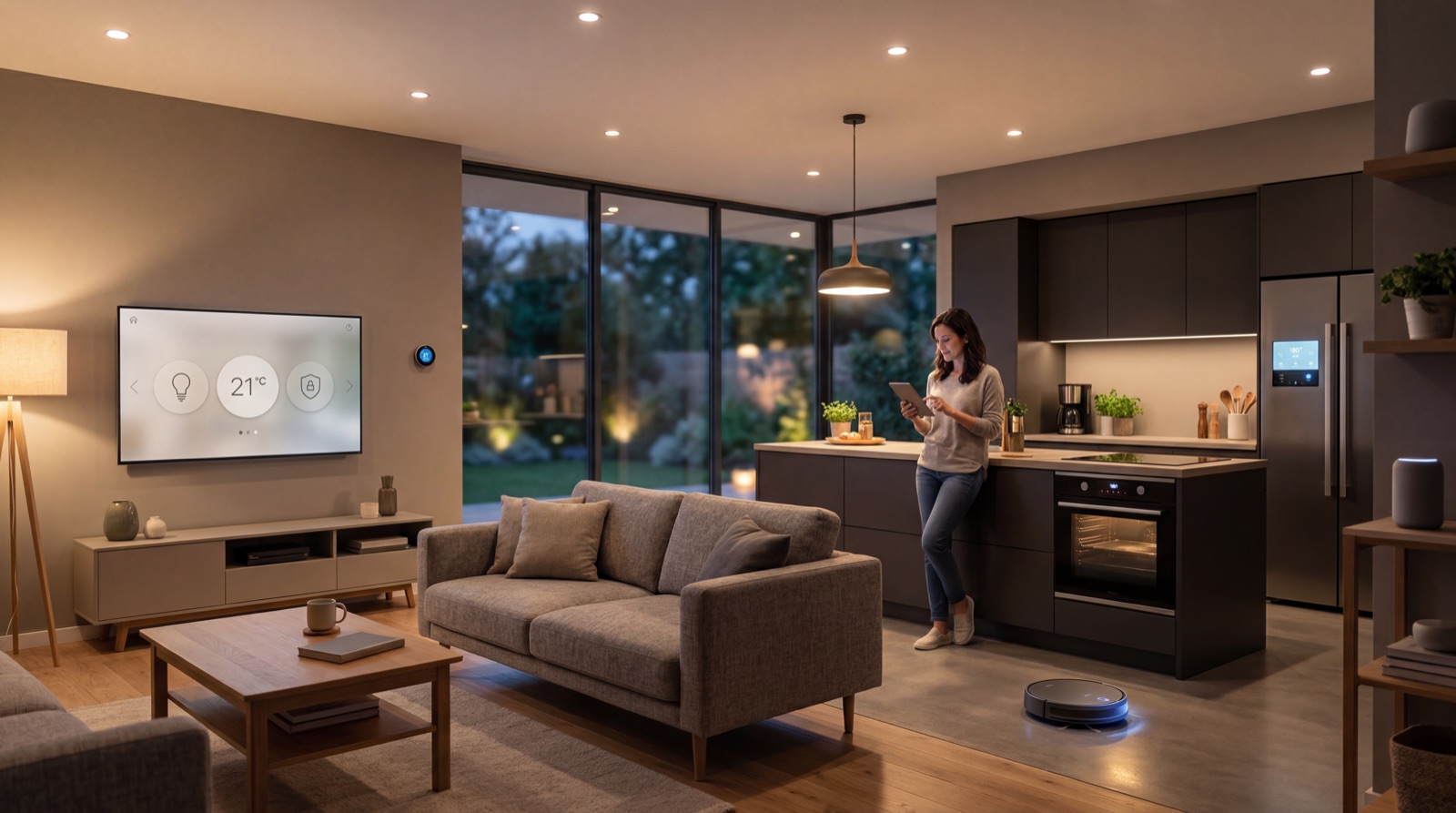
Midea introduced its “Three-in-One” whole-home intelligence strategy, the MevoX self-evolving home agent, and new whole-home suites and scenario solutions at its March 10 event.
Midea, one of China’s largest home-appliance groups, used its March 10 “Zhimei Wanxiang” whole-home intelligence event to outline a new smart-home direction. According to China Securities Journal (CS.com.cn) and Eastmoney, the company announced a “Three-in-One” whole-home intelligence strategy, a MevoX self-evolving home agent, and a lineup of whole-home intelligent suites and scenario solutions.
What Midea actually announced
The verified details from the cited reports are clear on the headline items but light on product specifics:
- Event and timing: Midea staged its 2026 whole-home intelligence strategy launch on March 10.
- Strategic framework: The company introduced a “Three-in-One” strategy for whole-home intelligence.
- Product layer: Midea presented whole-home intelligent suites and scenario solutions designed to bundle devices into coordinated home experiences.
- Agent layer: The company unveiled MevoX, described as a self-evolving home agent meant to serve as the home AI brain.
What remains missing in the coverage are detailed breakdowns of what the “three” elements are, how the bundles are structured, or how the agent will be packaged and sold.
MevoX is framed as the home AI brain
In the media coverage, Midea describes MevoX as a home AI brain with advanced reasoning and persistent memory capabilities. That framing is significant because it pushes the story beyond device control and into agent-led orchestration. It suggests the company wants an AI layer that can understand intent and coordinate multiple devices and scenarios rather than simply respond to one-off commands — a theme we’ve been tracking as enterprise AI stacks mature (Huawei Launches AI Data Platform to Push Enterprise AI Beyond Model Hype).
At the same time, the “self-evolving” language is a marketing claim, and there is no independent verification of how those capabilities are implemented. The sources do not provide model details, system architecture, or benchmarks.
Why this matters for the smart-home race
Midea is not a niche gadget brand. It sits at the center of China’s mainstream appliance market, which means an agent-led smart-home stack from Midea could shape how mass-market consumers experience home AI. That matters in a year when China is explicitly pushing AI into everyday devices and consumer hardware (China Maps 2026 AI Push for Phones, PCs, Robots).
If the company can turn MevoX into a reliable orchestration layer, the competitive focus shifts from individual devices to full-home ecosystems. That is a meaningful evolution: smart homes become less about whether a single device is connected, and more about whether the system can understand household intent and automate multi-device outcomes.
What is still unclear
- No official press release or technical documentation was found in the cited reports.
- Pricing, availability, and rollout timelines were not disclosed.
- Developer access or openness was not detailed, so it is unclear whether third-party devices or services can integrate with MevoX.
These unknowns determine whether the announcement becomes a near-term product shift or a longer-term positioning statement.
What to watch next
- Productization details: Whether Midea releases specific device lists, SKUs, or release windows tied to MevoX and the suites.
- Integration depth: Whether the agent can orchestrate across a wide range of appliances and services rather than a narrow set of flagship devices.
- Trust and privacy posture: Whether Midea publishes clear consent and data-handling rules for a home AI brain with persistent memory.
If those elements materialize, Midea’s move could mark a shift from connected-device catalogs to agent-led, intent-driven home automation at scale — echoing broader signals about China’s push to translate AI policy into real-world industry outcomes (Jiangsu’s AI Push Shows How China Wants Policy to Reach the Factory Floor).