Dek: State‑owned CNBM says its SYT80 (T1200‑grade) ultra‑high‑strength carbon fiber has reached industrial‑scale production, a claim with implications for aerospace and robotics supply chains.
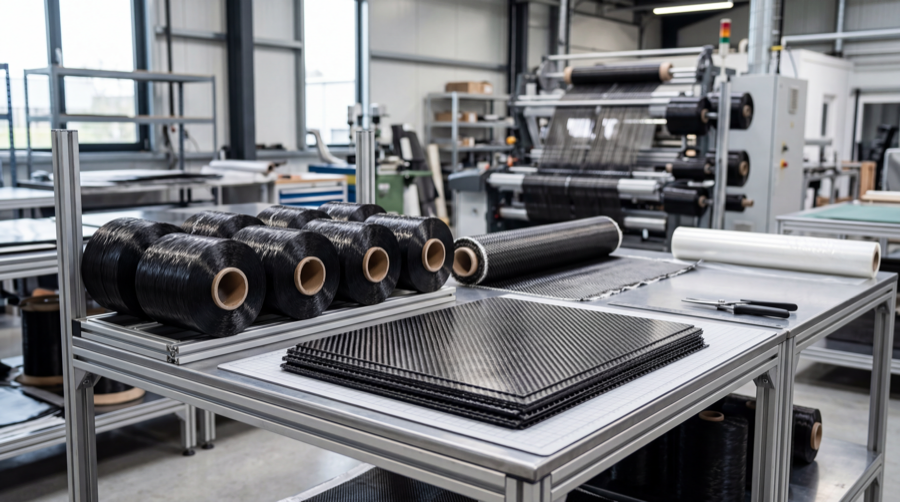
China National Building Material Group (CNBM) announced on March 11 in Beijing that it has developed SYT80, an ultra‑high‑strength T1200‑grade carbon fiber, according to Xinhua and China Daily. CNBM says the product has entered mass production, calling it the world’s first mass‑produced T1200‑class carbon fiber at this strength level.
What CNBM announced
Based on the reporting, the confirmed elements include:
- Product: CNBM introduced SYT80, a T1200‑grade ultra‑high‑strength carbon fiber.
- Mass‑production claim: CNBM says it is the first to achieve mass production of T1200‑class fiber at this strength level. (Xinhua; China Daily)
- Material properties: The fiber’s diameter is less than one‑tenth of a human hair, with tensile strength about 10× conventional steel and density about one‑quarter of steel. (Xinhua; China Daily)
- Use cases: CNBM positions the material for aerospace, the low‑altitude economy (drones/eVTOL‑related sectors), and humanoid robotics, among other industries.
- Scale note: China Daily reported that the fiber has already reached industrial‑scale production, with annual capacity measured in hundreds of tons.
Why this matters for robotics and AI hardware
Ultra‑high‑strength, lightweight materials are foundational to next‑generation robotics and aerospace (see China Maps 2026 AI Push for Phones, PCs, Robots). Reducing weight while preserving structural strength can improve payload, endurance, and safety for drones, eVTOLs, and humanoid robots. If SYT80’s mass‑production claim holds up, it could ease supply constraints and lower costs for high‑performance composite components across these sectors.
It also signals a broader push toward domestic supply chains for advanced materials—an important factor for China’s AI‑hardware ecosystem, where materials often become a hidden bottleneck for scaling production (see Huawei Launches AI Data Platform to Push Enterprise AI Beyond Model Hype).
What’s still unclear
Key questions remain before the industry can judge the real‑world impact:
- Independent verification: The “world’s first mass‑produced T1200‑grade” claim is a company statement without third‑party validation.
- Technical detail: The reports do not disclose full specs such as modulus, yield rate, cost, or performance under specific conditions.
- Commercial adoption: End‑customer contracts and deployment timelines are not yet public.
What to watch next
- Customer adoption in aerospace, drones, and robotics supply chains (see Jiangsu’s AI Push Shows How China Wants Policy to Reach the Factory Floor)
- Price and performance disclosure that would clarify competitiveness against imported T1200‑class fiber
- Downstream product launches that explicitly specify SYT80‑based composites
If CNBM can prove stable, high‑yield mass production and attract downstream customers, SYT80 could become a strategic material for China’s advanced‑manufacturing roadmap.