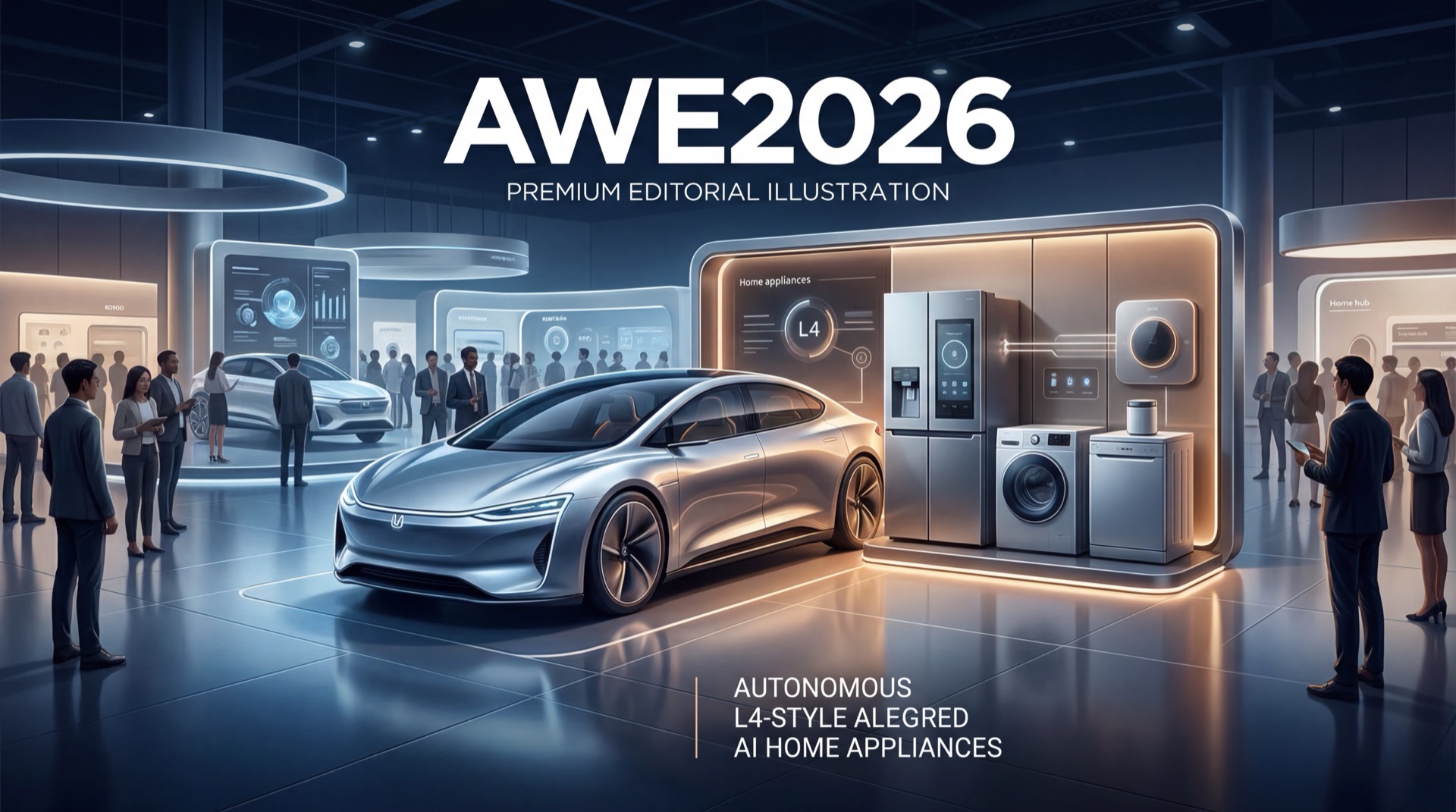
AWE2026, China’s largest home appliance and consumer electronics show, closed on March 15 in Shanghai after four days and 1,200+ exhibitors across roughly 170,000 square meters. The headlines were not just new gadgets but a clear push toward L4-style AI appliance experiences (led by Haier’s AI Eye 2.0 and its Seeker lineup), HarmonyOS smart-home upgrades from Huawei, and even early-stage moves into smart mobility as appliance brands revealed concept vehicles and energy ecosystems—signals that AI at home is now converging with the car and charging infrastructure outside it.
The AWE theme—“AI Technology, Enjoy the Future”—was visible in nearly every booth. But the most concrete shift was the migration from “feature AI” (a smarter washer or a better voice assistant) to system-level intelligence across kitchens, living rooms, and mobility. That’s the through-line of this year’s show: if AI is the new operating system for the home, then the car and the energy stack are its next runtime environments.
AWE2026’s biggest AI home upgrades
Haier’s announcement was the most direct statement about level-up automation. At AWE2026, the company showcased AI Eye 2.0 and said it is now deployed in its Seeker appliance suite, which it positions as “L4-level” smart home experiences. The L4 tag isn’t a literal driving standard here, but it signals a leap from device-level automation to environment-aware orchestration—systems that can perceive, decide, and act with limited user intervention.
Huawei’s booth reinforced that same shift in the software layer. The company highlighted new HarmonyOS smart-home experiences and debuted Xiaoyi Assistant 6.0, pushing voice and multimodal control into a more unified home OS. While the individual devices vary by vendor, the story at AWE is that the control plane is consolidating: a family of devices can now behave as a single, context-aware system rather than a set of apps.
Crucially, these announcements came alongside scale indicators for the industry. AWE’s official data for 2026 lists 1,200+ exhibitors and a 170,000-square-meter exhibition footprint, a strong signal that the ecosystem is large enough to support platform-level shifts rather than one-off product upgrades.
Smart mobility and energy spill over onto the show floor
AWE2026 also showcased a notable “crossing of the aisle” from appliances to mobility. BYD used the show to highlight its flash-charging technology within a broader smart-ecosystem narrative, positioning charging as part of the same consumer tech experience rather than a standalone auto story. Meanwhile, appliance maker Dreame presented its “Stellar Project” concept SUV, and other exhibitors, such as Tantu Tech, demonstrated a new-energy travel trailer concept (NEXUS) with a “light–storage–charge” energy solution and L3-level intelligent trailer parking.
These were not mass-market products—but they were deliberate signals. Appliance brands are testing the edges of mobility, while mobility brands are laying claim to home energy and automation. The show floor made the overlap visible: energy storage, fast-charging, and smart-home automation are now part of the same conversation.
Why appliance makers are eyeing the road
The business context helps explain the push. A recent smart-living white paper that cites AVCS data projects China’s smart home market to surpass RMB 830 billion by 2025. That is a big enough pool to encourage adjacent bets—especially for brands that already own distribution channels, manufacturing capacity, and user relationships in the home. Mobility, particularly smart EVs and related charging ecosystems, is a natural adjacency because it extends the same “AI for daily life” narrative beyond the front door.
There is also a technical logic. The data backbone for a smart home—sensors, cameras, voice interfaces, and context models—is increasingly compatible with the data backbone for a smart vehicle. As automakers add lidar, cameras, and in-cabin assistants, the line between “home AI” and “vehicle AI” grows thinner. AWE2026 showed that vendors are already thinking in that direction, even if commercialization is still early.
What changes next
What changed this year is the framing: AI appliances are no longer just “smarter devices.” They are being pitched as semi-autonomous systems with L4-like experiences, while mobility and energy are treated as part of the same ecosystem. That matters because it reshapes product roadmaps—AI at home becomes a platform strategy, and the car becomes one more node in the network.
What could happen next is a wave of cross-industry partnerships and product experiments: appliance makers forming alliances with automakers for in-car integration, charging and energy storage companies co-branding with smart-home platforms, and more public demos of L4-like automation inside the home. If those pilots prove reliable and cost-effective, AWE2026 may be remembered as the point where AI home, energy, and mobility started to fuse into a single consumer-tech stack.
Related reading
Sources
- https://www.36kr.com/p/3724063199115653
- https://tech.sina.cn/mobile/xp/2026-03-16/detail-inhramvr9438599.d.html?vt=4
- https://finance.sina.cn/stock/auto/2026-03-16/detail-inhrcati9212742.d.html
- https://www.awe.com.cn/contents/30/19798.html
- https://imgcdn.yicai.com/dt/files/2025/03/638784219460690000.pdf