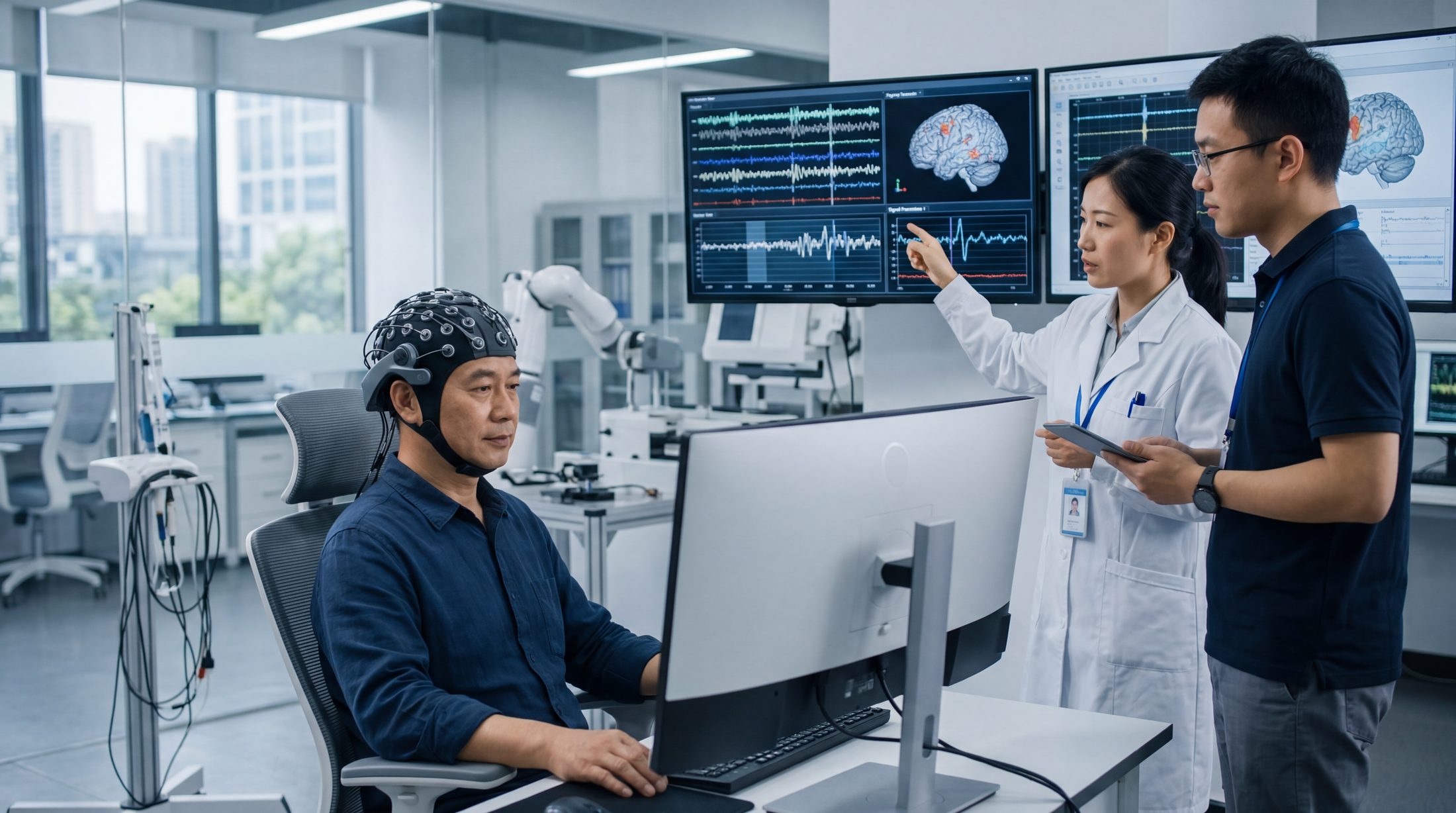
China’s brain-computer-interface story just became easier for global readers to follow. On March 7, Yao Dezhong, director of the Sichuan Institute of Brain Science, said some BCI products in China could gradually move toward practical public-facing use within three to five years. On its own, that remains a forecast rather than a formal national deadline. But paired with the rest of the same-day reporting, it turns a futuristic topic into something more tangible: a state-backed neurotech sector with trials already underway, patients being recruited, and a clearer commercialization narrative than China has offered before.
That is why this matters beyond headline novelty. Brain-computer interfaces are often covered either as science-fiction promise or as a Neuralink comparison exercise. The more useful framing here is that Beijing is trying to move the field into its next strategic-technology tier while Chinese researchers and local media are attaching concrete numbers to the path ahead.
This is no longer just a lab-stage talking point
The strongest element in the March 7 coverage is not the timeline by itself. It is the way that timeline sits inside a broader policy and industry frame.
Reuters reported that China’s new planning cycle has elevated brain-computer interfaces into a future-industry group that also includes quantum technology, embodied AI, 6G, and nuclear fusion. That matters because it places BCI inside Beijing’s next-wave strategic-tech vocabulary rather than leaving it as a niche medical-research topic. It also fits with China’s broader 2026 AI push across phones, PCs, robots, and other strategic hardware priorities.
For international readers, that is the real signal. China is not only saying that BCI is interesting research. It is saying the field belongs in the same national conversation as some of its most ambitious frontier-technology bets. Once that framing is in place, a three-to-five-year public-use estimate starts to read less like an isolated expert comment and more like an early marker for a larger commercialization push.
That does not mean broad mass-market adoption is around the corner. The safer interpretation is narrower: China wants to accelerate the path from laboratory and clinical experimentation toward limited practical services, and officials are comfortable talking about that direction in a much more public way.
Trials, patients, and insurance pilots make the story more concrete
What gives the story weight is that it is not built on policy language alone. The same-day reporting also pointed to evidence that China’s BCI ecosystem is already moving beyond concept-stage discussion.
According to the March 7 source set, China has become the second country to conduct invasive BCI human trials. Reports said the country now has more than 10 active trials and plans to recruit more than 50 patients this year. Those figures should remain clearly attributed to the reporting and not be inflated into proof of broad deployment. Even so, they show the field has advanced past purely theoretical ambition.
Chinese pickups of the Reuters report added another detail that makes the story more commercially meaningful: some BCI-related treatment items have already entered pilot medical-insurance coverage in certain provinces. That point deserves careful handling, because pilot coverage is not the same as nationwide reimbursement or routine clinical adoption. Still, it suggests parts of the healthcare system are beginning to test how BCI therapies might fit into real-world treatment and payment structures.
There is also a market-size argument attached to the story. The March 7 reporting cited an estimate that China’s BCI market could reach roughly RMB 5.58 billion by 2027. Forecasts like that should always be treated as directional rather than definitive. But combined with trial activity and policy support, the number helps explain why BCI is now being framed as an industry story rather than only a scientific one.
The Neuralink comparison is useful, but only up to a point
Any English-language article on this topic will naturally invite a comparison with Neuralink. That comparison is helpful because it gives readers an immediate reference point for why BCI matters. It also highlights that China wants a place in one of the world’s most closely watched neurotechnology races.
But the comparison can also flatten the story if it is used too casually. The March 7 evidence does not support the idea that China is on the verge of launching mainstream consumer BCI products, and it does not justify a claim that the country now leads the field outright. The safer read is that China is building a state-backed BCI ecosystem that blends strategic planning, clinical trials, and early commercialization signals. That broader frontier-tech race also echoes the investor appetite visible in Robot Era’s latest China humanoid-funding round.
In other words, this is not yet a story about a finished mass-market product. It is a story about ecosystem formation. Beijing is giving the field political priority. Researchers are putting tentative timelines around practical use. Trial numbers are growing. Media reports are increasingly connecting BCI to insurance pilots, market estimates, and long-term company-building goals.
That combination is what makes the story stronger than a pure hype cycle. It also makes it more relevant to investors, health-tech watchers, and anyone following the broader shift from generative-AI headlines toward deeper, harder-tech bets.
What readers should watch next
The next phase of the story will not be determined by big rhetoric alone. The key question is whether China can convert this strategic framing into repeatable real-world milestones.
The most important indicators to watch are straightforward: whether patient recruitment scales as planned, whether trial programs translate into clearer clinical outcomes, whether insurance pilots expand beyond small test cases, and whether Chinese BCI companies can turn policy visibility into products and services that feel meaningfully closer to everyday use.
There is also a longer horizon built into the Chinese reporting. Local coverage said China’s national BCI strategy aims for key technological breakthroughs by 2027 and hopes to foster two to three world-class companies by 2030. Those targets are still ambitions, not outcomes. But they show that the current conversation is already moving past isolated experiments and toward industry-building. The same ecosystem-building logic shows up in Huawei’s push to frame enterprise AI around infrastructure, retrieval, memory, and deployment rather than only model hype.
For 1M Reviews readers, that is the most useful takeaway. China’s BCI story is no longer just a future-tech curiosity buried inside a policy document. It is starting to look like a serious neurotech commercialization effort with a timeline, a trial base, and a healthcare-adoption angle that global audiences can track.
Bottom line
China’s latest BCI signal matters because it gives a frontier technology a more credible near-term frame. Yao Dezhong’s three-to-five-year estimate should stay clearly attributed and should not be overstated as a guarantee. But when that forecast is read alongside trial activity, patient-recruitment plans, pilot insurance coverage, and official strategic backing, the bigger picture becomes clearer.
China wants brain-computer interfaces to move from laboratory promise toward practical service. It is still early, and the gap between promising trials and broad public use remains large. Even so, March 7 offered one of the clearest snapshots yet of how that transition is being described — and marketed — inside China’s next wave of frontier-tech competition.