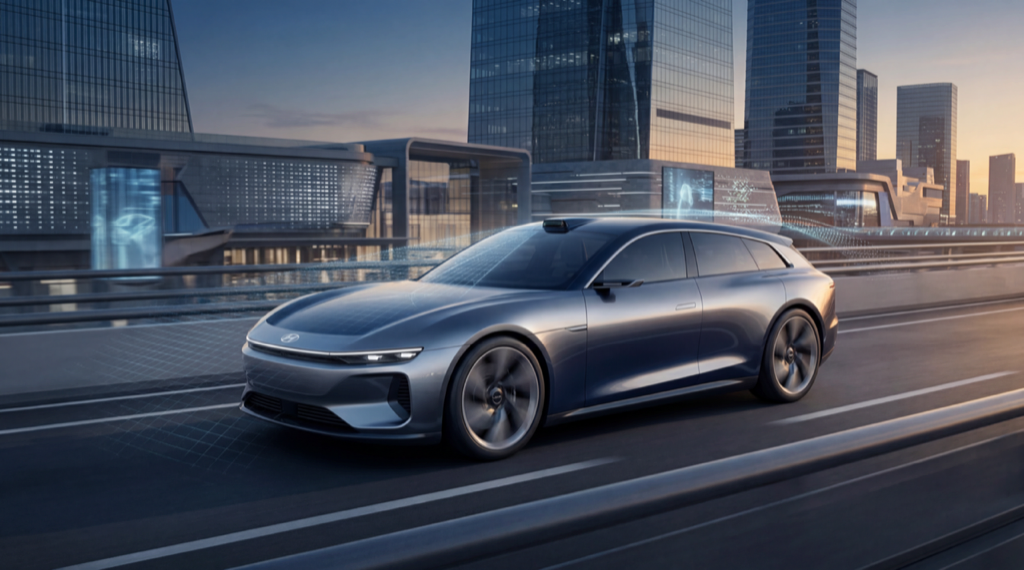
China’s automaker GAC and Huawei’s Qiankun smart‑driving ecosystem have confirmed that their co‑created Qijing brand will debut its first model, the GT7, on a March 17 debut, with local reports pointing to a June market launch and delivery window. The GT7 is positioned as a “new‑generation intelligent shooting‑brake coupe”, and early disclosures from multiple outlets highlight a headline hardware stack: an 896‑line production‑grade LiDAR (echoing the broader LiDAR push seen in models like the Huawei‑linked Aito M9), HarmonySpace in‑car cockpit software, Huawei XMC digital chassis engine, and a hardware architecture designed for L3‑level autonomy. The announcement puts a real name and timetable on Qijing’s first vehicle, turning a long‑running partnership narrative into a product‑level milestone.
The “GT7” name and March 17 global debut date were confirmed by several China auto and tech outlets, establishing the first concrete timeline for the Qijing brand’s rollout. The vehicle is consistently described as a high‑end smart shooting‑brake coupe, signaling a premium positioning rather than an entry‑level EV play. Reports also converge on a June go‑to‑market target, suggesting that the March event is a formal reveal or global debut rather than a distant concept preview. In short, Qijing is moving from brand‑level messaging to a product with a near‑term sales window.
The GT7’s disclosed specifications underline the Huawei Qiankun role in the vehicle’s intelligence layer. Key elements cited across sources include HarmonySpace for the cockpit, the HUAWEI XMC digital chassis engine, and an 896‑line production LiDAR—a high‑resolution sensor count that signals an emphasis on perception fidelity. The model is also described as having a hardware architecture capable of L3 autonomy, implying the vehicle’s sensor and compute stack are designed for higher‑level automated driving once regulations, validation, and software readiness allow. These features reinforce Huawei’s ambition to provide not just components but a full‑stack intelligent‑driving and digital‑chassis platform that can anchor a brand’s positioning.
March 17 now functions as the first major checkpoint for the Qijing–Huawei partnership. It is the date attached to the official global debut of the GT7, meaning the brand will need to show production‑intent design, a clear product definition, and a narrative that differentiates it in China’s crowded premium NEV segment. The event also comes with concrete technology talking points—896‑line LiDAR, HarmonySpace, XMC, and L3‑ready hardware—which collectively aim to frame Qijing as a technology‑forward premium marque rather than a conventional automaker sub‑brand. The expectation of June availability makes the launch window tight and suggests pre‑launch execution is already underway.
Several outlets mention June as the expected time for the GT7 to reach market or begin deliveries. That is a short runway from a March debut, which increases the stakes on manufacturing readiness, supply‑chain stability, and software validation. High‑spec hardware—especially a production‑grade 896‑line LiDAR—adds complexity in sourcing and integration, while the HarmonySpace and XMC layers imply substantial software integration work. If the June target holds, Qijing will need to demonstrate that its vehicle‑software stack is stable and that feature promises are not postponed into later OTA updates.
Choosing a shooting‑brake coupe body style for a first model is a deliberate brand signal. It targets buyers who want a mix of practicality and performance aesthetics, and it places Qijing closer to premium design language rather than mainstream sedans or compact SUVs. Pairing that form factor with a high‑spec sensor suite and a L3‑capable hardware architecture reinforces a premium‑tech narrative: the GT7 is meant to be seen as a showcase of what a GAC–Huawei co‑creation can achieve at the top end.
Huawei’s automotive approach has increasingly emphasized ecosystem depth—not just smart‑driving algorithms, but a suite of cockpit, chassis, and system‑level intelligence. The GT7’s configuration aligns with that strategy: HarmonySpace for the cabin, XMC for chassis control, and high‑resolution LiDAR for perception. In branding terms, a co‑created brand with a named flagship vehicle gives Huawei Qiankun an anchor product, helping it showcase real‑world implementations of its technology stack. For the broader ecosystem, a successful launch would validate the “ICT + automaker” model and likely encourage similar partnerships.
The premium EV space in China has become increasingly competitive, with consumers expecting advanced ADAS capabilities, high‑end cabins, and distinctive design. A first model like the GT7 must therefore differentiate through both technology intensity and brand story. The emphasis on 896‑line LiDAR and L3‑ready hardware is a clear attempt to stand out in a field where incremental gains in perception and computing can influence buyer perception. Meanwhile, the June launch expectation indicates that Qijing plans to compete not as a long‑term concept but as a product ready for near‑term delivery.
The March 17 debut will be the key moment to confirm product details, finalize specifications, and clarify the scope of L3‑capable hardware in real‑world operation. Equally important is whether the June launch timeline holds and how the vehicle’s smart‑driving capabilities are positioned in compliance with China’s evolving regulatory environment. If Qijing can deliver on the stated hardware stack and meet the near‑term launch window, the GT7 could become a pivotal example of the GAC–Huawei co‑creation model. If timelines slip, it will test whether the brand can sustain premium‑tech momentum while waiting for production and software maturity.
Sources
- Autohome report on GT7 naming, March 17 debut, and 896‑line LiDAR: https://www.autohome.com.cn/news/202603/1312790.html
- IT Home coverage on Qijing GT7 and Huawei Qiankun stack: https://www.ithome.com/0/927/105.htm
- CnEVPost report on GT7 naming, March 17 debut, and June timeline: https://cnevpost.com/2026/03/09/qijing-names-1st-ev-gt7-ahead-mar-17-debut/
- Sina Finance coverage on the GT7 naming and debut date: https://finance.sina.com.cn/stock/t/2026-03-10/doc-inhqnmhs6401832.shtml
- Huacheng (Guangzhou Daily) coverage on GT7 naming and June schedule: https://huacheng.gz-cmc.com/pages/2026/03/09/c60111e8438541c2a813b94086dcccd0.html