Dek: Fresh March 7 coverage around a Qwen-based CAD framework suggests China’s AI ecosystem is pushing beyond chatbots and into engineering workflows.
China’s AI story has lately been dominated by foundation models, policy slogans, and the race to build ever more capable assistants. Pointer-CAD offers a more grounded angle. Fresh March 7 coverage from South China Morning Post and Tech in Asia highlighted a CAD-generation framework that media reports linked to researchers associated with DeepSeek, Tencent, and the University of Hong Kong, while also saying the system is built on Alibaba’s Qwen 2.5 model.
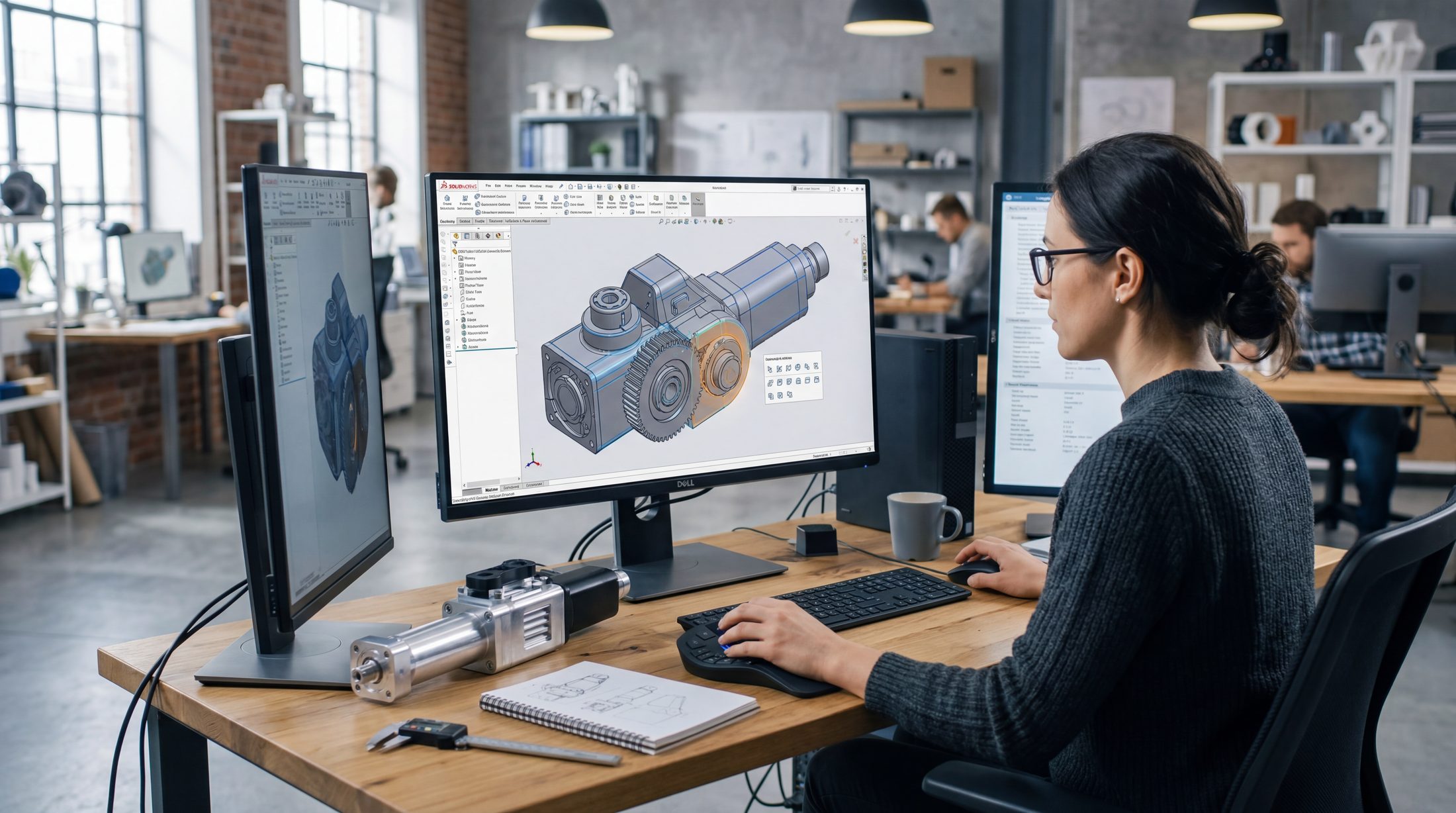
That mix alone makes the project interesting. But the bigger reason this story matters is where the technology is aimed. Pointer-CAD is not framed as another chatbot or coding copilot. It is aimed at computer-aided design, a workflow where geometry, precision, and editability matter far more than clever conversation. For an English-language tech audience, that makes it a useful signal that China’s AI push is stretching deeper into industrial software.
CAD is a harder, more meaningful AI test than another demo
Computer-aided design sits much closer to manufacturing reality than many AI headlines do. CAD files shape how engineers describe parts, assemblies, and manufacturable objects. If a model can help with that process in a credible way, it points to AI becoming useful inside product development and industrial design instead of staying in the realm of text generation.
That is what gives Pointer-CAD a stronger hook than a generic policy story. The project is meant to deal with a real weakness in LLM-style CAD generation: many command-sequence approaches can generate steps, but they struggle when a workflow requires selecting precise geometric entities such as edges or faces. In practice, that matters for common operations such as chamfering or filleting, where accuracy is not a cosmetic detail but part of whether a design can be edited and understood properly.
This is why the industrial-software angle matters. A CAD-oriented system does not need to beat consumer chatbots at personality. It needs to show it can handle geometry, structure, and engineering logic with fewer errors. That is a much more demanding test of whether AI can move from impressive output to genuinely useful tooling.
What Pointer-CAD actually claims
The public technical materials give the story more substance than a single media splash. The GitHub repository for Pointer-CAD describes itself as the official repository for the CVPR 2026 paper “Pointer-CAD: Unifying B-Rep and Command Sequences via Pointer-based Edges & Faces Selection.” The arXiv paper says the framework is designed to improve LLM-based CAD generation by combining command sequences with boundary-representation, or B-rep, geometry.
In simpler terms, the authors are trying to make CAD generation less brittle by giving the model a better way to reference and select actual geometric elements during multi-step design tasks. According to the abstract, the framework decomposes CAD generation into steps and conditions each next step on both the text description and the B-rep produced so far. When an operation needs a specific edge or face, the model predicts a pointer that selects the most relevant candidate.
That may sound technical, but the practical point is easy to understand: CAD workflows break down when the system cannot reliably refer to the right geometric feature at the right moment. Pointer-CAD is presented as a way to reduce that weakness.
The paper also says the team built a data-annotation pipeline that produced expert-level natural-language descriptions and used it to assemble a dataset of roughly 575,000 CAD models. The authors further say the approach improves performance on complex geometric structures while reducing segmentation and topology errors compared with earlier command-sequence methods.
Those claims should still be treated as research claims rather than field-proven enterprise results. But they are concrete enough to make the project more than a vague “AI for design” slogan.
Why this matters for China’s AI ecosystem
The most interesting part of this story is not just the paper itself. It is the ecosystem picture around it.
Recent China AI coverage has often clustered around a few familiar themes: headline model releases, government policy language, EV intelligence, or humanoid-robot ambition. Pointer-CAD points somewhere slightly different. It suggests that attention around Chinese large models is beginning to spill into industrial design software, developer tooling, and engineering workflows, much like Huawei’s recent enterprise AI infrastructure push highlighted how Chinese AI vendors are trying to move beyond model hype into real operational systems.
That is important because it broadens what people mean when they talk about China’s AI competition. The question is no longer only which lab has the strongest assistant or the cheapest inference. It is also whether Chinese model ecosystems can support more specialized tools in sectors that connect to manufacturing, hardware development, and enterprise software — the same industrial direction visible in Jiangsu’s factory-floor AI push.
The cross-ecosystem aspect also gives the story extra weight. Media coverage tied the project to researchers associated with DeepSeek, Tencent, and HKU, while the technical framing points to Qwen 2.5 as the base model. That makes Pointer-CAD feel less like an isolated lab curiosity and more like an example of how China’s AI stack is being mixed and reused across institutions and application layers.
For 1M Reviews readers, that is the more useful takeaway. China’s AI race is increasingly about where models go next. CAD is one answer because it sits at the intersection of software, product development, and industrial capability.
What should not be overstated
This is still an early-stage story, and the limits matter.
First, Pointer-CAD should not be described as a mass-market CAD product launch. The public repo exists, but the README also says “Code coming soon,” which is a reminder that the project is still closer to a research release than a production software platform.
Second, the DeepSeek, Tencent, and HKU linkage should remain clearly attributed to the March 7 media reports. The public GitHub and arXiv materials validate the project and the paper framing, but they are not identical to saying every ecosystem affiliation is independently confirmed in the same way.
Third, none of the available material proves immediate enterprise deployment at scale. The safest framing is that Pointer-CAD is an open research project with a strong industrial-software use case and a credible technical rationale, not proof that AI has already transformed professional CAD workflows.
Those distinctions matter, especially in AI coverage, where it is easy to confuse an interesting research direction with a finished market outcome.
What readers should watch next
The next phase of this story will depend on whether Pointer-CAD moves from intriguing paper to usable tooling.
The obvious signals to watch are whether the repo becomes more complete, whether benchmarks and demos are expanded, whether developers outside the original project begin testing it seriously, and whether any commercial CAD or engineering-software workflows start borrowing similar techniques.
More broadly, this is a category to keep watching across China tech. If more projects like this appear, the signal will be clear: the country’s model ecosystem is not just competing on chatbot attention, but trying to insert itself into domain-specific tools that matter for design, manufacturing, and industrial productivity — and that broader expansion already echoes China’s wider 2026 AI push across devices, robots, and software layers.
That is a more consequential long-term story than yet another headline about model rankings.
The bottom line
Pointer-CAD matters because it gives China’s AI narrative a more concrete industrial-software angle. Fresh March 7 coverage made the project visible as a broader ecosystem story, while the GitHub and arXiv materials show there is real technical work behind the headline.
It is still too early to call this a commercial breakthrough. But it is fair to read Pointer-CAD as a sign that Chinese AI development is moving into tougher, more practical workflows where geometry, engineering logic, and manufacturing relevance matter. That alone makes it one of the more interesting China AI signals in this news cycle.