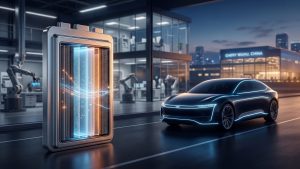
Li Auto, the Chinese EV maker, used Nvidia’s GTC 2026 on March 17 to unveil MindVLA-o1, a next-generation autonomous driving foundation model it says unifies perception, reasoning, and control in a single Vision-Language-Action (VLA) architecture. Speaking through its foundation model lead Zhan Kun, the company described MindVLA-o1 as a unified Transformer-based model and outlined five technical innovations spanning 3D spatial understanding, multimodal reasoning, unified behavior generation, closed-loop reinforcement learning, and hardware–software co-design. The announcement arrives as China’s L2 driver-assist penetration hit 64% in the first three quarters of 2025, raising the stakes for domestic autonomy platforms.
A foundation-model moment at GTC 2026
Multiple Chinese outlets, including IT Home, Sina Finance, 36Kr, Tencent News, and Zaker, reported Li Auto’s MindVLA-o1 reveal as part of an Nvidia GTC 2026 session. The choice of venue matters: Nvidia GTC 2026 is where the industry gathers around AI infrastructure, accelerators, and tooling, and Li Auto used that platform to position its autonomous driving stack as an AI-first foundation model rather than a conventional automotive software upgrade. In its GTC session catalog entry, Nvidia lists the MindVLA-o1 talk as a dedicated presentation, underscoring that Li Auto is treating the model itself as a core product narrative.
What MindVLA-o1 is positioned to do
Li Auto calls MindVLA-o1 a “next-generation autonomous driving foundation model,” and the company’s framing highlights a unified VLA architecture that runs in a single Transformer. In practice, that means the model is designed to jointly encode perception, reasoning, and control rather than handing off between multiple separately trained modules. Media summaries describe the model’s goals in terms of broader situational understanding and more stable control, with Li Auto signaling an intent to move from feature-by-feature stacking toward a model-centered platform that can iterate faster as data and training improve.
Five technical pillars Li Auto highlighted
Li Auto said MindVLA-o1 is built around five technical innovations, which it presented as a combined roadmap for end-to-end autonomy:
- 3D spatial understanding to improve the model’s grasp of scene geometry and the relative positions of surrounding objects.
- Multimodal reasoning so the system can fuse visual, language, and action signals into a single reasoning process.
- Unified behavior generation to streamline decision-making and control outputs within one model rather than separate policy layers.
- Closed-loop reinforcement learning to continuously refine driving behavior through iterative feedback.
- Hardware–software co-design to align model architecture with vehicle compute constraints and deployment efficiency.
Those five points are the core of Li Auto’s “unified Transformer” story. Instead of emphasizing one hardware spec or a narrow driving feature, the company is trying to define a full-stack AI loop that can generalize across scenarios.
From feature stacks to model platforms
The shift in messaging is itself significant. Chinese automakers have historically promoted autonomous driving through individual functions and milestone-grade features. MindVLA-o1 reframes the narrative around a foundation model that can be extended across the stack. By placing perception, reasoning, and control inside a single VLA backbone, Li Auto is effectively betting that the next phase of autonomy will look less like a modular toolkit and more like a model platform that can be upgraded through data scale and training improvements. That is aligned with broader AI industry trends, but in the automotive context it also implies new requirements for validation, safety, and on-vehicle performance.
Closed-loop learning and compute constraints
Two of the five pillars — closed-loop reinforcement learning and hardware–software co-design — point to the operational realities of autonomy. Closed-loop learning implies an emphasis on iterative training cycles where model behavior is improved through feedback, rather than purely offline training. Hardware–software co-design suggests Li Auto is optimizing model architecture for the compute budgets and thermal constraints of real vehicles, not just data center performance. Those are foundational requirements for scaling a large model into a consumer product, and Li Auto’s decision to highlight them signals that deployment efficiency is part of the core model design.
China market context: L2 penetration at 64%
The market backdrop is also moving quickly. Xinhua, citing China’s Ministry of Industry and Information Technology, reported that L2 driver-assist passenger car sales grew 21.2% year over year in the first three quarters of 2025, with penetration reaching 64%. That level of adoption means driver-assist capability is already becoming a mainstream expectation in China’s new-car market. For Li Auto, MindVLA-o1 is a way to differentiate in a category where L2 is now common and where the competition is shifting toward who can deliver the most robust, scalable autonomy platform.
Competitive implications for Chinese EVs
Li Auto’s GTC presentation signals a broader competition among Chinese automakers to move up the autonomy stack. By branding MindVLA-o1 as a foundation model, the company is attempting to frame its autonomous driving strategy around AI scale and model iteration rather than incremental feature releases. That raises the bar for peers, because a foundation-model story implicitly promises faster improvements, more generalizable behavior, and better long-tail performance — even if those outcomes still have to be proven in real-world driving. The stakes mirror the broader ecosystem push, including Nvidia’s DRIVE Hyperion roadmap for L4 robotaxis, which is setting a fast-moving benchmark for advanced autonomy stacks.
What changed and what might happen next
What changed is that a Chinese automaker has elevated autonomous driving to a foundation-model narrative on a global AI stage, with MindVLA-o1 positioned as a unified Transformer-based VLA system and supported by five stated technical pillars. What may happen next is a more visible race among Chinese EV makers to articulate their own model-centric autonomy platforms, with greater emphasis on data loops, compute efficiency, and measurable gains in driving stability. As China’s L2 penetration continues to rise, the companies that can translate foundation models into safer and more scalable on-vehicle performance are likely to shape the next phase of the market.
Sources
- IT Home — “Li Auto releases next-generation autonomous driving foundation model MindVLA-o1”
https://m.ithome.com/html/929923.htm - Sina Finance — “Li Auto releases next-generation autonomous driving foundation model MindVLA-o1”
https://finance.sina.com.cn/roll/2026-03-17/doc-inhrhxzp8073446.shtml - 36Kr — “Li Auto releases next-generation autonomous driving foundation model MindVLA-o1”
https://36kr.com/newsflashes/3726737807981187 - Nvidia GTC 2026 session catalog — “MindVLA-o1”
https://www.nvidia.com/gtc/session-catalog/sessions/gtc26-s81978/ - Xinhua — “MIIT: L2 driver-assist penetration reached 64% in 2025 Q1–Q3”
http://www.news.cn/20260122/cdaa0e4605d64668955c54a9aa6b8604/c.html