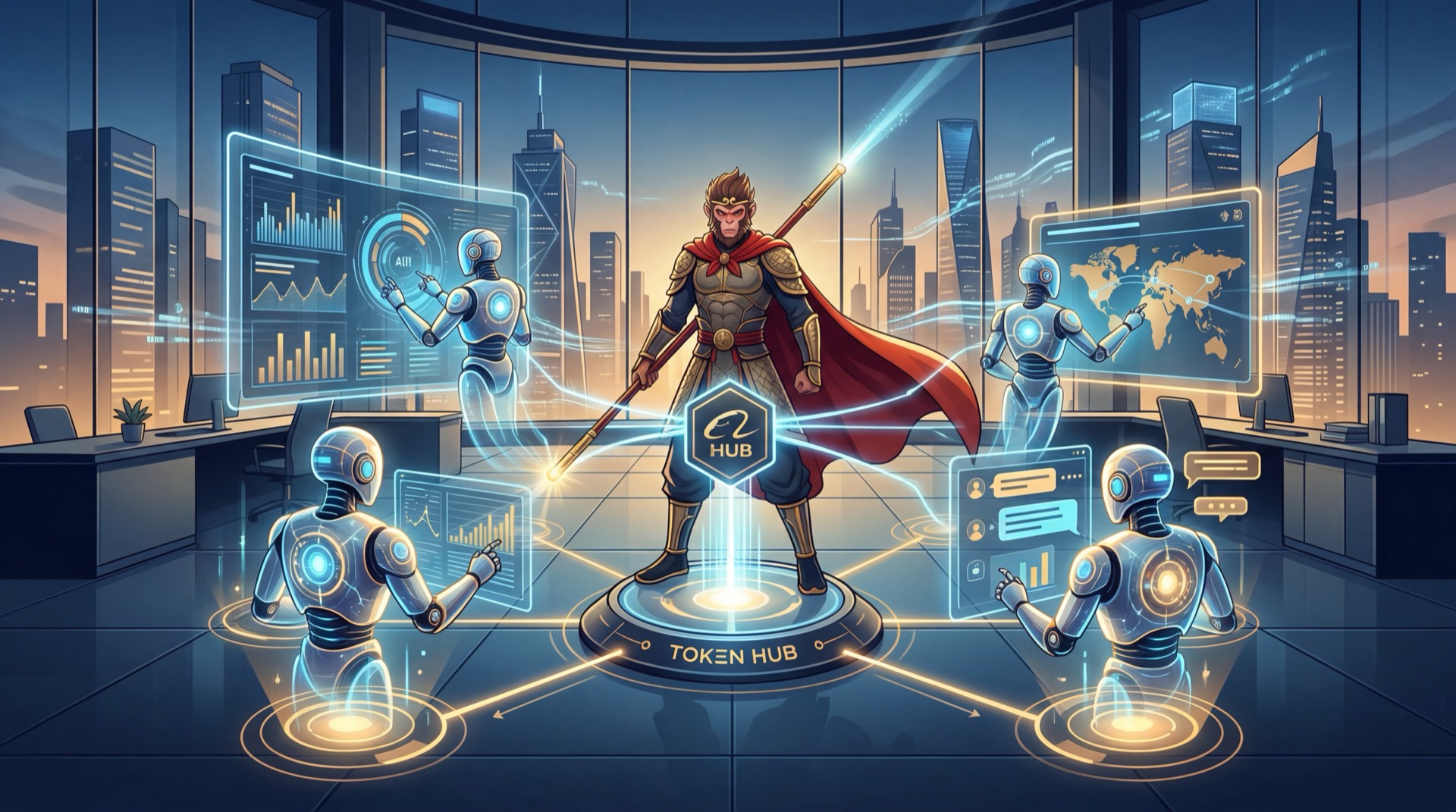
Alibaba spent March 16 and March 17 turning an internal AI reshuffle into a product story. On March 16, Alibaba’s official news site Alizila said the company had created the Alibaba Token Hub, or ATH, business group under CEO Eddie Wu, with the Wukong business unit folded into the new structure. A day later, Reuters and CNBC reported that Alibaba had launched Wukong, a new enterprise AI platform built around multiple agents and tied to DingTalk. The significance is that Alibaba is no longer framing AI only as a model race. It is trying to push AI agents into paid enterprise workflows.
ATH makes Alibaba’s commercialization logic more explicit
The March 16 reorganization matters because the name of the new unit is unusually direct. Alizila said ATH would be led by Alibaba CEO Eddie Wu and would include the Wukong business unit, which it described as building an AI-native work platform for enterprises. “Token Hub” is not the kind of label a company uses when it only wants to talk about research capability or chatbot popularity. It signals that Alibaba is trying to organize AI around token production, distribution and application, which is much closer to a monetization framework than a pure lab structure.
That sequence is what gives the story more weight than a routine org-chart update. In less than 48 hours, Alibaba first told the market that AI resources would sit in a new group directly overseen by the CEO, then showed a product that could convert those model capabilities into everyday work tasks. The timing suggests that Wukong is not an isolated experiment. It looks more like the first visible operating layer for the new structure Alibaba wants to build around enterprise AI.
Wukong is being positioned as a workflow layer, not another chatbot
Reuters, CNBC and AI Business all described Wukong as an enterprise tool that can coordinate multiple AI agents rather than simply answer prompts in a chat window. Reuters said the platform can handle tasks such as document editing, spreadsheet updates, meeting transcription and research. CNBC reported that Alibaba described Wukong as giving businesses a single interface for managing multiple agents while also providing enterprise-grade security infrastructure. Those details matter because they place Wukong closer to workflow software than to consumer-facing chat products.
That distinction is important in China’s current AI market. There is already no shortage of model launches, assistant demos and “agent” claims from Chinese internet companies and startups. What enterprises actually pay for, however, is usually not a model in the abstract. It is a tool that can fit into permission systems, internal documents, meeting records and collaborative processes without creating new governance headaches. By foregrounding multi-agent orchestration, document work and security, Alibaba is signaling that it wants Wukong to be understood as an operating layer for office tasks rather than another general-purpose AI showcase. That positioning also fits a broader industry shift we noted earlier when Huawei argued enterprise AI had to move beyond model hype and into usable data infrastructure.
DingTalk gives Alibaba something many agent startups do not have
The DingTalk connection may be the most commercially important part of the launch. CNBC said Wukong would sit inside DingTalk and that Alibaba planned integrations with platforms such as Slack and Microsoft Teams. Chinese financial and technology reports cited in the source brief added that DingTalk already serves more than 20 million enterprise organizations. Even if only a fraction of that base experiments with AI automation, Alibaba starts from a much stronger distribution position than a standalone agent company trying to win enterprise adoption one account at a time.
That installed base changes the competitive equation. Many AI agent products still need to persuade companies to adopt a new platform, retrain users and then trust a new vendor with sensitive workflow data. Alibaba, by contrast, can attach Wukong to an existing enterprise collaboration product that already handles communication and coordination. If that distribution channel works, Wukong does not need to win attention only through benchmark claims or viral demos. It can ride an existing business-software footprint and move straight into workflow usage, which is where enterprise software spending becomes more durable.
This is also a bet that enterprise AI should be measured in token consumption and task completion
The combination of ATH and Wukong makes Alibaba’s broader AI strategy easier to read. Reuters framed the launch as part of China’s wider AI agent wave, but Alibaba’s version of that story is not just about saying it has agents too. The company is creating an organizational layer explicitly tied to tokens and a product layer explicitly tied to work execution. Put together, that suggests Alibaba wants enterprise AI to be sold not only as intelligence but as measurable workflow throughput: how many tasks get done, how much compute is consumed, and how deeply the platform sits inside office processes.
That is a more commercially grounded narrative than “our model is smarter.” Token usage can be priced. Workflow automation can be packaged into enterprise subscriptions. Security features can justify premium contracts. A consumer chatbot may bring mindshare, but an enterprise platform tied to recurring business processes is more likely to create stable revenue. Alibaba has not yet proven Wukong will become that kind of product at scale, but the structure it announced this week shows where it expects AI monetization to come from.
The launch also suggests Alibaba wants to move the conversation beyond Qwen alone
CNBC noted that Wukong’s release came as Alibaba restructured and after personnel changes affecting the team that oversaw its well-known Qwen chatbot line. Even without over-reading those shifts, the timing is revealing. Alibaba is broadening the public AI conversation from model families and chatbot competition to enterprise deployment, orchestration and software integration. Earlier this month, we also noted how Alibaba had already centralized its foundation-model push after the Qwen exit, and Wukong now gives that internal reshuffle a clearer enterprise product face. That does not mean Qwen becomes irrelevant. It means the company is trying to show that the next stage of competition will be about how models are packaged, governed and sold inside real business environments.
That shift matters for international readers because it places Alibaba into a different comparison set. Instead of being judged only against other foundation-model developers, Alibaba is inviting comparison with enterprise automation vendors, workplace software platforms and agent-tool builders. In that frame, DingTalk distribution, enterprise security and cross-platform integration matter just as much as raw model capability. Wukong therefore looks less like a side product and more like Alibaba’s attempt to build a China-based enterprise agent stack with a clearer path to adoption.
What changed, and what comes next
What changed this week is that Alibaba connected AI organization and AI product in a way that points directly to commercialization. ATH made token infrastructure and business structure more visible. Wukong translated that structure into a DingTalk-based platform for multi-agent work. Instead of telling the market that enterprise AI remains an opportunity, Alibaba showed how it wants to insert AI agents into document work, spreadsheets, meeting notes and research flows that companies already run every day.
What happens next will determine whether this becomes a meaningful turning point or just a well-timed launch. The clearest things to watch are whether Wukong gains visible adoption inside DingTalk accounts, whether promised integrations with tools such as Slack and Microsoft Teams arrive, and whether Alibaba can keep enterprise customers comfortable with security and permissions as more tasks are delegated to agents. If those pieces fall into place, this week may be remembered as the moment Alibaba pushed its AI narrative beyond model competition and toward enterprise agent monetization. If they do not, ATH and Wukong will still look important in hindsight, but mainly as an early map of where Alibaba wanted the business to go.
Sources
- Alizila — “Alibaba establishes Alibaba Token Hub Business Group”
https://www.alizila.com/alibaba-establishes-alibaba-token-hub-business-group/ - Reuters — “Alibaba launches AI platform for enterprises as agent craze sweeps China”
https://www.reuters.com/world/asia-pacific/alibaba-launches-new-ai-agent-platform-enterprises-2026-03-17/ - CNBC — “Alibaba launches agentic AI tool for businesses with Slack, Teams integration plans”
https://www.cnbc.com/amp/2026/03/17/alibaba-wukong-ai-enterprise-tool-restructuring-qwen-exits.html - AI Business — “Alibaba launches enterprise AI agent platform”
https://aibusiness.com/agentic-ai/alibaba-launches-enterprise-ai-agent-platform - Lianhe Zaobao — “Alibaba launches what it calls the world’s first enterprise AI agent platform, Wukong”
https://www.zaobao.com.sg/finance/china/story20260317-8747683