Huawei and GAC used a March 17 launch event to move their automotive partnership into a more ambitious phase. The two companies formally introduced Aistaland, known in Chinese as Qijing, as a new premium EV brand and simultaneously gave its first model, the GT7 shooting brake, a global debut with blind orders opening in China. English-language outlets including CarNewsChina and CnEVPost quickly framed the story as more than a model unveil. The significance is that Huawei is no longer only supplying smart-cockpit and driver-assistance systems to partner carmakers; it is helping shape a branded premium vehicle program from the ground up.
Aistaland is being presented as a brand platform, not a one-off model
The launch matters because Huawei and GAC did not present Aistaland as a short-lived sub-brand built around one flashy car. On 1M Reviews, we had already tracked the program first as a March 17 debut teaser and then as a pre-launch confirmation that GAC–Huawei Qijing had named the GT7 and mapped out its debut and June launch window. CCTV and IT Home both said the companies used the event to explain the brand itself: Aistaland comes from “AI Start New Land,” while its core value proposition is “Make Difference.” That branding language may sound familiar to anyone who follows EV launches, but the operating details are more revealing. Chinese coverage said the two companies expect the brand’s lineup to cover multiple categories over the next three years, with a shooting brake and a mid-to-large SUV planned first in 2026. In other words, this is being pitched as a product sequence, not a concept-car moment.
The operating model also looks deeper than a standard supplier relationship. CnEVPost said a Huawei Qiankun team is stationed in Guangzhou and shares office space with the Aistaland team, while IT Home and Sina reported that Huawei sent hundreds of staff to work alongside GAC and introduced its IPD and IPMS development processes into the joint program. GAC, for its part, is responsible for manufacturing execution and quality control. That division of labor matters because it turns Huawei’s role from “technology vendor on a finished vehicle” into something closer to a co-development partner influencing product definition, engineering cadence and commercial positioning from an earlier stage.
GT7 gives the new brand a concrete product and a visible technology stack
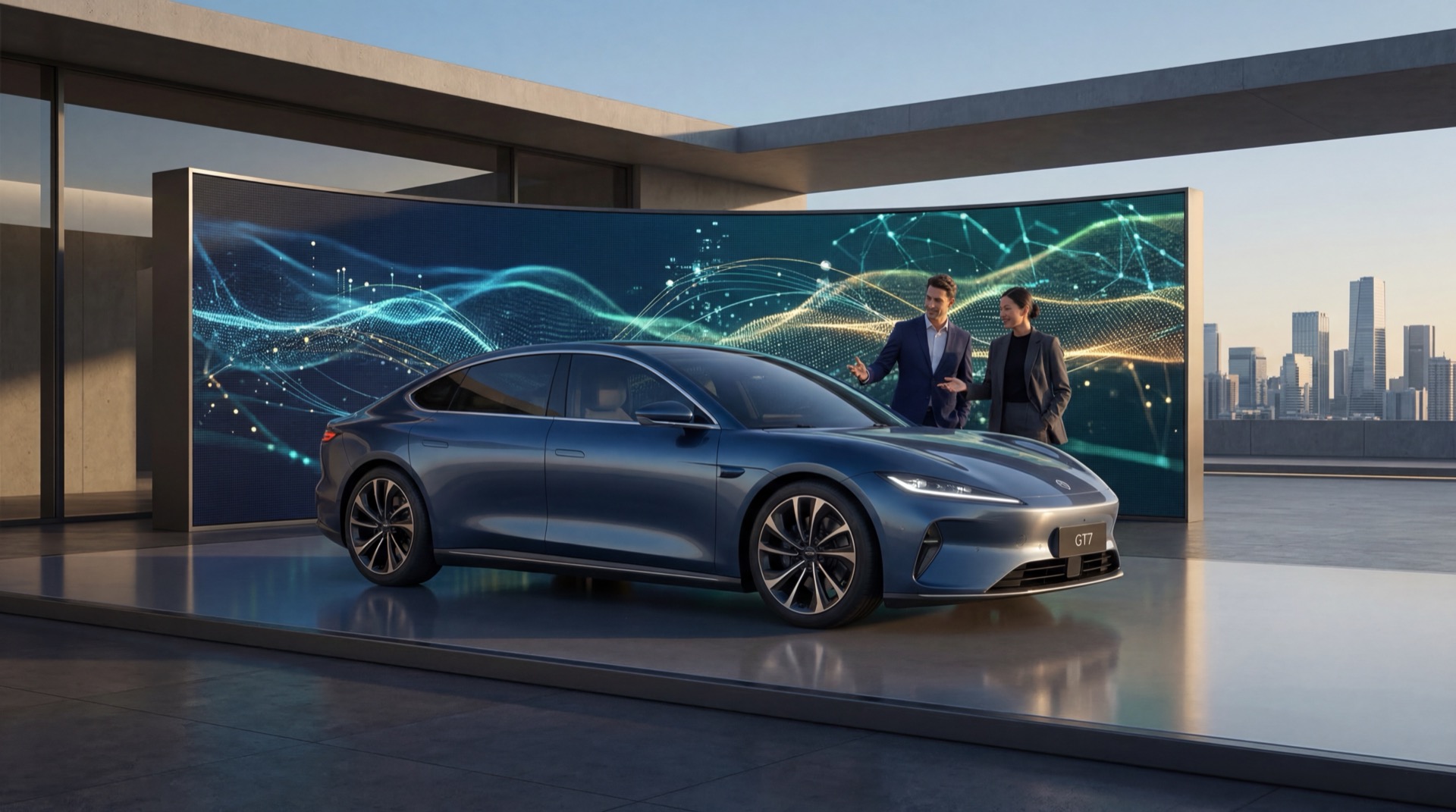
The GT7 is what keeps the launch from drifting into abstract strategy talk. A week before the unveiling, we had already noted that Huawei-backed Qijing GT7 was being positioned for a March 17 debut, but the March 17 event turned that outline into a real product program with blind orders opening in China. CarNewsChina, CnEVPost, CCTV and Chinese tech media all described the GT7 as a premium intelligent shooting brake, a body style that still stands out in China’s EV market because it sits between the utility of an SUV and the stance of a sport wagon. The car measures 5,050 mm in length, 1,980 mm in width and 1,470 mm in height, with a 3,000 mm wheelbase. CnEVPost said the GT7 will appear at the Beijing Auto Show at the end of April, with launch and delivery planned for June, while CarNewsChina said showroom appearances should begin in April.
The specification sheet is one reason the model has immediate story value. CnEVPost said the GT7 uses Huawei’s 896-channel LiDAR, a spec that lands as China’s premium EV market is increasingly treating high-line lidar as a visible differentiator, much like we noted when Lantu’s Taishan Ultra started deliveries with 896-line lidar. CarNewsChina and IT Home said the vehicle also carries Huawei’s Qiankun intelligent driving stack, a HarmonyOS cockpit, the new Xiaoyi AI agent, the Qiankun Chitu platform, a tri-motor powertrain and a jointly customized CATL Qilin battery. Chinese reports added support for an 800-volt architecture and 6C fast charging. Even if the company has not yet published the full system output, battery capacity or driving range, the hardware list is detailed enough to show how Aistaland wants to compete: not by making a quiet first entry, but by opening with a technology-heavy flagship.
Huawei is using Aistaland to deepen its role in the EV value chain
That is why the bigger story is strategic rather than purely product-based. Huawei has already become a familiar name in China’s auto sector through smart-cockpit, intelligent-driving and vehicle software partnerships, but Aistaland makes that involvement more explicit at the brand layer. The GT7 is not simply another car “powered by Huawei” buried inside someone else’s portfolio. It is the first visible product under a new premium badge whose launch narrative revolves around Huawei Qiankun’s contribution to driving, cockpit interaction, chassis coordination, lighting and safety. The brand story and the technology story are being sold together.
That matters because it suggests Huawei wants to capture more value from the vehicles it helps shape. Supplier economics are usually narrower than brand economics. If Huawei’s technology becomes central to how an EV brand is positioned, marketed and differentiated, its influence extends beyond component revenue and into product definition itself. Aistaland is a good test case because the message from the launch was clear: GAC brings industrial know-how and production discipline, while Huawei brings the intelligent layer that turns a conventional premium EV into something closer to a software-defined mobility product. The result is a more integrated commercial model than simply shipping sensors or infotainment software to an automaker.
The market opportunity is visible, but execution questions have not gone away
The choice of a shooting brake also tells us something about the intended market. CnEVPost noted that the segment used to be highly niche in China, but the commercial success of models such as the Zeekr 001 proved there is real demand for more style-driven electric wagons. CarNewsChina explicitly named the Zeekr 001 and Nio ET5 Touring as domestic reference points, while broader premium comparisons extend to imported models such as the Porsche Taycan Cross Turismo. Aistaland is clearly trying to enter that conversation at the higher end of the market rather than chase pure mass volume first. CnEVPost said the brand aims to deliver a driving and riding experience that can rival vehicles in the 1 million yuan class.
Still, a premium positioning line is easier to declare than to execute. The launch left several critical numbers undisclosed, including the GT7’s official pricing, total power output, battery capacity and final range figures. CarNewsChina also noted that the architecture is designed to support future Level 3 automated driving functions once regulations allow, which means some of the most ambitious automation language remains dependent on policy as well as engineering. Sina added that Aistaland is building a “1+N” service network across 70 cities, with first stores expected to begin trial operations in late April and open in early May. That distribution effort is meaningful, but the real test will be whether buyers see enough substance behind the co-created brand story once pricing and real-world deliveries arrive.
What changed, and what comes next
What changed this week is that Huawei and GAC turned a smart-car alliance into a premium EV brand architecture with a real launch calendar and a real first vehicle. Before March 17, Aistaland was still closer to an emerging project. After the launch, it became a public brand with a defined English name, a flagship model, blind orders, a technology stack and a follow-on SUV already on the roadmap. For Huawei, that is an important shift in posture. The company is no longer being framed only as the intelligence layer inside other companies’ products. In this partnership, it is part of the badge-building process itself.
What happens next will determine whether Aistaland becomes a durable brand or just another ambitious China EV debut. The key things to watch are whether the GT7’s April showroom rollout and end-of-April Beijing Auto Show appearance convert attention into meaningful order momentum, whether June pricing and delivery details back up the premium narrative, and whether the planned SUV broadens the brand beyond a single eye-catching launch. If execution holds, Aistaland could become one of the clearest examples yet of Huawei moving deeper into the business of shaping premium EV brands, not merely equipping them. If it does not, the March 17 debut will still matter as a sign of where China’s technology-and-automotive partnerships are trying to go.
Sources
- CCTV — “Aistaland brand launch and GT7 global debut held in Guangzhou”
https://5gai.cctv.com/2026/03/18/ARTIoomAixNnK3kEXEP9ydzI260318.shtml - IT Home — “AISTALAND announced as the English brand name, jointly created by Huawei and GAC, with GT7 unveiled”
https://www.ithome.com/0/930/160.htm - CarNewsChina — “Huawei & GAC ignite Qijing: GT7 shooting brake debuts with blind orders, rivals Zeekr 001”
https://carnewschina.com/2026/03/17/huawei-gac-ignite-qijing-gt7-shooting-brake-debuts-with-blind-orders-rivals-zeekr-001/ - CnEVPost — “Huawei-backed Qijing gets English name Aistaland, debuts 1st model GT7”
https://cnevpost.com/2026/03/17/qijing-gets-english-name-aistaland-debuts-gt7/ - Sina Finance — “Huawei Qiankun and GAC launch the Aistaland brand, with the GT7 debut and blind orders opening”
https://finance.sina.com.cn/tob/2026-03-17/doc-inhrikre5186936.shtml