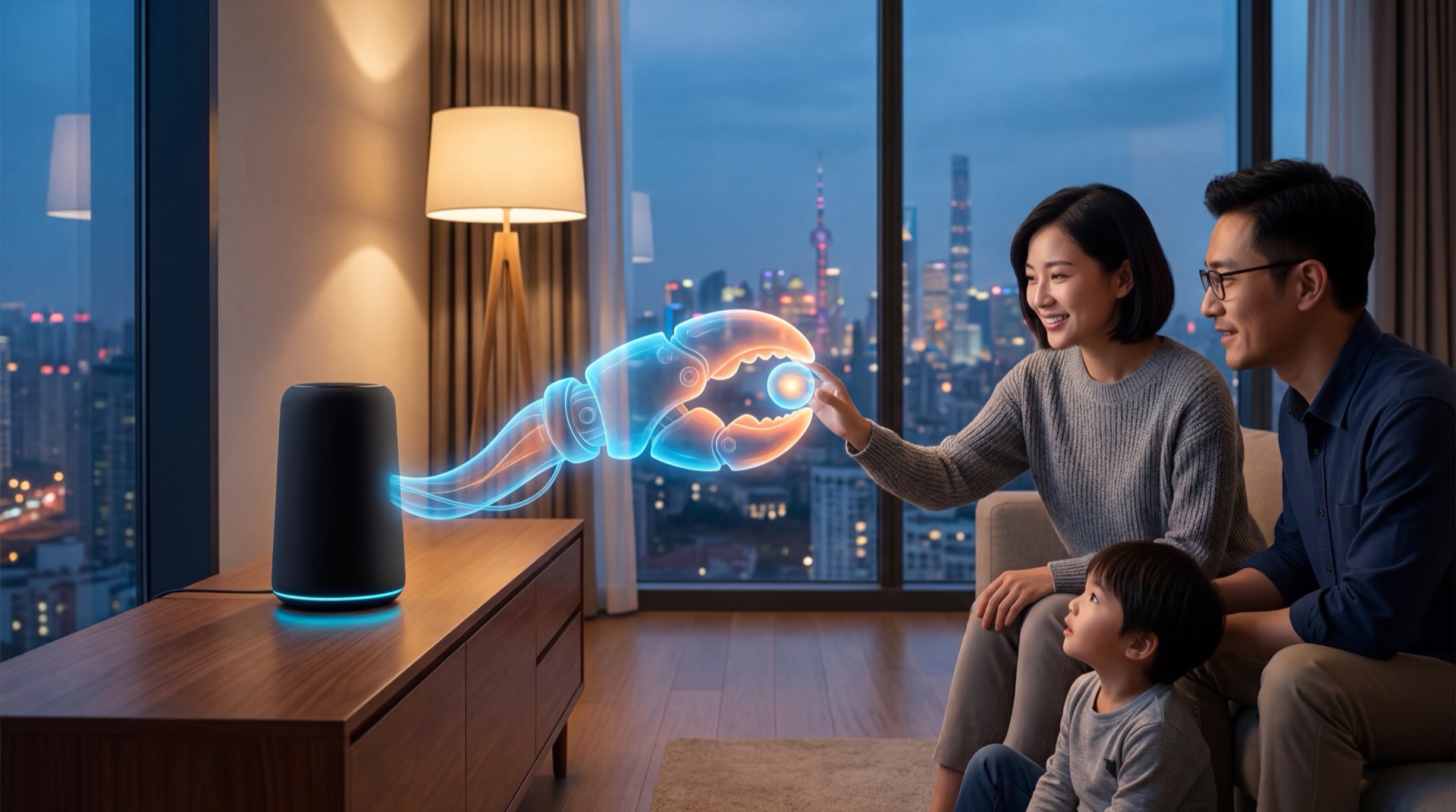
Baidu used its March 17 AI Day event and the follow-up coverage on March 17-18 to show it wants China’s latest OpenClaw frenzy to reach ordinary households, not just developers and office workers. Reuters reported that Baidu rolled out a new family of AI agents, while Bloomberg said the company was tapping its Xiaodu smart-speaker base to advance an “agentic AI paradigm.” Chinese coverage from Unwire.hk and The Beijing News described the package as a “lobster family” spanning Xiaodu Lobster for the home plus desktop, mobile, cloud and security variants. The significance is that Baidu is trying to turn AI agents from a cloud-and-demo story into a consumer device ecosystem.
This is a consumer distribution play, not just another AI launch
The Reuters framing matters because it places Baidu’s announcement inside a broader national shift rather than treating it as a one-company product refresh. The report explicitly said Baidu was joining China’s OpenClaw frenzy with new AI agents, which means the news is being read as part of a competitive wave already pulling in large Chinese internet companies. Bloomberg pushed that interpretation further by arguing that Baidu was using smart speakers to fuel the next stage of agentic AI. Together, those reports suggest Baidu wants to compete not only on model capability, but on where AI agents actually live and how often consumers touch them.
That is what makes the Xiaodu angle important. In China’s current AI cycle, many companies have shown agents through developer workflows, research copilots or enterprise software demos. Baidu’s March 17 rollout points somewhere else: voice-first, home-facing, multi-device task execution. The Beijing News described the launch as a move to put OpenClaw into smart speakers, while Unwire.hk emphasized that Baidu was bringing agent capabilities into household space through Xiaodu devices. In other words, Baidu is betting that the next battle is not only who has an agent, but who can make that agent feel natural in an everyday setting.
The “lobster family” gives Baidu a fuller product story than a single app could
One reason the launch works as an English-language story is that it is not limited to a lone chatbot or phone assistant. The source package and Chinese coverage both show Baidu presenting a broader product family: Xiaodu Lobster for the home, alongside desktop, mobile, cloud and security variants. That matters because Baidu is not asking users to imagine AI agents in only one environment. It is pitching an ecosystem where task execution can begin in one place and continue across others, with voice, screens and cloud services tied together under one narrative.
That multi-end framing also helps Baidu stand out from more abstract “agent platform” announcements. A home speaker can act as a constant voice entry point. A desktop version can connect the same logic to office-style productivity. A mobile version keeps the agent present on the device users carry everywhere. Cloud and security variants signal that Baidu is also thinking about deployment and governance, not only interaction design. Even without a full public spec sheet for every version, the family structure itself is a fact anchor: Baidu is presenting agentic AI as an operating environment rather than a feature add-on.
Baidu is also trying to remove the setup burden that still slows agent adoption
The cloud side of the rollout reinforces that point. In an official PR Newswire release, Baidu said it launched DuClaw, a zero-deployment service from Baidu AI Cloud that lets users access the OpenClaw platform instantly through a web interface. According to the release, DuClaw includes pre-built Baidu skills such as Baidu Search, Baidu Baike and Baidu Scholar, supports multiple mainstream foundation models, and is planned to integrate with WeCom, DingTalk and Feishu. That is a meaningful set of details because one of the biggest frictions in the current agent market is not curiosity, but setup: images, servers, model APIs and reliability all still scare away non-technical users.
Baidu’s pricing signal shows the company understands that barrier. The same release said first-time users could subscribe to DuClaw for RMB 17.8 per month during a limited March promotion, or roughly $2.50. That is not proof of mass-market traction, but it is proof of intent. Baidu is not presenting agent access as a premium experiment reserved for technical teams. It is testing whether lower-friction packaging and low introductory pricing can widen the top of the funnel.
The PR release also added another useful fact: Baidu said its flagship Baidu App had already integrated OpenClaw during the Chinese New Year period, reaching a product with about 700 million monthly active users. Even allowing for the fact that this is company-provided framing rather than independent reporting, it still matters strategically. It suggests Baidu is trying to connect three layers at once: app traffic, cloud delivery and household hardware.
Smart speakers may regain strategic value if agents become ambient rather than screen-bound
This is where Bloomberg’s interpretation is especially interesting. For several years, smart speakers were often treated as lower-growth hardware, useful but no longer central to big-tech ambition. Baidu’s March 17 push implies that agentic AI may change that calculation. A speaker sitting in a living room is always on, naturally voice-driven and shared by multiple people in a household. That is a very different interface from a browser tab or enterprise dashboard. If AI agents are supposed to schedule, search, retrieve, coordinate and act, then the most valuable device may not always be the most powerful screen. It may be the device that is easiest to talk to.
Unwire.hk and The Beijing News both support that reading by highlighting Baidu’s effort to bring OpenClaw-style capabilities into home space rather than limiting them to cloud-side demos. That does not mean smart speakers automatically become the winning consumer AI format again. But it does mean Baidu is trying to reframe them from media playback gadgets into household execution hubs. In strategic terms, that is a bigger claim than launching another assistant.
The competitive framing is clear, but the commercial proof is still thin
The story is therefore strong at the level of direction, but less complete at the level of measurable adoption. Reuters and Bloomberg both placed Baidu’s move inside China’s wider AI-agent race, which makes the competitive picture easy to understand for international readers. Baidu is now being discussed alongside the other Chinese tech groups trying to turn agentic AI into a product category. But the public reporting still leaves several gaps. Current sources say much more about launch architecture than about user numbers, monetization pace or how often consumers will actually trust an agent to complete meaningful household tasks.
That is why the most durable headline from March 17-18 may not be that Baidu has “agents too.” It may be that Baidu gave China’s OpenClaw boom a consumer hardware face, a voice interface and a clearer path into ordinary usage scenarios. The unanswered questions are whether those scenarios become sticky, whether cross-device execution works reliably enough outside staged demos, and whether low-friction services such as DuClaw turn experimentation into repeat usage.
What changed, and what comes next
What changed this week is that Baidu moved the center of gravity of its AI-agent story closer to the home. Before this rollout, China’s OpenClaw discussion was easier to associate with developer tooling, enterprise pilots and cloud-side capability demos. After March 17, Baidu is helping define a different version of that story: one where agents speak through Xiaodu hardware, travel across desktop and mobile touchpoints, and use cloud services in the background without asking users to manage the plumbing themselves.
What happens next will determine whether that shift is strategically important or merely well staged. The key things to watch are whether Baidu discloses broader rollout and usage data for the lobster-family products, whether promised integrations with WeCom, DingTalk and Feishu arrive on schedule, and whether Xiaodu devices can genuinely regain relevance as AI entry points rather than novelty containers. If those pieces line up, Baidu may end up doing something more valuable than launching a few new agents: it may show how China’s OpenClaw race moves from cloud excitement into everyday consumer behavior.
Sources
- Reuters — “Baidu joins China’s OpenClaw frenzy with new AI agents”
https://www.reuters.com/business/media-telecom/baidu-joins-chinas-openclaw-frenzy-with-new-ai-agents-2026-03-17/ - Bloomberg — “Baidu Taps OpenClaw Smart Speakers to Fuel Agentic AI Paradigm”
https://www.bloomberg.com/news/articles/2026-03-17/baidu-taps-openclaw-smart-speakers-to-fuel-agentic-ai-paradigm - Unwire.hk — “Baidu unveils Xiaodu Lobster and brings OpenClaw capabilities into the home”
https://unwire.hk/2026/03/17/baidu-xiaodu-lobster-home-ai-agent/ai/ - The Beijing News — “Baidu launches its ‘lobster’ family pack and puts OpenClaw into smart speakers”
https://www.bjnews.com.cn/detail/1773741150129742.html - PR Newswire — “Baidu Launches DuClaw, Enables Zero-Deployment Access to OpenClaw”
https://www.prnewswire.com/news-releases/baidu-launches-duclaw-enables-zero-deployment-access-to-openclaw-302710924.html