Google is in talks with Envicool and other Chinese suppliers to buy liquid-cooling systems for data centers, Reuters reported on March 17, citing people familiar with the matter. Follow-up coverage from IT Home, Securities Times, AASTOCKS, DIGITIMES and Sina Finance said Google’s procurement team traveled to China this month, met Envicool and may see at least one more supplier. The immediate story is not a signed deal. The bigger story is that the AI buildout is squeezing yet another part of the hardware chain: cooling. As AI racks run hotter and denser, China’s liquid-cooling suppliers are becoming harder for global buyers to ignore.
The pressure is moving beyond chips
The clearest reason this story matters is that it shifts the AI infrastructure conversation away from semiconductors alone. For the past two years, most headlines have focused on GPU shortages, export controls and custom AI chips. The Envicool talks suggest that the bottleneck is now spreading into lower-profile systems that keep those chips usable inside high-density facilities. IT Home, citing the Reuters report, said liquid-cooling systems have become critical because the heat generated by AI workloads now exceeds what conventional air cooling can comfortably handle. That makes cooling gear less like a supporting accessory and more like enabling infrastructure.
Reuters framed the talks in exactly that way. Its report said the global race to build AI data-center capacity is not only tightening supply for advanced chips, but also for comparatively lower-value equipment that sits deeper in the physical stack. That distinction matters. Export controls may still define the politics of the chip war, but operators still need pumps, pipes, distribution units and other thermal-management components to make expensive compute clusters run at scale. If Google is visiting Chinese vendors for that gear, the signal is not simply about one procurement trip. It is about where the next supply-chain chokepoint is emerging.
Envicool fits the moment unusually well
Envicool is a particularly good proxy for that shift because the company sits squarely in the cooling segment now benefiting from AI-capex spillover. Reuters described the Shenzhen-listed supplier as having a market value of roughly RMB 98 billion, while its revenue for the first nine months of last year rose about 40 percent. That kind of growth does not prove a Google order, but it does show that investors have already started to treat liquid cooling as one of the clearest second-order beneficiaries of the AI buildout.
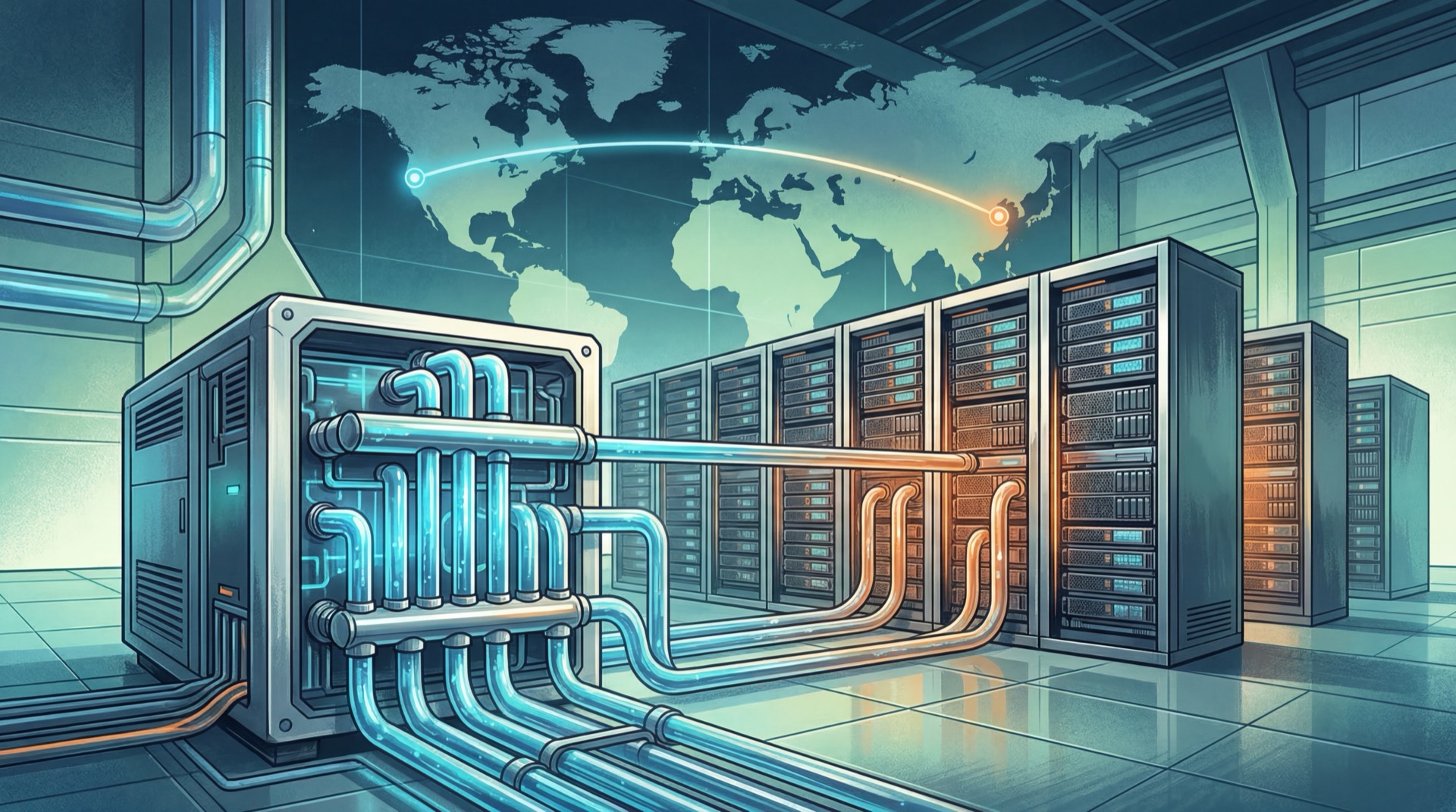
The more interesting detail is product fit. According to Reuters and the Chinese follow-up coverage, Envicool recently showed a cooling distribution unit, or CDU, built to Google specifications at an industry event. A CDU is not flashy consumer hardware. It is a core part of a liquid-cooling system because it distributes coolant to server racks and helps stabilize temperatures in dense installations. Reuters also said Goldman, after an analyst call with the company, pointed to quarter-by-quarter growth expected in Envicool’s liquid-cooling business and mentioned potential orders that could include Google’s fifth-generation CDU and related parts. In the same coverage, the company was also said to be expanding capacity in Guangdong while continuing production buildouts in Thailand and the United States. That combination makes Envicool look less like a local niche name and more like a supplier trying to scale with global demand.
China’s advantage is scale as much as cost
The supply-chain angle is the real headline for an English-language audience. China is still central to large parts of the global electronics and data-center ecosystem, but AI coverage often underplays that reality unless the subject is chips or export restrictions. The Envicool story forces a broader view. Chinese vendors have accumulated manufacturing scale partly because domestic demand has already pushed them through multiple data-center build cycles. IT Home noted that the liquid-cooling market is fragmented and that Chinese suppliers have gradually gained recognition as local projects helped them raise output and lower costs. In other words, global buyers are not only shopping China because it is cheap. They are shopping China because China already built capacity in a market that is suddenly much tighter.
That matters even more because cooling is not an isolated component business. Once a supplier proves it can meet a global hyperscaler’s specifications, it becomes easier to win adjacent orders across the same infrastructure layer. Sina Finance argued that the Google talks highlight two broader signals: Chinese companies have become globally competitive in liquid-cooling technology, and the industry is reaching the point where liquid cooling is shifting from optional to essential. That reading is slightly more interpretive than Reuters, but it aligns with the underlying logic. As higher-power AI chips push thermal limits, the value of reliable cooling vendors rises sharply.
This is one of the clearest second-order AI trade stories yet
The numbers attached to the sector help explain why this line is worth watching beyond one news cycle. Reuters cited JPMorgan as saying the global market for AI-server liquid-cooling systems is expected to jump from $8.9 billion last year to more than $17 billion in 2026. That is close to a doubling in a short period. Sina Finance, citing Chinese industry research, added that China’s liquid-cooled server market could exceed RMB 40 billion by 2027. Whether every forecast lands exactly on target is less important than the direction of travel: cooling is no longer a side category inside AI infrastructure spending.
That changes the investment story around suppliers such as Envicool. Until recently, many investors treated thermal management as a supporting function rather than a headline opportunity. The AI boom is rewriting that assumption. High-density computing raises heat loads, and heat loads force changes in data-center design. Once that happens, companies selling CDUs, liquid loops and related thermal components stop looking like peripheral beneficiaries. They start to resemble bottleneck relievers. That is why this round’s reported talks between Google and Chinese vendors stand out. They show how AI spending is moving from chips and models into the heavy, practical infrastructure that keeps both of them working.
What is confirmed, and what is not
The strongest version of the story must still remain careful. Public reporting does not show a final contract, and the available sources repeatedly point to talks rather than a completed order. Reuters said Google was in talks with Envicool and other Chinese companies. IT Home said sources described a recent China visit by Google’s procurement team and noted meetings with Envicool. Sina Finance added a useful company-side caveat: Envicool’s securities office said it was not currently aware of relevant customer information or business progress at the operating level. That response does not deny the market chatter, but it also does not validate a signed deal.
That distinction is essential for the article’s framing. The right verbs here are “talks,” “sourcing push,” “qualification” and “procurement discussions,” not “partnership,” “win” or “major order.” The safest conclusion is that Google appears to be surveying Chinese liquid-cooling capacity as AI data-center demand tightens. Even if the talks do not result in immediate orders, they already tell us something meaningful: China’s suppliers are credible enough to be part of the conversation when a global hyperscaler looks for thermal infrastructure.
What changed, and what could happen next
What changed this week is not that China suddenly invented liquid cooling. It is that a reported Google sourcing push gave the segment a much clearer global signal. The center of gravity in AI infrastructure coverage has been drifting from models toward physical capacity for months, but the Envicool story makes that shift easy to see. It links a hyperscaler, a Chinese supplier, a specific product category and a wider market forecast in one chain. That is why the story reads bigger than a single corporate rumor. It captures how the AI buildout is turning previously secondary hardware categories into strategic assets.
What happens next will determine whether the story becomes a durable supply-chain trend or remains a strong but early indicator. The first thing to watch is whether Google’s talks produce formal orders or broader supplier qualification activity in China. The second is whether Envicool or peers disclose additional capacity, customer wins or product-generation upgrades tied to global hyperscalers. The third is whether cooling keeps behaving like the next bottleneck across the wider AI stack, especially as higher-power chips push more data centers beyond the practical ceiling of air cooling. Even without a signed Google deal today, the direction is already clearer than before: the global AI race is no longer only about who can get enough chips. It is also about who can keep them cool.
Sources
- Reuters — “Google in talks with China’s Envicool, others to buy data centre cooling systems, sources say”
https://www.reuters.com/world/china/google-talks-with-chinas-envicool-others-buy-data-centre-cooling-systems-sources-2026-03-17/ - IT Home — “Google said to be in talks to buy Chinese liquid-cooling gear for data centers”
https://www.ithome.com/0/929/962.htm - Securities Times — “Bull-market favorite gets a fresh catalyst as the liquid-cooling trade heats up”
https://www.stcn.com/article/detail/3681798.html - Sina Finance — “Google’s domestic liquid-cooling talks pull Envicool into the rumor spotlight”
https://finance.sina.com.cn/jjxw/2026-03-18/doc-inhrkskt7525985.shtml - DIGITIMES — “Google in talks for Envicool liquid-cooling systems as server procurement team visits China”
https://gb-www.digitimes.com.tw/tech/dt/n/shwnws.asp?CnlId=1&id=0000749448_UOM3Y1LO5J94O478JSUUC&wpidx=5