Dek: GAC says its GOVY flying-car project began trial production in January, with the first vehicle expected to roll off in March and demo operations targeted for 2027.
China’s flying-car story has often been told through concept images, policy slogans, and long-dated promises. What makes GAC’s latest update worth watching is that it adds something more concrete: a factory, a trial-production start date, and a near-term vehicle timeline.
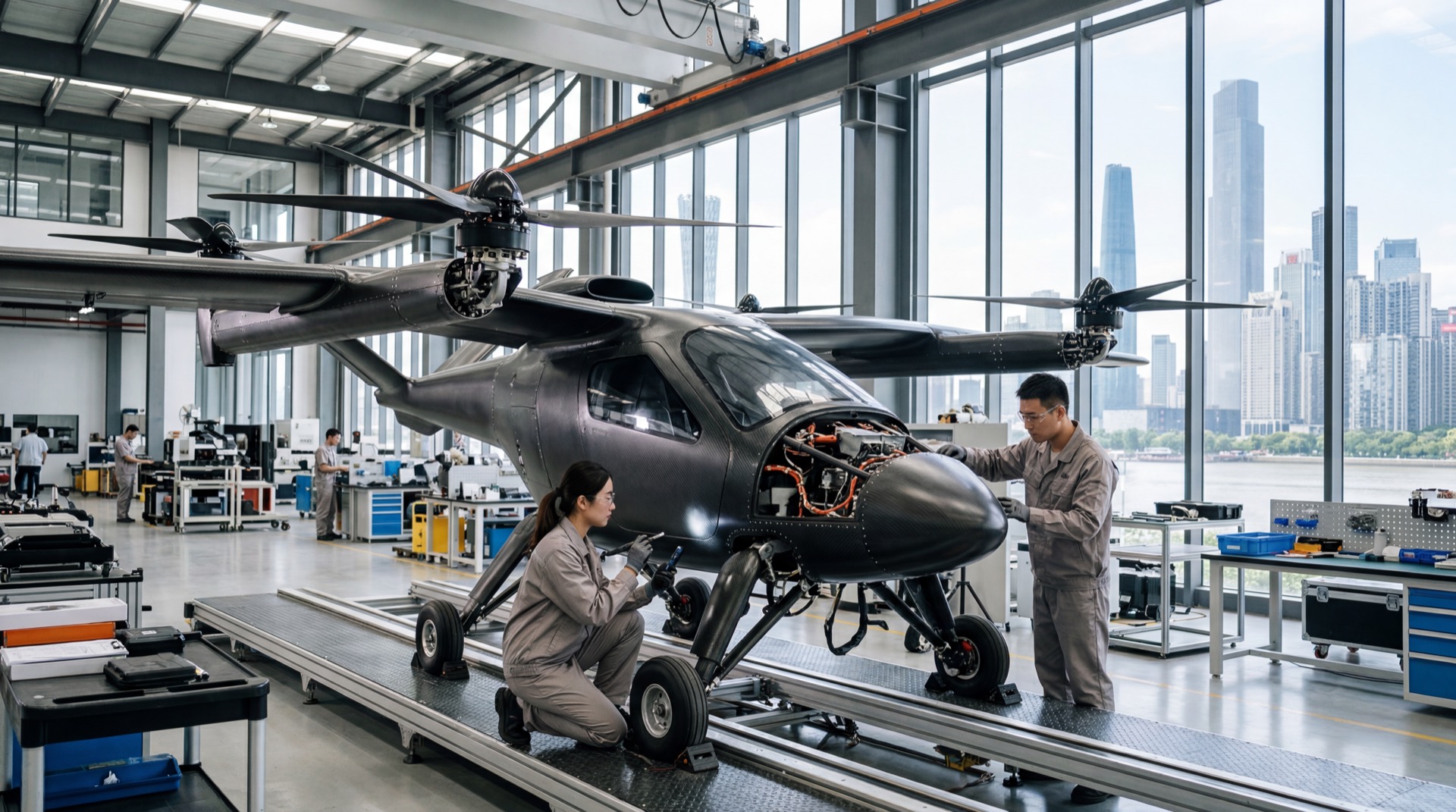
In a March 7 interview published by Sina Finance and credited to Chinese outlet Chang’an Avenue Observer, GAC chairman Feng Xingya said the automaker’s incubated flying-car brand GOVY has built a factory in Guangzhou, started trial production in January 2026, and expects its first flying car to roll off the line in March. Feng also said GOVY plans to begin demo operations in two to three Greater Bay Area cities in 2027.
That does not mean China suddenly has a mass-market flying-car business. But it does suggest the conversation is moving a step closer to manufacturing reality.
What GAC actually said
The strongest reported facts all come from Feng’s interview during China’s annual parliamentary meetings, often referred to as the “two sessions.” According to the published report, GAC’s GOVY project has already moved beyond the concept stage far enough to establish a production site in Guangzhou and begin trial manufacturing work this year.
That matters because trial production is a more meaningful milestone than a splashy prototype reveal. It implies the company is testing how a vehicle can move through factory processes, quality checks, and early production preparation rather than simply showing design intent.
The same source also gave the project a broader timeline. Feng said the first vehicle is expected to come off the line in March 2026, while 2027 is the target year for launching pilot or demo operations in two to three cities in the Greater Bay Area, the southern China mega-region that includes Guangzhou, Shenzhen, and Hong Kong.
For English-language readers, that gives the story a cleaner frame: GAC is not claiming nationwide commercialization right now. It is laying out a phased path from factory trial production to limited city demonstrations.
Why this matters beyond one prototype
The GOVY update is not just about one futuristic vehicle. It also fits into China’s broader push around the low-altitude economy, a policy umbrella that covers drones, short-range aerial mobility, low-altitude logistics, and related traffic-management infrastructure.
A March 8 China Securities Journal report, republished by Eastmoney, said this year’s government work report continues to treat the low-altitude economy as an emerging pillar industry. The same report argued that smart cars, embodied robots, and flying cars share overlapping technologies and supply chains, which helps explain why a traditional automaker such as GAC sees this as a plausible adjacency rather than a science-fiction side project.
That overlap is one reason this story travels beyond China. Global readers already understand that automakers are expanding their playbook beyond conventional EV launches, as seen in XPeng’s latest dual-powertrain G6 strategy and BYD’s battery-and-charging push. The next layer is whether some of those same manufacturing and supply-chain capabilities can extend into low-altitude mobility.
GAC’s message is that this is no longer only a policy concept. In its telling, the project now has an industrial base, a production timeline, and a city-level demo roadmap.
Still a milestone, not a commercial launch
This is where the story needs careful wording.
Trial production is not the same as mass production. It does not confirm large-scale output, broad customer deliveries, or mature regulatory clearance. Likewise, demo operations in 2027 are not the same as full commercial rollout. They suggest controlled pilot programs, likely tied to selected routes, cities, and regulatory frameworks.
That distinction matters because flying-car coverage is easy to overstate. The available reporting supports saying that GAC has started trial production and expects a first vehicle this month. It does not support saying GOVY is already broadly commercialized or that everyday urban air mobility is about to become routine in China.
Readers should also assume that certification, airspace management, safety rules, and local infrastructure remain major gating factors. Feng’s comments themselves point in that direction: he paired the GOVY update with calls for stronger planning, route-network design, and clearer regulatory coordination around low-altitude development.
Why global readers should care
There are at least two reasons this story matters outside China.
First, it offers a more grounded signal of how Chinese automakers are approaching next-generation mobility. A lot of flying-car coverage globally still centers on startups and speculative timelines. GAC’s update stands out because it comes from an established automaker talking about factory progress and city demonstrations, not just investor vision.
Second, it shows how China’s industrial-policy language can start feeding into physical manufacturing plans. The low-altitude economy is often dismissed as a buzzword. But when companies begin attaching factories, dates, and pilot-city targets to that policy language, it becomes more than rhetoric. It becomes something investors, suppliers, and competitors can track.
That industrial-throughline is easier to read when placed alongside other China tech manufacturing stories such as Westwell’s industrial AI expansion, where software, logistics systems, and factory execution are increasingly converging.
That does not guarantee success. It does mean the sector is becoming easier to measure.
Bottom line
GAC’s latest GOVY update is best understood as a manufacturing milestone, not a consumer launch. The key facts are that the company says trial production began in January 2026, the first vehicle could roll off in March, and demo operations are being targeted for 2027 in a handful of Greater Bay Area cities.
For now, the safest conclusion is also the most useful one: China’s flying-car push is still early, but GAC is trying to move it from concept-stage storytelling toward a more trackable industrial timeline.