China has already finalized a national rule requiring safer car-door handles with mechanical release capability from Jan. 1, 2027, while regulators are separately consulting on standards that would push critical functions back to physical controls and make yoke-style steering wheels far harder to certify. The significance is broader than any single feature change. By tightening rules around emergency egress, blind operation and steering safety in the world’s biggest EV market, Beijing is starting to redraw the design boundaries for cars sold in China — and, by extension, for global automakers that cannot afford to ignore Chinese compliance.
This is a regulation-led design reset, not one isolated feature rule
The easiest way to misunderstand this story is to reduce it to one headline about hidden door handles. In reality, the stronger news signal comes from three connected regulatory tracks that all point in the same direction. One finalized national standard covers door-handle safety. A separate consultation draft would push a long list of critical vehicle functions back toward physical controls. Another draft would make half steering wheels, or yoke-style designs, much harder to certify under a new impact-test logic. Read together, the message is that Chinese regulators are no longer only policing software claims or EV subsidies. They are starting to regulate the physical interface between the driver and the car.
That is why this story travels better in English than yet another China EV pricing brief. Recent coverage of China’s car market has centered on price wars, profitability, overseas expansion and spec-sheet escalation. This time, the lead actor is not Xiaomi, BYD or XPeng. It is the Ministry of Industry and Information Technology, or MIIT, plus the mandatory national-standard process behind it. The shift matters because regulation changes design choices for entire product lines, not just for one quarter’s launch strategy.
Door handles are the part that is already final
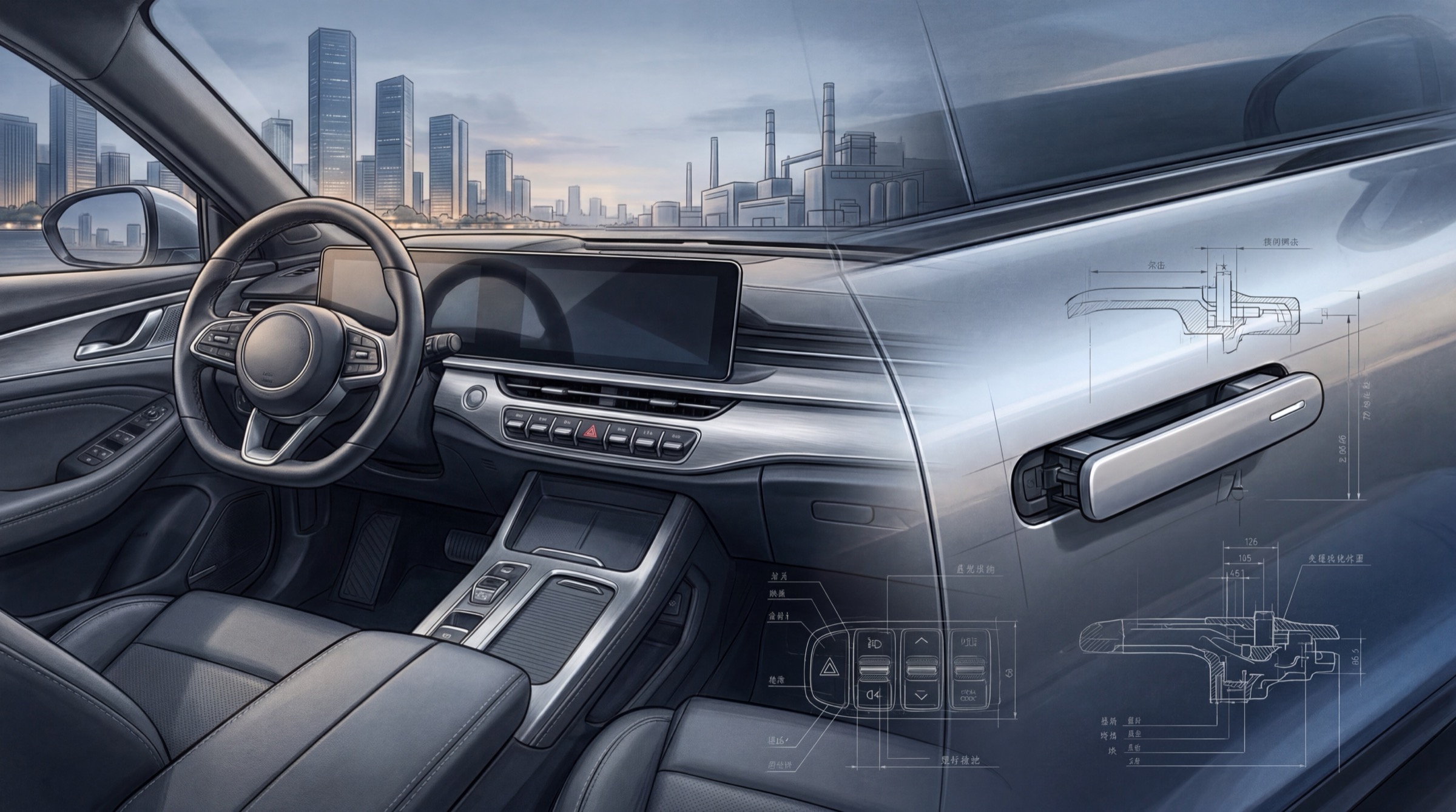
The firmest regulatory anchor in the package is GB 48001—2026, the national safety standard for automotive door handles. MIIT published its explanatory graphic on Feb. 2, confirming that the rule had already been released. International follow-up coverage from AP and NPR translated the practical consequence into simple language: China is moving against hidden, electronic-only door-handle designs by requiring a mechanical release path. In more technical terms, the rule is not banning every flush or powered handle as a styling choice. It is requiring that the handle system still provide a mechanical means of release and meet clearer safety and marking requirements.
The timing matters. The standard takes effect on Jan. 1, 2027. AP also reported that already approved vehicle models would get a longer transition period, extending compliance adjustment to Jan. 1, 2029. That phased structure is important because it shows regulators are not demanding an overnight industry reset. But it also means the direction is no longer hypothetical. Door-handle design has moved from an aesthetic and branding decision into a compliance question with a defined implementation clock.
The wider significance is that China appears to be the first major auto market to write this design issue into a formal national standard at scale. Hidden handles became popular as part of the minimalist EV look that companies such as Tesla helped normalize. China’s intervention suggests regulators now see emergency egress, rescue access and failure scenarios as important enough to override pure styling logic. That is a meaningful policy signal because it tells automakers that sleekness no longer gets to stand above mechanical redundancy.
Physical controls and yoke steering are not final yet — but the direction is unmistakable
The second and third parts of the story need more careful language, because they are not in the same stage as the door-handle rule. On Feb. 12, MIIT opened public consultation on five draft mandatory national standards, with comments due by Apr. 13, 2026. One of the most closely watched items in later reporting was the proposed revision to signage and controls requirements that would push critical functions away from screen-only interaction. CarNewsChina’s breakdown said the draft would require physical controls for functions such as turn signals, hazard lights, the horn, P/R/N/D selection, wipers, defogging, windows, the advanced emergency call system, EV power-off and ADAS activation. The draft logic emphasizes fixed positioning, blind operation and tactile or audible feedback.
That does not mean China has already made screen-heavy cockpits illegal. The accurate phrasing is that regulators are moving to require physical controls for critical functions, and they are doing so through a consultation-stage standard that has not yet fully taken effect. But even as a draft, it is a strong statement about where Chinese safety policy is heading. It says the cockpit cannot rely entirely on visual search and touchscreen logic when the function involved is essential to safe driving or emergency response.
The yoke issue needs similar precision. CarNewsChina reported on Feb. 13 that a draft steering-safety standard, GB 11557—202X, would subject steering wheels to impact testing at 10 fixed points around the rim. That matters because yoke or half-wheel designs do not offer the same continuous rim structure as a full round wheel. The draft therefore does not simply “ban” yokes in one sentence. Instead, it creates a compliance logic under which yoke-style steering designs become much harder to validate. That is the safer and more accurate way to write the story.
The common theme is mechanical redundancy and blind operation
These three lines of regulation look different on the surface, but they are all trying to solve a similar design problem. What happens when a driver needs to act quickly, under stress, in poor visibility, or in a failure scenario involving power or software? A mechanical door release helps when electronics fail or rescuers need predictable access. Physical controls matter when the driver should not have to hunt through a screen for a safety-critical function. A full steering wheel matters when crash validation and predictable hand placement take priority over futuristic styling.
In that sense, China is not only regulating a list of components. It is regulating a design philosophy. For years, many EV interiors and exteriors moved toward smooth surfaces, hidden mechanisms and screen-centric interaction because those choices signaled modernity and technological confidence. Beijing’s new approach says some parts of that minimalist aesthetic create too much operational ambiguity. Regulators are effectively pulling the industry back toward visible, tactile and mechanically backed-up interfaces.
That change is already starting to show up in product messaging. Xiaomi’s recent SU7 refresh was framed not only around LiDAR and hardware upgrades, but also around mechanical door handles and compliance with upcoming Chinese safety rules. That is a small but telling shift. Safety regulation is no longer a back-office engineering constraint. It is becoming part of the product story itself.
Why global carmakers should care
The global angle is what makes this more than a domestic standards update. China is not just the world’s largest EV market. It is also one of the most important markets for product development, supply-chain scale and manufacturing economics. If a door module, steering layout or cockpit interface must satisfy Chinese rules to compete in that market, automakers may decide it is easier to design one compliant architecture for multiple regions rather than one China-specific solution and another for export markets.
That does not mean Europe or the United States will automatically copy every Chinese rule. But it does mean China is starting to behave less like a passive destination for global auto design and more like a place where design constraints are written and then exported through scale. AP’s early reporting highlighted the global implications of the door-handle move, and later industry coverage framed the broader package as evidence that China is becoming a de facto rule-maker for EV design. That framing may be stronger than what regulators themselves would say, but it captures the strategic shift well: compliance in China is beginning to shape what “normal” future car design looks like.
What changed, and what comes next
What changed is that China’s auto story is no longer only about faster product cycles, cheaper batteries or harsher price competition. It is now also about regulators stepping in to decide which parts of the EV design language are acceptable and which are too risky. The finalized door-handle rule already gives the market a hard compliance deadline. The physical-controls and steering proposals give a clear preview of where the rest of the rulebook may be heading.
What comes next is a staged industry response, not an instant redesign of every vehicle on the road. Carmakers now have to treat Jan. 1, 2027 as the real implementation point for new door-handle requirements, with some approved models transitioning through Jan. 1, 2029. They also have to track the Apr. 13 consultation deadline and prepare for the possibility that China will formalize tougher standards around cockpit interaction and steering geometry. The key caveat is simple but essential: only the door-handle rule is already finalized. The physical-controls and yoke-related standards remain in draft or consultation form. Even so, the trajectory is already clear. China is no longer just the market where EV design scales. It is increasingly the market where some of the rules for that design are being written.
Sources
- MIIT — Illustrated explanation of GB 48001—2026, Safety Technical Requirements for Automotive Door Handles (2026-02-02)
- MIIT — Public consultation notice on five draft mandatory national standards, including intelligent connected vehicle and control-related requirements (2026-02-12)
- AP — China will ban hidden car door handles starting in 2027 (2026-02-03)
- CarNewsChina — China to require physical controls for vehicle functions, reducing reliance on central control screen (2026-02-16)
- CarNewsChina — China to ban half-steering wheels in new safety standard (2026-02-13)
Editorial caveats: Treat the door-handle standard as the finalized part of the package, with implementation from Jan. 1, 2027 and a reported transition period for already approved models through Jan. 1, 2029. Treat the physical-controls and steering-wheel items as draft or consultation-stage standards, not fully effective rules. The strongest interpretation is that China is moving to regulate minimalist EV design more aggressively, not that every screen-heavy cockpit or every yoke wheel has already been outlawed today.