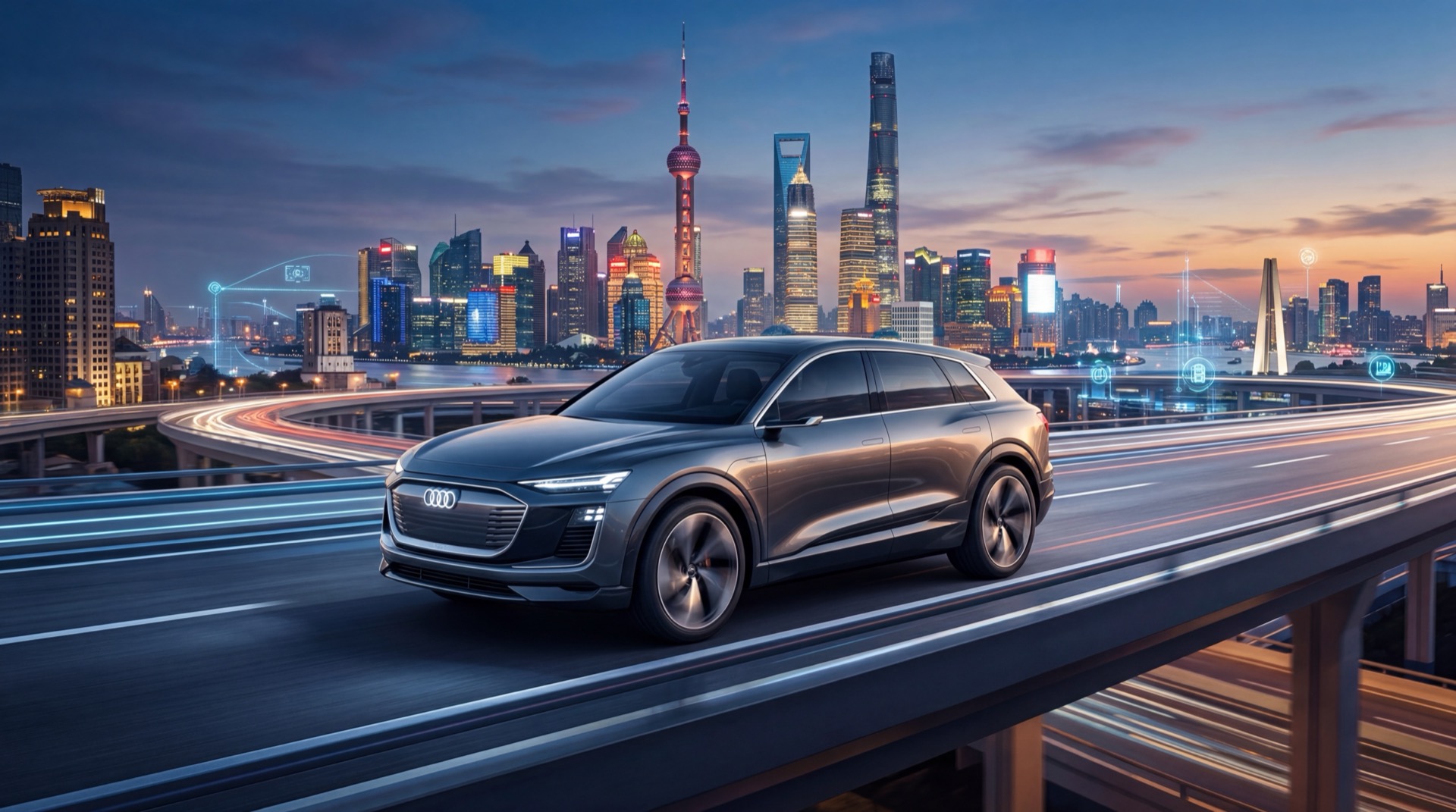
In mid-March, Audi’s China operation and follow-up reports clarified the E7X, a China-only electric SUV under the all-caps AUDI sister brand developed with SAIC. Audi has confirmed the model will debut at Auto China 2026 in Beijing and launch in the first half of 2026. Media reports built from the official app and website add the harder details: CATL battery cells, a 900V architecture, up to 751 km of CLTC range and Momenta-assisted driving. The bigger point is not another EV spec sheet. It is that China is no longer only where global carmakers sell electric cars, but increasingly where a legacy premium brand like Audi defines the product itself.
This is bigger than another Audi launch story
If this were only a launch note, the headline would be simple: Audi has another electric SUV coming. But the E7X matters because it sits inside a very different corporate and industrial setup from a normal global Audi product. Audi’s own MediaCenter says the E7X is the second production model from the China-exclusive AUDI sister brand and that it was jointly developed with SAIC on the Advanced Digitized Platform. That matters because the product is not being framed as a lightly localized version of a European Audi. It is being framed as a China-specific answer to China-specific market pressure.
That distinction changes the story. The real subject is not whether Audi can add one more premium EV to showrooms. It is whether a foreign legacy automaker now has to rely on Chinese joint-venture execution, Chinese batteries, Chinese software and Chinese digital integration to stay relevant in the world’s biggest EV market. In that sense, the E7X is not just a new vehicle. It is an unusually visible sample of how China’s EV stack is moving up the value chain, from manufacturing advantage to product-definition power.
What Audi has confirmed, and what media has filled in
A careful version of this story needs to separate three kinds of information.
First, there is what Audi has officially confirmed. The company says the E7X is a fully electric premium SUV for China, the second production model under AUDI, and a joint Audi-SAIC project tailored to Chinese customers. Audi has also confirmed the Beijing show window, April 24 to May 3, 2026, and the first-half 2026 market launch. The official release also gives core dimensions and confirms two powertrain outputs, 300 kW and 500 kW.
Second, there is the large body of specification detail compiled by media from the SAIC-Audi app and website. CarNewsChina reported a 109 kWh CATL-backed battery setup, up to 751 km of CLTC range, a 900V electrical architecture, a roof-mounted LiDAR unit and Momenta’s latest Flywheel model for highway and urban NOA. Carscoops added that battery-pack choices may span roughly 100 kWh to 109.3 kWh, with the range window stretching from 615 km to 751 km depending on configuration. Those details are useful, but they should stay clearly attributed to media reports compiling official Chinese-market materials, not treated as if Audi’s English-language press note had published every number in one place.
Third, there is what still has not been confirmed. Pricing remains undisclosed. The vehicle has not formally gone on sale yet. And none of this proves that Audi will export the same formula globally. That last point matters. The E7X is best read as a China-specific strategy, not as evidence that Audi worldwide will adopt one uniform China-designed EV template.
SAIC, CATL and Momenta are not side notes to this product
The strongest reason this story belongs on an analysis page rather than in a simple spec roundup is that the Chinese partner stack sits at the center of the product logic. Audi’s own language says the E7X combines Audi’s engineering with SAIC innovations in China’s digital ecosystem. CarNewsChina’s coverage adds CATL battery cells, a 900V platform and Momenta-assisted driver functions. Put together, that means the Chinese role is not limited to contract manufacturing or supplier cost savings. It reaches into architecture, battery strategy, software capability and the in-car digital experience.
That is the deeper shift. For years, foreign carmakers could treat China as a crucial sales destination and a production base while keeping core product-definition authority elsewhere. The E7X suggests that formula is getting harder to defend in EVs. In China’s premium EV market, the benchmarks now move too quickly and too locally. Battery range, charging architecture, assisted-driving expectations and digital ecosystem integration are no longer secondary features. They are part of the product’s identity. And on this vehicle, Chinese capabilities are doing a meaningful share of that defining work.
Why this matters for Audi’s position in China
Automotive News framed the E7X as part of Audi’s effort to halt its China sales slide, and that industrial context is essential. Audi is not localizing this aggressively for symbolic reasons. It is doing it because China’s premium EV market no longer rewards global prestige alone. Local consumers have become used to fast software updates, strong charging performance, advanced driver-assistance claims and heavy digital integration. Domestic rivals and fast-moving Chinese EV specialists have trained the market to expect that package.
That is why the E7X should not be described as Audi simply “bringing German engineering to China.” The more accurate reading is that Audi is trying to remain competitive in China by combining its brand equity with capabilities that China now leads or commercializes faster: JV speed, a deep battery supply chain, local driver-assistance software and a digital ecosystem designed around Chinese user habits. In plain terms, foreign incumbents increasingly need China not only as a market, but as a development environment.
This also explains why the AUDI sub-brand exists in the first place. The all-caps sister brand gives Audi more room to move faster, look different and respond more directly to local taste without forcing every China-market experiment to fit the visual and product conventions of the global four-ring lineup. That is not proof the strategy will win. It is proof the company thinks older playbooks are no longer enough.
What changed, and what could happen next
What changed this week is that a set of scattered product signals started to form a coherent industry story. The official Audi material confirmed the launch path and the SAIC-developed, China-exclusive positioning. CarNewsChina and ArenaEV turned the official Chinese-market materials into a readable spec package. Carscoops pushed the interpretation further and treated the E7X as evidence that China is reshaping what an Audi SUV can look like. Taken together, those signals make the E7X more than a product preview. They make it a case study in how China is becoming the reference point for at least some foreign brands’ EV decisions inside China.
What happens next still depends on factors not yet public. Price remains unknown. The car has not been formally launched. Actual reception will depend on execution, not just messaging. But even before those answers arrive, the strategic meaning is visible. The E7X shows that China is no longer merely the biggest EV arena where global brands try to protect share. It is increasingly the place where they learn what a competitive premium EV has to be. If that trend deepens, more foreign incumbents may end up using Chinese partnerships, Chinese software and Chinese battery ecosystems not as supplements, but as the core of their China-market product definition.
That shift toward China-defined product decisions also sits alongside Mercedes-Benz Debuts VLE Electric MPV, Confirms China Production at Fujian Benz, China’s EV Battery Makers Top 70% Global Share as BYD’s Five-Minute Charging Raises the Bar and China’s EV Safety Reset Targets Door Handles, Controls and Yokes, because together they show foreign brands relying more heavily on local production, China’s battery stack and fast-moving market expectations to stay credible in premium EVs.
Sources
- Audi MediaCenter — AUDI E7X: all-electric premium SUV for China (2025-12-08)
- CarNewsChina — AUDI E7X electric SUV debuts on official website, 0-100 km/h in 3.97s and 109kWh CATL battery (2026-03-18)
- Carscoops — China Rewrites What An Audi SUV Should Look Like (2026-03-19)
- ArenaEV — AUDI E7X officially launches in China (2026-03-18)
- Automotive News — Audi hopes new SAIC-developed EV will halt China sales slide (2026-03-18)
Editorial caveats: Keep Beijing debut timing, first-half 2026 launch and Audi-SAIC joint development as official information. Keep detailed battery, range, acceleration, LiDAR and Momenta NOA claims attributed to media reports compiling the official app and website. Do not write the price as known, do not imply deliveries have started, and do not present the E7X as proof that Audi will export the same China-defined formula globally.