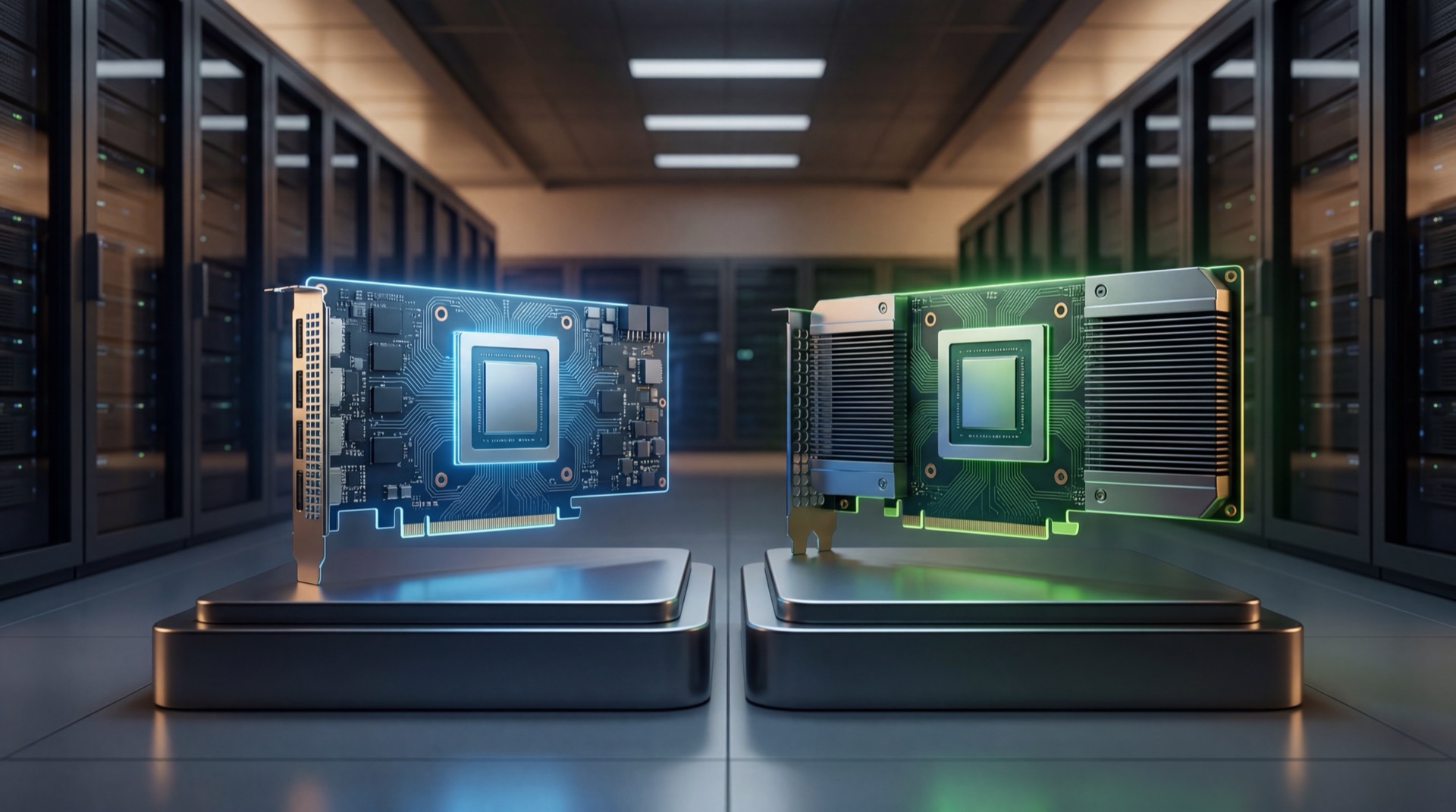
At Huawei’s China Partner Conference and Ascend AI partner summit in Shenzhen on March 19-20, the company launched the Atlas 350 accelerator card built on its Ascend 950PR processor and said it can deliver roughly 2.8 times Nvidia’s H20 on FP4 inference workloads. That claim matters because it pushes China’s AI chip narrative beyond sanctions survival and into product-level competition in the inference layer now driving enterprise AI spending. If Huawei can turn an event-stage performance pitch into real deployments, Chinese companies may begin treating a domestic accelerator not just as a fallback under export controls, but as a more credible default option for local AI infrastructure.
This is not just another domestic chip launch
Huawei’s own framing around the Shenzhen events helps explain why this launch deserves more than a routine hardware write-up. On March 19, the company opened Huawei China Partner Conference 2026 with a broader message about building a stronger computing base, expanding Ascend-centered ecosystems and helping partners deploy AI across industries. That matters because the Atlas 350 was not introduced as an isolated component announcement. It appeared inside a larger pitch that China’s AI stack now needs deployable infrastructure, partner integration and workload-specific optimization, not just abstract claims of self-reliance.
That is what makes the product more interesting than a generic “Huawei launched a new chip card” story. For the past few years, much of the China AI chip discussion has centered on shortages, restrictions and whether domestic vendors could fill the hole left by tighter U.S. export controls. Atlas 350 changes the tone. The real message is no longer simply that China can produce an alternative. It is that Huawei is willing to publicly frame that alternative against Nvidia’s China-tailored H20 and argue that local hardware can be better suited to the inference jobs Chinese enterprises actually want to run.
What Huawei announced, what media filled in, and what is still unverified
A careful reading of this launch has to separate three layers of information.
First, there is what Huawei and its event speakers clearly put on the table. Huawei announced that Atlas 350 is the first shipping hardware product in the Ascend 950 generation, that it uses the new Ascend 950PR processor, and that it is aimed at recommendation inference, multimodal generation and large language model inference. The company also used the Shenzhen partner event to highlight a seven-partner rollout, with vendors including Kunlun, H3C-backed or state-linked server makers such as Hua Kun Zhenyu, Shenzhou KunTai, Changjiang Computing, PowerLeader, iSoftStone and Baixin unveiling Atlas 350-based systems.
Second, there is the larger spec package reported by Chinese media and summarized by South China Morning Post for an international audience. Those reports say the card reaches 1.56 PFLOPS at FP4 precision, includes 112GB of HBM memory, offers 1.4TB/s of bandwidth and runs at 600W. Chinese event coverage also attributed to Huawei executives the claim that Atlas 350 delivers about 2.8 to 2.87 times the single-card computing performance of Nvidia’s H20, while improving multimodal generation speed by about 60 percent and reducing memory access granularity from 512 bytes to 128 bytes, which reportedly lifts small-operator memory efficiency by roughly four times.
Third, there is what no one should overstate. Those headline-grabbing comparisons still come primarily from Huawei’s own event stage and media reports relaying the event, not from a neutral third-party benchmark suite. That distinction is essential. The right language here is “Huawei said” or “according to executives speaking at the event,” not “Atlas 350 has been independently proven to beat H20 across the board.” There is also still no widely disclosed pricing, shipment volume or independent customer performance data. Commercial rollout has begun through partners, but that is not the same thing as broad market validation.
Why the inference angle matters more than the benchmark theater
The most important strategic detail is not the raw 2.8-times-H20 claim. It is the product’s positioning around inference. Huawei and event coverage repeatedly framed Atlas 350 as an inference-focused accelerator for recommendation systems, multimodal generation and LLM inference rather than as a universal answer to every AI compute task. That matters because enterprise AI spending in 2026 is moving toward deployment density, response efficiency and cost-per-inference, not only headline training ambition.
That is also why Nvidia’s H20 is the natural comparison point. H20 is widely understood as Nvidia’s China-compliant product for a restricted market, not as the company’s unconstrained global flagship. So Huawei is not trying to argue that it has leapfrogged Nvidia on every training or software dimension. The sharper point is narrower and more commercial: if Chinese companies mainly need a reliable inference accelerator for local enterprise workloads, then a domestic card optimized around those needs may be more relevant than a compromised imported option designed to stay within export-control boundaries.
This is where the China story begins to shift. Under the old frame, a domestic accelerator was something buyers considered because the best Nvidia products were unavailable. Under the new frame Huawei is trying to build, a domestic accelerator could become attractive because it is tuned for the local deployment environment itself: Chinese enterprise inference loads, Chinese partner systems, Chinese cloud and industry stacks, and Chinese software ecosystems built around Ascend. That is a much more ambitious story than substitution under pressure.
The 600W caveat and the limits of the current pitch
Still, the bullish interpretation should not ignore the trade-offs embedded in the same spec sheet. The reported 600W power draw is high, and it deserves to sit in the story next to the performance claims, not disappear under the marketing headline. If Huawei wants Atlas 350 to be read as a practical enterprise inference default, then power efficiency, thermal constraints, rack-level deployment economics and software maturity will matter almost as much as single-card throughput. Readers should also keep in mind that a product optimized for FP4 inference is not automatically the best answer for all training, compatibility or ecosystem requirements.
That caveat is especially important because the launch arrives at a moment when Chinese AI infrastructure buyers are making more nuanced decisions than simple import substitution. Hardware performance is only one layer. Software tooling, model portability, developer familiarity and integration into production systems are equally important. Huawei’s conference messaging suggests the company understands that, which is why the seven-partner rollout matters. It signals that Huawei is trying to sell an ecosystem and a deployable stack, not just a spec sheet.
Why the seven-partner rollout may matter as much as the chip itself
If Atlas 350 had appeared only as a lab-grade accelerator or a roadmap announcement, the story would be much weaker. Instead, Huawei paired the product with seven partner-backed server launches at the event. That is a meaningful commercialization signal. It suggests the company wants Atlas 350 to move quickly into packaged systems and industry solutions rather than remain a symbolic semiconductor milestone.
For international readers, this is the more durable implication. China’s AI hardware contest is increasingly about who can assemble a usable stack: accelerator cards, complete systems, tuned inference workloads, developer tools and industry-facing deployment channels. Nvidia still carries enormous advantages in software, installed base and global developer mindshare. But inside China, export controls have already changed the reference point. The most relevant question is no longer whether a domestic vendor can exactly replicate Nvidia’s full global position. It is whether Chinese enterprises now have a serious local option that is good enough, deployable enough and workload-appropriate enough to become the default for a meaningful share of inference spending.
What changed this week, and what could happen next
What changed this week is that Huawei made that argument in unusually direct terms. By launching Atlas 350 during its March 19-20 Shenzhen partner events, tying it to the Ascend 950PR generation, publicly comparing it with H20 on FP4 inference workloads and rolling it out through seven partners, Huawei turned China’s AI chip discussion from a defensive story into an offensive one. The company is effectively saying that the next phase of China’s AI hardware race will be decided not only by surviving sanctions, but by winning the inference workloads that real customers are now buying.
What happens next depends on factors the launch itself cannot settle. Third-party testing still needs to verify how Atlas 350 performs in production conditions. Buyers will want clearer evidence on software maturity, deployment economics and sustained workload behavior. Pricing and shipment scale also remain unclear. But even before those answers arrive, the narrative has already shifted. China’s domestic AI hardware stack is no longer only asking whether it can replace restricted imports in an emergency. It is beginning to ask whether it can become the preferred platform for local enterprise AI inference. That is the strategic meaning of Atlas 350, and it is why this launch matters more than another domestic chip headline.
That China’s inference-centered hardware contest is now colliding with earlier reporting on Nvidia says China H200 orders are in as Reuters reports Beijing approval and a Groq inference play, Huawei launches an AI inference data infrastructure stack spanning central and edge deployments and A Shenzhen Startup Says Its AI Agent Ported DeepSeek-OCR-2 to Huawei Ascend in 38 Minutes, because together they show China’s AI stack moving from emergency substitution toward deployable local inference ecosystems.
Sources
- Huawei Enterprise Business — Huawei China Partner Conference 2026 opens in Shenzhen (2026-03-19)
- IT Home — Huawei Atlas 350 accelerator card launched with the new Ascend 950PR processor (2026-03-21)
- South China Morning Post — Huawei challenges Nvidia with powerful new AI accelerator card (2026-03-20)
- Guancha.cn — Huawei launches a new AI accelerator card, China’s only FP4-supported inference product, with computing power nearly triple that of H20 (2026-03-21)
- Securities Times — Huawei unveils a new generation of computing chip products (2026-03-21)
Editorial caveats: Keep the Atlas 350 launch, Ascend 950PR branding and partner-conference context as official/event-grounded facts. Keep the 1.56 PFLOPS FP4 figure, the roughly 2.8-times-H20 comparison, the 112GB HBM capacity, the 1.4TB/s bandwidth, the 600W power figure and the 60 percent multimodal-generation improvement attributed to Huawei executives or media reports relaying the event. Do not present those figures as independently verified third-party benchmarks. Do not imply public pricing, confirmed shipment scale or universal superiority over Nvidia’s broader lineup. Keep the card framed as inference-focused and the commercialization story framed as a seven-partner rollout rather than a fully proven mass-market deployment.