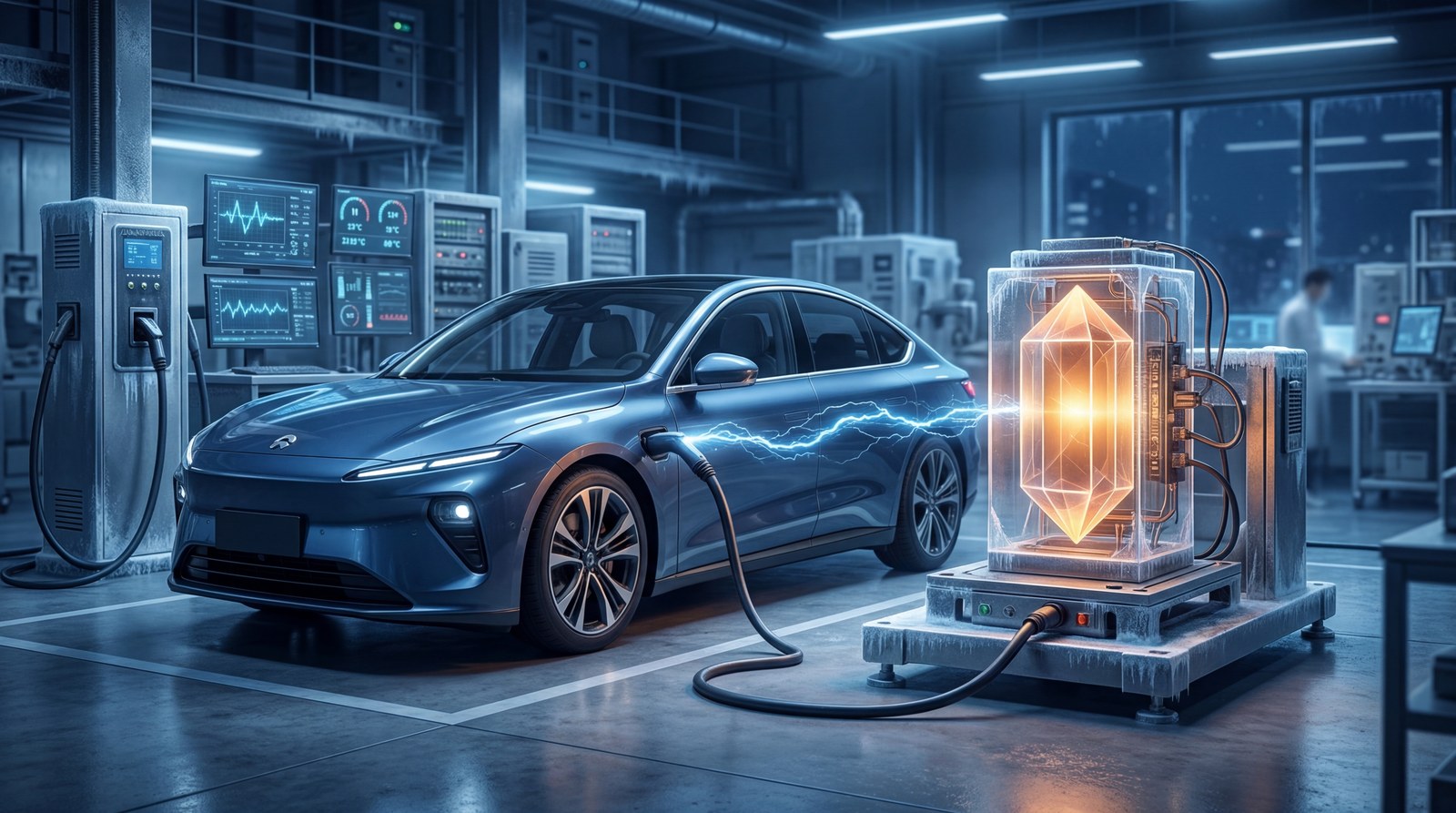
On March 19, BAIC said it had completed a sodium-ion battery prototype with cell energy density above 170 Wh/kg, 4C fast charging that can recharge in about 11 minutes, and operating capability from -40°C to 60°C with more than 92% energy retention at -20°C. Those figures, still based mainly on company disclosures relayed by Chinese and industry media, matter because they suggest China’s electric-vehicle race is no longer only about price cuts, sales rankings, or the dominance of lithium battery champions like CATL and BYD. It is widening into a contest over next-generation battery chemistry, with automakers themselves trying to own sodium-ion capabilities rather than simply wait for suppliers to define the next step.
BAIC is trying to make battery chemistry part of its own identity
The most important part of the announcement is not merely that BAIC built another battery sample. Chinese automakers regularly talk about battery sourcing, safety, or charging. What stands out here is that BAIC wants to show it can claim a seat in the chemistry race itself. According to media reports relaying the company’s R&D account, BAIC has completed a sodium-ion sample and opened up a prismatic-cell manufacturing process, while also filing about 20 patents around the technology.
That framing matters because it shifts BAIC from being a buyer of battery technology to a company that wants to be seen as building its own battery stack. The company’s broader Aurora Battery language reinforces that idea. BAIC is not presenting sodium-ion as an isolated lab experiment. It is presenting a portfolio that spans lithium batteries, solid-state batteries, and sodium-ion batteries, which turns the message into something larger: BAIC wants investors, partners, and future customers to think of it as an automaker with a multi-chemistry roadmap.
That is a different story from the more familiar China EV narrative centered on product launches, discounting, or export pressure.
Recent 1M Reviews coverage has tracked that older framing through Audi’s China-only E7X push and China’s EV safety reset, both of which focused on product definition, regulation, and commercial pressure rather than a new chemistry stack. Here, the company is trying to argue that future competitiveness may come from controlling alternative chemistry options that fit specific use cases better than today’s default lithium-ion route.
The specifications explain why sodium-ion is getting attention
The parameter set is what makes the story travel beyond China. BAIC’s reported prototype combines more than 170 Wh/kg cell-level energy density, 4C fast charging, an about 11-minute full recharge window, operating tolerance from -40°C to 60°C, and more than 92% energy retention at -20°C. For English-language readers, that package is more meaningful than a vague claim of a “breakthrough.” It points to the exact reasons sodium-ion keeps attracting attention: cost potential, low-temperature resilience, and the possibility of reducing dependence on lithium-heavy supply chains.
The low-temperature angle is especially important. One of sodium-ion’s most frequently discussed advantages is better performance in cold conditions compared with many lithium-based setups. BAIC is leaning directly into that use case. If those numbers eventually translate beyond the prototype stage, they would give sodium-ion a more practical role in affordable EVs, fleet vehicles, and cold-climate applications where winter performance still shapes the user experience.
Fast charging is the second major hook. A chemistry platform associated mainly with cost or cold-weather resilience can still look secondary if charging remains too slow. That is why BAIC’s claimed 4C charging and roughly 11-minute refill time matter so much in the narrative. The company is trying to show that sodium-ion does not have to be framed as the budget chemistry that sacrifices convenience. It wants readers to see it as a candidate for real-world EV usability.
China’s battery race is widening beyond battery champions
The broader industry context is what turns BAIC’s prototype into a strategic signal. Over the past months, China’s sodium-ion conversation has already been shaped by battery giants and major supply-chain players, including CATL and partners such as Changan, while BYD has also discussed progress on later-generation sodium-ion work. Earlier 1M Reviews coverage on China’s EV battery makers topping 70% global share as BYD’s five-minute charging raised the bar showed how concentrated the current battery hierarchy still looks. What BAIC adds is a different kind of signal: the next battery race may not belong only to battery makers.
That could have real implications for how China’s EV industry evolves. If automakers want to own more of the chemistry narrative themselves, then the competitive map changes. Battery technology becomes less of a component story and more of a platform story tied to product planning, supply-chain bargaining power, regional climate strategy, and long-term vehicle cost structure. In that scenario, a car company is not just choosing among supplier roadmaps. It is trying to shape them or build parallel options.
This is why BAIC’s announcement lands as more than another technical milestone. It hints that Chinese OEMs increasingly want next-generation battery chemistry to become part of their industrial identity. The strategic pitch is not simply “we can buy advanced batteries.” It is “we can help define which chemistry wins in the next phase of electrification.”
That framing also broadens the China EV story for international readers. Much of the global coverage of Chinese EV competition still revolves around price wars, manufacturing scale, and export expansion. BAIC’s sodium-ion prototype points to a more ambitious reading: China’s EV competition is moving deeper into control over the next underlying technology stack.
What still needs proof before this becomes a commercial turning point
A careful reading still needs restraint. Nearly every headline metric in this story depends on BAIC’s own disclosures as relayed by media outlets, not on independent third-party validation. The more-than-170 Wh/kg figure should be treated as a cell-level prototype number, not as proof of a production-ready battery pack. The same caution applies to the 11-minute charging claim, the low-temperature retention figure, and the wide temperature operating range.
There is also a difference between a sample-stage success and a commercial battery program. BAIC has not yet attached this sodium-ion battery to a specific production vehicle timeline, and it has not shown that the chemistry is ready for large-scale deployment across its lineup. The safest language is that BAIC has completed a sodium-ion prototype and opened up a prismatic-cell manufacturing route, not that it is already shipping sodium-ion EVs.
This distinction matters because sodium-ion remains an early-stage industrial bet. The technology may become important in lower-cost vehicles, cold-weather markets, and supply-diversified electrification, but that does not mean the competitive hierarchy is settled. Prototype headlines can arrive much earlier than mass adoption. For now, BAIC’s announcement is best read as a signal of where Chinese automakers want the race to go, not final proof that the race has already been won.
What changed this week, and what could happen next
What changed this week is that a Chinese automaker publicly tried to turn sodium-ion chemistry into part of its own strategic identity rather than leaving that narrative to battery suppliers. BAIC used a prototype announcement to argue that the future EV contest will not be defined only by who cuts prices fastest or who ships the most lithium batteries. It may also be defined by who owns the next chemistry roadmap for affordability, cold-weather usability, and supply-chain flexibility.
What happens next depends on execution. If BAIC or other Chinese automakers can move sodium-ion from prototypes into clearly identified vehicle programs, the center of gravity in the battery race could shift further from pure supplier dominance toward tighter OEM control. If they cannot, this will still remain an important marker: the moment China’s EV industry began to frame next-generation battery chemistry as an automaker capability, not just a supplier feature. Either way, the message is already clear. China’s battery race is no longer only about lithium scale. It is becoming a battle over who gets to define the chemistry after lithium.
Sources
- IT Home — BAIC sodium-ion battery breakthrough reaches industry-leading level (2026-03-19)
- Electrek — Another sodium-ion EV battery breakthrough emerges in China with 4C fast charging in 11 mins (2026-03-20)
- CnEVPost — BAIC unveils sodium-ion breakthrough, joining China’s battery push (2026-03-20)
- CarNewsChina — 11-minute full charge: BAIC’s sodium-ion leap challenges lithium dominance (2026-03-20)
Editorial caveats: Treat the more-than-170 Wh/kg figure, roughly 11-minute charging, more-than-92% retention at -20°C, and the -40°C to 60°C operating range as BAIC-linked claims relayed by media, not as independently verified production outcomes. Do not imply that BAIC has already commercialized sodium-ion EVs or that the prototype metrics automatically translate to pack-level, mass-market vehicle performance.