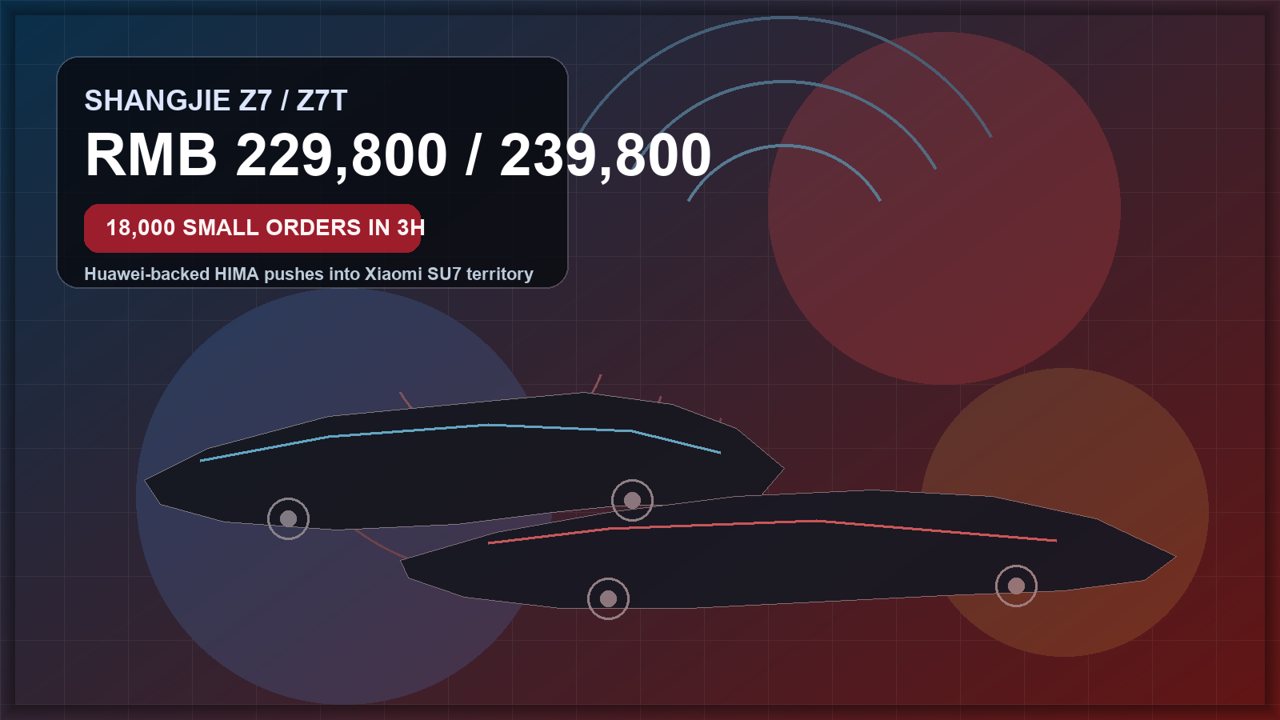
Huawei-backed Harmony Intelligent Mobility Alliance (HIMA) opened pre-sales on March 23 for the Shangjie Z7 and Z7T at RMB 229,800 and RMB 239,800, and Chinese outlets later reported 18,000 small orders in three hours. Those figures should be read as early reservations rather than deliveries or locked-in sales. The bigger story is strategic: Huawei and SAIC are moving a 896-line LiDAR, ADS 4.1 driver-assistance stack, an 800V battery platform and up to 905 km of CLTC range into the same mass-premium electric coupe and shooting-brake segment where Xiaomi SU7 has become one of China’s most visible benchmarks.
This is the formal pre-sale stage, not another filing rumor
The first reason the launch matters is that it marks a commercial step forward from earlier regulatory or lineup chatter. HIMA’s official site now lists the Shangjie line with a booking entry, while Chinese launch coverage on March 23 put the Z7 at a pre-sale starting price of RMB 229,800 and the Z7T at RMB 239,800. In other words, this is no longer a story about Huawei’s broader auto ecosystem expanding in theory. It is the formal pre-sale stage for a new Huawei-backed electric-car pair, with pricing, positioning and reservation mechanics already on the table.
That distinction matters for site-history de-duplication as well. Earlier coverage around Huawei-affiliated models had touched the Shangjie name only in passing, mostly in the context of MIIT-style filing or broader product-matrix discussion. Round_223 is different because the news peg is concrete: pre-sales have opened, the cars now have public starting prices, and the market has already produced an initial reservation signal. Framing it as a launch-and-demand story rather than a vague “Huawei expands its car lineup” piece is what keeps the article fresh and more internationally legible.
Huawei is pushing its full smart-driving stack into a mainstream price band
The core industry significance is not just that Huawei has another EV on stage. It is that the Shangjie Z7 line is being sold as standard-equipped with a package that Chinese coverage normally associates with more expensive trims and higher-end branding. IT Home and Autohome both highlighted five Huawei technology pillars across the range: a 896-line dual optical-path imaging LiDAR setup, Huawei’s ADS 4.1 driver-assistance system, the Huawei Tuling platform, a Huawei Giant Whale 800V high-voltage battery platform and the Harmony cockpit. That gives Huawei a much sharper story than simple badge appeal. It is trying to make advanced sensing and software a volume-market differentiator rather than a niche premium add-on.
That pricing move is important because the Shangjie Z7 is entering one of China’s most fought-over EV brackets. The roughly RMB 230,000 zone is where consumers start comparing styling, acceleration, range, brand heat and driver-assistance capability side by side. Xiaomi SU7 has already shown how much attention a tech-branded electric sedan can pull in that band, while Tesla Model 3, XPeng P7 and Zeekr 001 remain obvious reference points in Chinese coverage. Huawei’s message with the Z7 and Z7T is that it no longer wants its strongest automotive software-and-sensor pitch to stay above the mainstream market. It wants that pitch in the center of the price war.
The hardware sheet is designed to support more than a hype cycle
The specification package helps explain why the launch is more than a marketing event. Chinese launch recaps say the cars use 81 kWh and 100 kWh battery options, offer a single-motor rear-wheel-drive setup rated at 264 kW and a dual-motor all-wheel-drive version rated at 434 kW, and can reach up to 905 km of CLTC range in the longest-range configuration. Autohome also cited a 0-100 km/h acceleration time of 3.44 seconds for the dual-motor version. Those numbers do not prove real-world superiority on their own, and CLTC should always be read as a domestic test-cycle figure rather than universal road performance. But they do show that Huawei and SAIC are not asking buyers to choose between tech features and basic EV credentials.
The body format also broadens the commercial bet. Chinese reports describe the Z7 as a large electric coupe and the Z7T as the wagon-like variant, with the Z7 measuring 5,036 mm in length on a 3,000 mm wheelbase. That matters because the pair is not simply chasing one narrow customer profile. The Z7 can go after buyers who want a more overtly sporty sedan silhouette, while the Z7T gives HIMA a product better aligned with shoppers who want cargo flexibility without moving up into an SUV. In a market as crowded as China’s, that kind of two-body-style rollout can help Huawei turn one launch into a broader shelf-presence strategy.
The “18,000 in three hours” headline is useful, but only with the right caveat
The most clickable metric attached to the launch is the report that the Shangjie Z7 and Z7T logged 18,000 small orders within three hours. That figure is worth using because it says something real about opening-night attention. A new Huawei-backed EV pair entering a high-traffic price band and quickly drawing that level of reservation interest tells us the market was paying attention. It also gives the launch a stronger immediate-news hook than a pure specification recap.
At the same time, the wording has to stay disciplined. Chinese source material consistently frames the figure as small orders, reservation volume or initial booking interest. It should not be rewritten as delivered units, final sales or even fully locked firm orders. Early reservation numbers in China’s EV market are useful signals, but they are still top-of-funnel indicators. They say the launch generated curiosity and purchase intent. They do not prove long-term demand durability, conversion quality or a smooth delivery ramp. PChome’s report that display cars and test-drive units are entering more than 200 stores across 90 cities, with deliveries expected in the second quarter, helps show that commercialization is moving forward, but the real test will come later.
Why this remains a very China-specific story
This topic still satisfies the hard “China relevance” requirement because every critical moving part is rooted in China’s domestic EV competition. Huawei is supplying the software, sensor and ecosystem narrative through HIMA. SAIC is the industrial partner behind the Shangjie line. Xiaomi SU7 is the most obvious competitive reference because it has become a defining benchmark for a younger, tech-forward electric sedan audience in China. Even Tesla Model 3, XPeng P7 and Zeekr 001 enter the story through a Chinese-market comparison frame rather than through a generic global-EV lens.
That domestic framing is also why international readers should care. China’s EV market is where pricing pressure, hardware bundling and software feature competition are being compressed at extraordinary speed. When Huawei starts pushing 896-line LiDAR and ADS 4.1 into a pre-sale bracket around RMB 230,000, it suggests that advanced driver-assistance hardware is moving further down the pricing ladder. That has implications beyond one car launch. It points to a market in which Chinese brands increasingly treat high-spec sensor stacks as mainstream selling points rather than halo-only features.
What changed, and what could happen next
What changed on March 23 is that Huawei’s automotive strategy became easier to read in volume-market terms. HIMA is no longer only associated with higher-priced SUVs or broader ecosystem storytelling. With the Shangjie Z7 and Z7T, Huawei and SAIC are trying to bring a very Huawei-coded mix of LiDAR, ADS 4.1, 800V architecture and long-range positioning into a segment where price-sensitive but tech-hungry buyers are already comparing Xiaomi, Tesla, XPeng and Zeekr products line by line. That is the real competitive development, not just the reservation headline.
What happens next will determine whether the launch becomes a durable market turning point or just a strong first-night signal. The first question is conversion: how many of those early small orders become firmer orders as the launch cycle matures. The second is pricing discipline: if final market pricing stays aggressive while the core hardware promise remains intact, the Shangjie pair could sharpen pressure on Xiaomi SU7 and other rivals in China’s mass-premium EV class. The third is execution: second-quarter delivery timing, store rollout and user feedback on Huawei’s driver-assistance experience will matter more than event-stage language. For now, the safest conclusion is that Huawei has made its intent unmistakable: it wants its smartest automotive stack fighting in China’s mainstream electric-sedan battlefield, not watching from a more expensive tier.
Related coverage on 1M Reviews
- Xiaomi Gives the SU7 Standard LiDAR at a Near-Flat Price
- Dongfeng Took Voyah to Hong Kong Without Raising Fresh Cash as China’s State Carmakers Pushed a Huawei-Backed Premium EV Story
- China’s EV Safety Reset Targets Door Handles, Controls and Yokes
Sources
-
HIMA official Shangjie page
– https://hima.auto/shangjie/
– Key takeaway: Confirms the Shangjie model line is live on HIMA’s official site with a booking entry, supporting the formal pre-sale-stage framing. -
IT Home — pre-sale launch recap
– https://www.ithome.com/0/931/792.htm
– Key takeaway: Confirms the March 23 pre-sale launch, the RMB 229,800 / RMB 239,800 starting prices, the 896-line LiDAR, ADS 4.1, 800V battery platform and the up-to-905-km CLTC figure. -
IT Home — follow-up on early reservation momentum
– https://www.ithome.com/0/931/907.htm
– Key takeaway: Reports that the Shangjie Z7 / Z7T logged 18,000 small orders in three hours and repeats the core launch positioning. -
Autohome — specs, performance and competitor framing
– https://www.autohome.com.cn/news/202603/1313109.html
– Key takeaway: Adds battery, motor and acceleration details, and frames Xiaomi SU7, Tesla Model 3, XPeng P7 and Zeekr 001 as key rivals. -
PChome — commercialization and delivery context
– https://article.pchome.net/info/12087.html
– Key takeaway: Adds the 90-city / 200-store display-and-test-drive rollout and the expectation that deliveries will begin in the second quarter.
Editorial caveat: The reported “18,000 in three hours” figure refers to small orders or early reservations, not deliveries or guaranteed long-term sales. The HIMA official page is useful as proof of launch-stage presence and booking availability, but detailed specifications in this article rely primarily on Chinese media launch recaps rather than the official landing page alone.