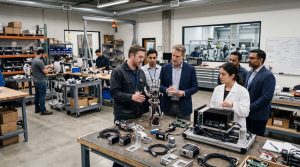
Leju Robotics and Dongfang Precision have put an automated humanoid-robot assembly line into operation in Foshan, Guangdong, with reported annual capacity of 10,000 units and throughput of one robot every 30 minutes. English-language reporting from China Daily, Newsgd, CGTN, and independent outlets says the line digitalizes 24 precision assembly processes, includes 77 inspection or testing procedures, and lifts production efficiency by more than 50% versus traditional methods. The significance is bigger than one factory update. It suggests China’s humanoid-robot race is starting to produce a new kind of signal for investors and industry watchers: not just what a robot can do on stage, but how quickly companies think they can build it at industrial scale.
A manufacturing headline with unusually concrete numbers
The strongest part of this story is that it comes with hard production language rather than vague ambition. The Foshan line is repeatedly described as China’s first automated humanoid-robot production line, and multiple English reports converge on the same operational metrics: annual capacity of about 10,000 units, a takt time of one robot every 30 minutes, 24 digitalized assembly stages, and 77 quality-control or testing procedures. China Daily also highlighted a 92% automation rate across key processes and assembly precision reaching 0.02 millimeters.
That level of detail matters because humanoid-robot coverage often swings between flashy demonstrations and broad market forecasts. What is usually missing is evidence that companies are beginning to translate prototype work into repeatable factory systems. Foshan offers a more concrete data point. Instead of arguing in the abstract that embodied AI is becoming commercial, Leju and Dongfang Precision are pointing to throughput, inspection density, and process engineering.
For English-language business readers, that changes the frame. The relevant question is no longer only whether Chinese robotics companies can build impressive demos. It becomes whether they can create manufacturing systems that make output more predictable, reduce unit inconsistency, and support higher-volume delivery if demand arrives.
The line reflects a broader shift in China’s humanoid-robot race
China’s humanoid-robot push has generated plenty of headlines over the past year, but most have centered on funding rounds, trade-show demonstrations, policy support, or pilot use cases. The Foshan line is interesting because it belongs to a later stage of the story. It is about industrialization.
That distinction is important. A sector can attract capital and public attention long before it proves it can manufacture at scale. In robotics, that gap is especially wide because each step from prototype to volume production creates new challenges: component consistency, calibration, final inspection, yield management, supply coordination, and software-hardware integration under factory conditions. A line that claims mixed-model flexible assembly and standardized testing is therefore not just a productivity tool. It is a statement that the companies involved believe humanoid robots are becoming a manufacturing problem as much as a design problem.
This is where the Foshan project fits a broader China narrative. Chinese advanced manufacturing sectors often become globally competitive not only because of product development, but because local companies and regions get very good at compressing the time between prototype, process engineering, and scaled output. If the reported numbers hold up in practice, Foshan may become one of the clearest examples yet of embodied AI moving into that phase.
Leju and Dongfang Precision are showing the kind of division of labor the sector needs
The partnership also tells its own story. Leju brings the robotics side of the equation: humanoid products, software integration, and a technology narrative tied to embodied intelligence. Dongfang Precision brings industrial-manufacturing credibility, especially in automation and equipment. Put together, the arrangement looks less like a single company trying to do everything and more like an early version of the supply-chain specialization that mature manufacturing sectors usually require.
That matters because humanoid robots will be difficult to scale if every company insists on treating the product as a pure research project. Industrialization typically arrives when responsibilities begin to split more clearly across the value chain. Product companies focus on systems, capabilities, and application fit. Manufacturing partners focus on process stability, assembly efficiency, testing, and delivery rhythm. The Foshan line looks notable precisely because it suggests China’s humanoid ecosystem is starting to build that separation of roles.
The location matters too. Foshan sits in one of China’s densest manufacturing regions, where supply-chain access, automation know-how, and industrial subcontracting are easier to mobilize than in many other markets. That does not guarantee commercial success, but it does help explain why this kind of production experiment is emerging in Guangdong instead of remaining stuck in the concept phase.
What the factory line proves, and what it does not
The most sensible reading of the Foshan project is neither breathless nor dismissive. On the positive side, the line clearly gives the humanoid-robot market a stronger industrial signal than a funding announcement or promotional demo would. A company claiming 10,000 units of annual capacity is telling suppliers, investors, and customers that it sees a path toward meaningful production volume. The use of digitalized assembly, multiple inspection stages, and flexible manufacturing language also suggests an effort to build a proper manufacturing system rather than a showroom narrative.
At the same time, readers should resist the temptation to overstate what has been achieved. Reported annual capacity is not the same thing as realized shipments. One robot every 30 minutes does not automatically mean demand exists at that pace. And a line entering operation does not settle the harder commercial questions around unit economics, downstream applications, after-sales support, or how many customers are ready to buy humanoid robots in meaningful quantities.
The wording also deserves care. It is safer to describe the 10,000-unit figure as reported or claimed capacity than as proven output. That is not skepticism for its own sake. It is simply the distinction that serious industrial reporting should maintain until longer-term production evidence emerges.
What changed, and what could happen next
What changed this week is that China’s humanoid-robot story gained a factory-scale benchmark. Instead of another headline about a robot learning new motions or another company raising money, the market now has a more operational signal: a production line in Foshan with named partners, reported throughput, and specified assembly and inspection architecture. That makes the sector easier to analyze through the lens of manufacturing capability, not just technological promise.
What happens next is even more important. If Leju and Dongfang Precision can show sustained output, stable quality, and visible customer deployment, the Foshan line could become evidence that China is moving faster than many rivals from humanoid prototypes to industrial delivery systems. If the line remains more symbolic than commercial, it will still matter as a marker of where the competition is heading: toward throughput, yield, flexible assembly, and regionally anchored supply chains.
Either way, the direction is now clearer. China’s humanoid-robot race is no longer only about building robots that can perform on camera. It is increasingly about building factories that can make those robots in volume, with measurable process control and repeatable manufacturing discipline.
Sources
-
China Daily — Chinese firm rolls out automated humanoid robot production line
https://www.chinadaily.com.cn/a/202604/07/WS69d45bd2a310d6866eb41eba.html -
Newsgd — China’s first automated humanoid robot production line starts operation in Foshan
https://www.newsgd.com/node_99363c4f3b/c4167579e1.shtml -
CGTN — China is making one humanoid robot every 30 minutes
https://news.cgtn.com/news/2026-03-31/China-is-making-ONE-humanoid-robot-every-30-minutes-1LXE7MYRJba/index.html -
Interesting Engineering — China opens humanoid robot factory
https://interestingengineering.com/ai-robotics/china-opens-humanoid-robot-factory -
Macao News — Foshan launches China’s first humanoid robot production line
https://macaonews.org/news/greater-bay-area/foshan-china-first-humanoid-robot-production-line/