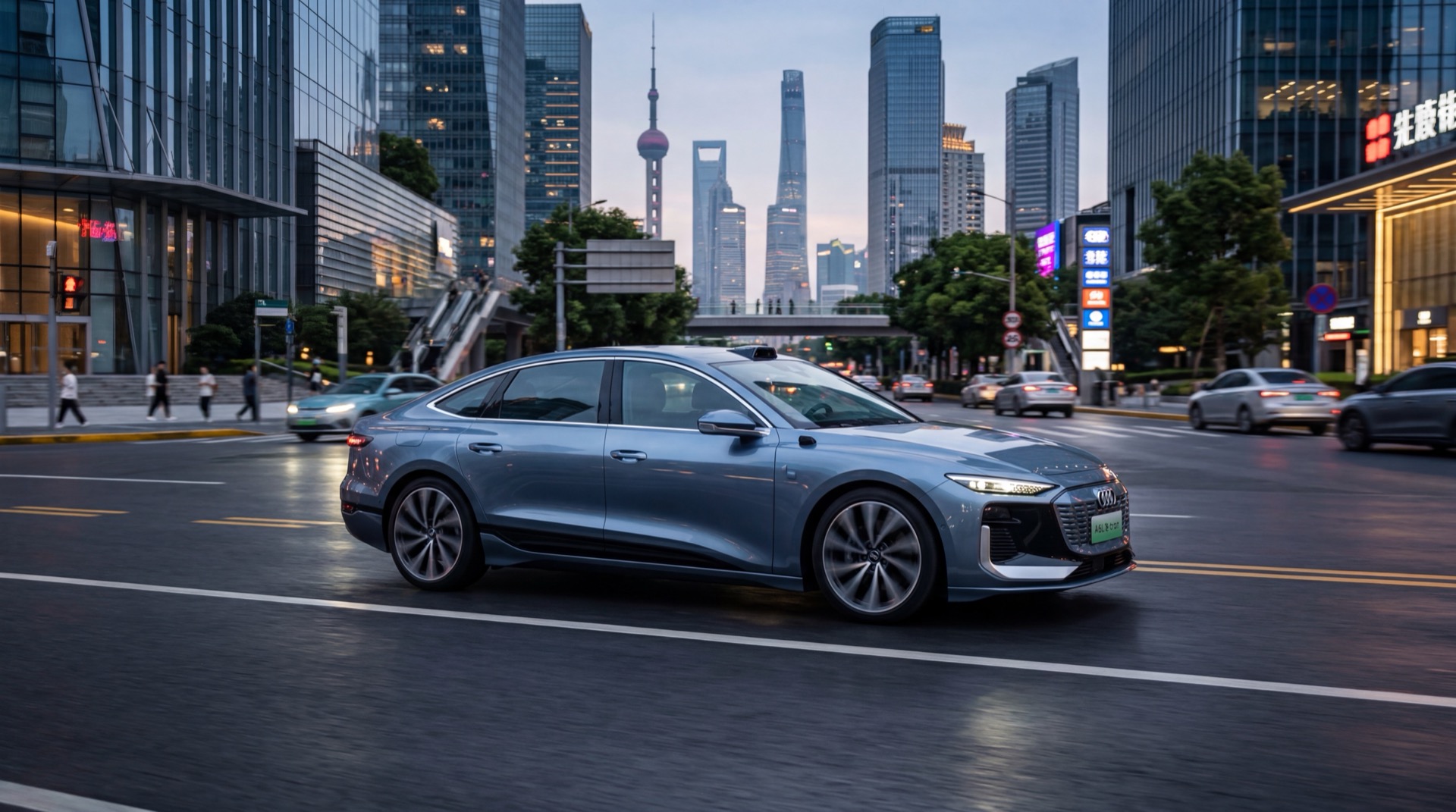
Audi has started pre-sales for the A6L e-tron in China, pricing the electric sedan from RMB 313,000 to RMB 443,000 and bundling it with Huawei’s Qiankun driver-assist stack, urban navigate-on-autopilot functions and up to 815 kilometers of CLTC range. The March 25 launch matters beyond one new model: it shows how a German luxury brand is now localizing not only body dimensions and pricing, but also the intelligence layer of the car itself in order to stay competitive in China’s premium EV market, where domestic brands have reset expectations around software, charging and value.
This is a China-specific launch, not a global model copied into the market
FAW-Audi opened pre-sales with four variants and attached a full package of local incentives, including trade-in subsidies of up to RMB 32,000, an additional purchase subsidy of RMB 10,000 in some local reports, a two-year zero-interest loan plan within a five-year financing package, and a first-edition perk worth RMB 45,000 for 888 launch units. Those details matter because they show Audi is not treating the A6L e-tron as a halo product that can float above the market on badge value alone. It is entering a price-sensitive premium segment in which buyers now expect aggressive launch packages, transparent financing support and a clear value story from day one.
The rest of the product definition is equally tailored to China. Chinese reports put the sedan at about 5,073 mm long, 1,942 mm wide and 1,522 mm high, with a 3,076 mm wheelbase, while Audi’s earlier global-debut material framed the A6L e-tron as a long-wheelbase car built specifically for Chinese executive-sedan preferences. Inside, Audi is offering an 11.9-inch virtual cockpit, a 14.5-inch central display and a 10.9-inch passenger screen, plus an AR head-up display and a 20-speaker Bang & Olufsen system. That is important because premium EV competition in China is no longer decided by exterior design alone; cabin digitization, screen architecture and entertainment features are now part of the core product proposition.
Huawei has moved from domestic-brand differentiator to foreign-luxury necessity
The A6L e-tron’s most strategically important feature is not the number of screens or even the long range claim. It is Huawei’s Qiankun driver-assist system. FAW-Audi and multiple Chinese media outlets say the car uses a dual-lidar and vision-based setup, supports navigate-on-autopilot functions in urban roads and highways, and can handle more complex parking scenarios. Audi’s April 2025 background material went further by describing the A6L e-tron and Q6L e-tron family as part of a wider China software ecosystem, with map-free L2 driving assistance integrated into the PPE-based vehicle architecture. That makes this launch more than a trim update. It turns Huawei from an optional supplier story into a visible part of Audi’s China EV survival strategy.
That shift is notable for an English-language audience because Huawei-assisted driving has usually been discussed through Chinese domestic brands. Here, the same software stack is being used by a German luxury nameplate that historically sold design, ride quality and brand heritage first. Audi is effectively acknowledging that in China’s premium EV segment, intelligent driving is no longer a side feature that can be filled in later. It sits near the center of the buying decision. The fact that the A6L e-tron follows the Q6L e-tron family, which also launched with Huawei technology, suggests this is not a one-model experiment. It looks more like a repeatable localization template for Audi’s next phase in China.
The hardware package shows Audi is resetting price and usability at the same time
On paper, the rest of the hardware package supports that interpretation. The A6L e-tron sits on the PPE architecture, uses an 800-volt electrical system and carries a 107 kWh battery in Audi’s official background materials and CnEVPost’s launch coverage. Charging power is rated at up to 270 kW. Depending on the source, the car can add roughly 294 to 302 kilometers of range in 10 minutes under ideal conditions, while a 10 percent to 80 percent charge takes about 20 to 20.7 minutes. Range reporting varies slightly across outlets: CnEVPost and China Youth Auto cited a top CLTC range of 815 kilometers, while IT Home reported 785 kilometers for the version it summarized. The safer conclusion is that Audi wants buyers to read the A6L e-tron as a long-range executive EV with fast-charging credibility, not as a compliance model.
The starting price sharpens that signal. At RMB 313,000, the A6L e-tron is not being positioned as an untouchable imported-style luxury EV. CnEVPost also noted that the earlier Q6L e-tron family started at RMB 348,800, which means Audi is using the sedan to reach a slightly lower entry point while still marketing high-end features such as lidar, Huawei assistance and an 800-volt platform. In practical terms, Audi is trying to narrow the gap between premium-brand perception and local-market value expectations. That is one of the clearest signs yet that foreign luxury makers understand they cannot defend share in China’s EV market by keeping old premium pricing logic intact.
Audi is launching this car into a market that has already changed underneath it
The broader industry backdrop helps explain why Audi is moving this way. Gasgoo, citing data from China Passenger Car Association secretary-general Cui Dongshu, said the average price of luxury vehicles in China slipped to RMB 344,000 in February 2026 from RMB 358,000 across 2025, while combined sales for BMW, Mercedes-Benz and Audi fell by roughly 260,000 units in 2025 compared with 2024. Gasgoo also said Audi is betting on localized electric models such as the Q6L e-tron and A6L e-tron, developed with Huawei for intelligent driving, as part of its response. That turns the A6L e-tron launch into a market-structure story as much as a product story: Audi is responding to share pressure by rebuilding its China offer around localized value rather than relying on legacy luxury positioning.
Gasgoo’s larger argument was that China’s auto market is shifting from blunt price wars toward value competition, with product mix, policy changes and compliance pressure reshaping how brands price and package their vehicles. The A6L e-tron fits that framework neatly. Audi is not simply discounting its way into relevance. It is combining a more approachable starting price with a China-specific body style, a software stack Chinese buyers already recognize, and charging and range figures that need to hold up against local EV standards. In other words, Audi is trying to rebuild perceived value, not merely lower the ticket price.
What changed, and what could happen next
What changed this week is that Audi’s China EV reset stopped being an abstract strategy line and became a concrete product formula. The A6L e-tron shows the company putting three decisions on the table at the same time: local long-wheelbase packaging, local-market pricing and a local intelligence partner. For years, foreign luxury brands could treat software and assisted driving as secondary layers on top of a familiar premium-car playbook. This launch suggests that approach no longer works in China. The intelligence stack is now as much a part of brand competitiveness as drivetrain performance or cabin finish.
What could happen next is that the A6L e-tron becomes a test case for how far foreign luxury brands are willing to localize in China’s EV era. If the model gains traction, Audi will have evidence that German premium brands can still compete by pairing global vehicle engineering with Chinese software and value logic. If it struggles, the pressure on foreign marques will intensify, because the market will have delivered a harsher message: localizing the tech stack is necessary, but no longer sufficient on its own. Either way, the launch has already changed the conversation. Audi is no longer just selling another electric sedan in China; it is publicly rewriting what a foreign premium EV has to look like in the country’s most demanding car market.
Related coverage
- Audi’s China-Only E7X Shows How Chinese Partners Are Rewriting the German EV Playbook
- Huawei-Backed Shangjie Z7 Opens Pre-Sales at RMB 229,800 as HIMA Pushes Into Xiaomi SU7 Territory
- Li Auto’s First $1 Billion Buyback Is a Confidence Bet on Surviving China’s EV Squeeze
Sources
-
CnEVPost — Audi begins pre-sales of A6L e-tron with Huawei driver-assist system in China
– https://cnevpost.com/2026/03/25/audi-begins-pre-sales-a6l-e-tron-china/
– Key takeaway: Confirms the March 25 pre-sales launch, the RMB 313,000 to RMB 443,000 range, Huawei’s Qiankun ADS, the 107 kWh battery, up to 815 km CLTC range, and production at Audi’s first exclusive pure-EV plant in China. -
FAW-Audi — Audi A6L e-tron global debut with PPE platform and Huawei Qiankun technology
– https://www.audi.cn/zh/audi_brand/news_experience/news20250422.html
– Key takeaway: Provides the official background on PPE, the China-specific long-wheelbase positioning, dual lidar, map-free L2 driving assistance, the 107 kWh battery and 270 kW charging. -
FAW-Audi — A6L e-tron model page
– https://www.audi.cn/zh/models/a/a6/a6l_e-tron.html
– Key takeaway: Summarizes the product’s official selling points, including Huawei Qiankun intelligent driving, dual lidar, long range and fast charging. -
China Youth Auto — FAW-Audi A6L e-tron opens pre-sales with up to 815 km CLTC range
– https://auto.youth.cn/xc/202603/t20260326_16575897.htm
– Key takeaway: Adds detailed trim-level range, charging, power and incentive information, including the 815 km top-range figure and the 888-unit first-edition launch benefits. -
Gasgoo — 2026: A Pivotal Year from “Price Wars” to “Value Wars”?
– https://autonews.gasgoo.com/articles/news/2026-a-pivotal-year-from-price-wars-to-value-wars-2033895523021381633
– Key takeaway: Supplies the broader market context that luxury pricing is falling, BBA are under pressure in China, and Audi is betting on localized electric models built with Huawei for intelligent driving.