The International Energy Agency gave the global auto industry a sharper way to describe its dependence on China this week. In a March 26 release tied to its Energy Technology Perspectives 2026 report, the IEA said a one-month halt in Chinese battery supply-chain exports would cut electric-car factory output outside China by an estimated $17 billion, with more than half of the losses falling on the European Union. That matters because the agency is no longer talking about China’s clean-tech scale only as a cost advantage. It is now framing that dominance as a measurable resilience risk for the global EV industry.
The IEA turned a familiar dependency into a hard-loss scenario
The new thing is not that China dominates clean-tech manufacturing. That has been obvious for years. The new thing is that the IEA has now attached a quantified industrial-loss scenario to that dominance. In the agency’s words, Energy Technology Perspectives 2026 is the first edition to include an “N-1” supply-chain security analysis, asking what would happen if the single largest supplier of a technology were removed from the market. For most of the steps analysed, that largest exporter is China.
The result is more uncomfortable than a generic concentration warning. The IEA said production outside the largest exporting country could, in principle, meet most demand outside China at the final manufacturing stages. But every major supply chain it examined still contains at least one step where less than a quarter of demand could be met without the largest manufacturer. In other words, final assembly may look diversified on paper while the system still depends on a handful of bottleneck components, materials, or processing steps.
That distinction is what turns this from a broad clean-energy story into a sharper China industrial story. The IEA said China accounts for 60% to 85% of production capacity across multiple clean-tech supply-chain steps, and it added that the overall geography of manufacturing is unlikely to change significantly before the end of the decade based on committed projects, mining plans, and current market trends. For international readers, the shift is clear: China’s manufacturing lead is no longer just being described as scale. It is being priced as a single-point failure risk.
Why batteries matter more than a generic clean-tech warning
The IEA’s own comparison across technologies shows why the battery number will resonate far beyond energy-policy circles. A one-month disruption to Chinese solar supply-chain exports would reduce monthly output from solar PV module factories outside China by around $1 billion, according to the agency. That is meaningful, but the battery-chain scenario is much larger. The IEA said a one-month halt in Chinese battery supply-chain exports would cut overseas EV factory output by about $17 billion. More than half of that hit would land in the European Union.
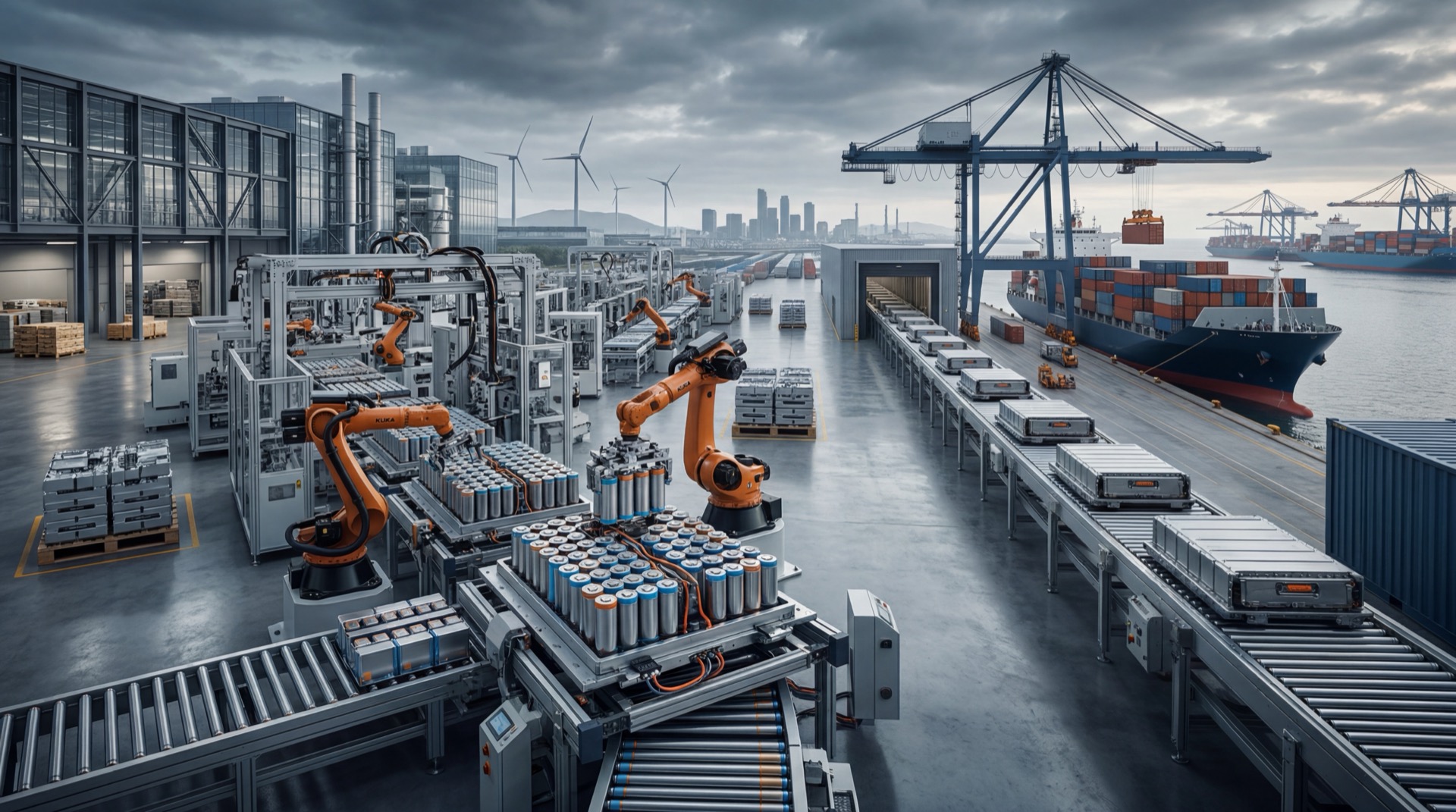
That makes batteries the cleanest bridge between a China manufacturing story and an automotive industry story. Europe has spent years trying to expand local EV production, but final vehicle assembly is only one layer of the stack. If upstream battery materials, components, and intermediate processing remain concentrated in China, overseas factories can still be left exposed even when car plants and pack lines sit outside China. The IEA’s stress test suggests the weak point is not whether the world can assemble electric cars at all. It is whether enough critical inputs can keep flowing when the biggest supplier disappears.
The numbers cited by pv magazine Australia, drawing on the IEA report, underline just how concentrated some of those upstream links remain. Its recap said China accounts for about 80% of lithium-ion battery supply-chain production capacity, 95% of PV wafers, and 97% of anode materials. Those figures help explain why a battery disruption creates a much larger industrial shock than a headline about “clean-tech concentration” might suggest. Even if non-Chinese markets can build more downstream capacity, the substitution challenge still becomes far more difficult when upstream nodes remain so heavily clustered in one country.
China’s advantage is not just scale, but industrial efficiency
Another reason this story matters is that the IEA does not describe China’s lead as a simple artifact of trade flows or policy slogans. It links the advantage to manufacturing economics. In batteries, the agency said manufacturing efficiency and automation explain more than 40% of China’s cost advantage over Europe. That is an important detail because it means the resilience problem is not solved simply by announcing more factories elsewhere. Diversification has to compete against a manufacturing system that is already faster, denser, and often cheaper.
Trade data from the same IEA release reinforces that point. After dipping in 2024, the global value of gross trade in key energy technologies rebounded by around 10% in 2025 even as prices for some products declined. China remained the dominant force in clean-energy technology manufacturing, and the IEA said Chinese gross exports of clean-energy technologies exceeded $165 billion in 2025, equivalent to roughly 15% of the country’s overall trade surplus. That is not the profile of a supplier the rest of the world can easily swap out in a couple of quarters.
The demand backdrop makes the problem more urgent rather than less. The IEA said the global market for key energy technologies could grow from nearly $1.2 trillion today to around $2 trillion by 2035 under current policies, and to almost $3 trillion under governments’ stated policies. If demand keeps rising while supply geography remains broadly similar through the end of the decade, the world is not moving into a phase of lower dependence on Chinese manufacturing. It is moving into a phase where the cost of that dependence gets larger in absolute terms.
The warning is about resilience, not imminent rupture
The cleanest way to write this story is to keep the caveat visible. The IEA is not saying China will halt exports. It is not predicting a near-term collapse in overseas EV production. What it has offered is a scenario analysis meant to show how concentrated supply chains translate into economic exposure. That difference matters. Without it, the story becomes either alarmist or politically distorted.
The agency’s own language supports the more careful interpretation. It said production outside China could, in principle, meet most demand outside China at the final stages of manufacturing. The real problem sits in the weak links underneath those final stages. That is why this report should be read as a resilience warning rather than a decoupling forecast. The stress test is not saying diversification is impossible. It is saying diversification remains incomplete in the parts of the system that matter most when supply is interrupted.
That nuance also matters for policy and corporate strategy. A country can subsidize local EV plants, battery pack assembly, or module manufacturing and still remain exposed if precursor materials, specialty components, or intermediate processing stay concentrated in China. In that sense, the IEA’s message is not that the world has failed to diversify at all. It is that partial diversification at the visible end of the chain does not eliminate risk if upstream bottlenecks remain largely unchanged.
What changed this week, and what could happen next
What changed this week is the vocabulary of the debate. China’s dominance in clean-tech manufacturing has been discussed for years in terms of cost, scale, and industrial policy. The IEA has now translated part of that discussion into a factory-output number that boardrooms and policymakers can immediately understand: a one-month interruption in Chinese battery supply-chain exports could erase about $17 billion in EV factory output outside China. That makes the issue easier to compare against investment plans, localization strategies, and industrial-security policy.
What could happen next is not a sudden unwinding of China’s role. The IEA has already suggested the supply-chain map is unlikely to change dramatically before 2030. That means automakers, battery makers, and governments are likely to respond with a familiar mix of regional redundancy, upstream investment, and trade-security planning while still relying heavily on Chinese manufacturing depth. The uncomfortable conclusion is that both sides of the story remain true at once: China’s scale continues to lower costs for the global EV economy, and that same scale remains the system’s biggest measurable vulnerability.
Sources
-
IEA — Strengthening supply chains can improve resilience and reduce economic security risks for key energy technologies
https://www.iea.org/news/strengthening-supply-chains-can-improve-resilience-and-reduce-economic-security-risks-for-key-energy-technologies -
IEA — Energy Technology Perspectives 2026
https://www.iea.org/reports/energy-technology-perspectives-2026 -
Carbon Pulse — China’s dominance in clean energy technologies leaves rest of world vulnerable, says IEA
https://carbon-pulse.com/497196/ -
pv magazine Australia — China’s clean tech manufacturing dominance a supply chain risk: report
https://www.pv-magazine-australia.com/2026/03/27/chinas-clean-tech-manufacturing-dominance-a-supply-chain-risk-report/