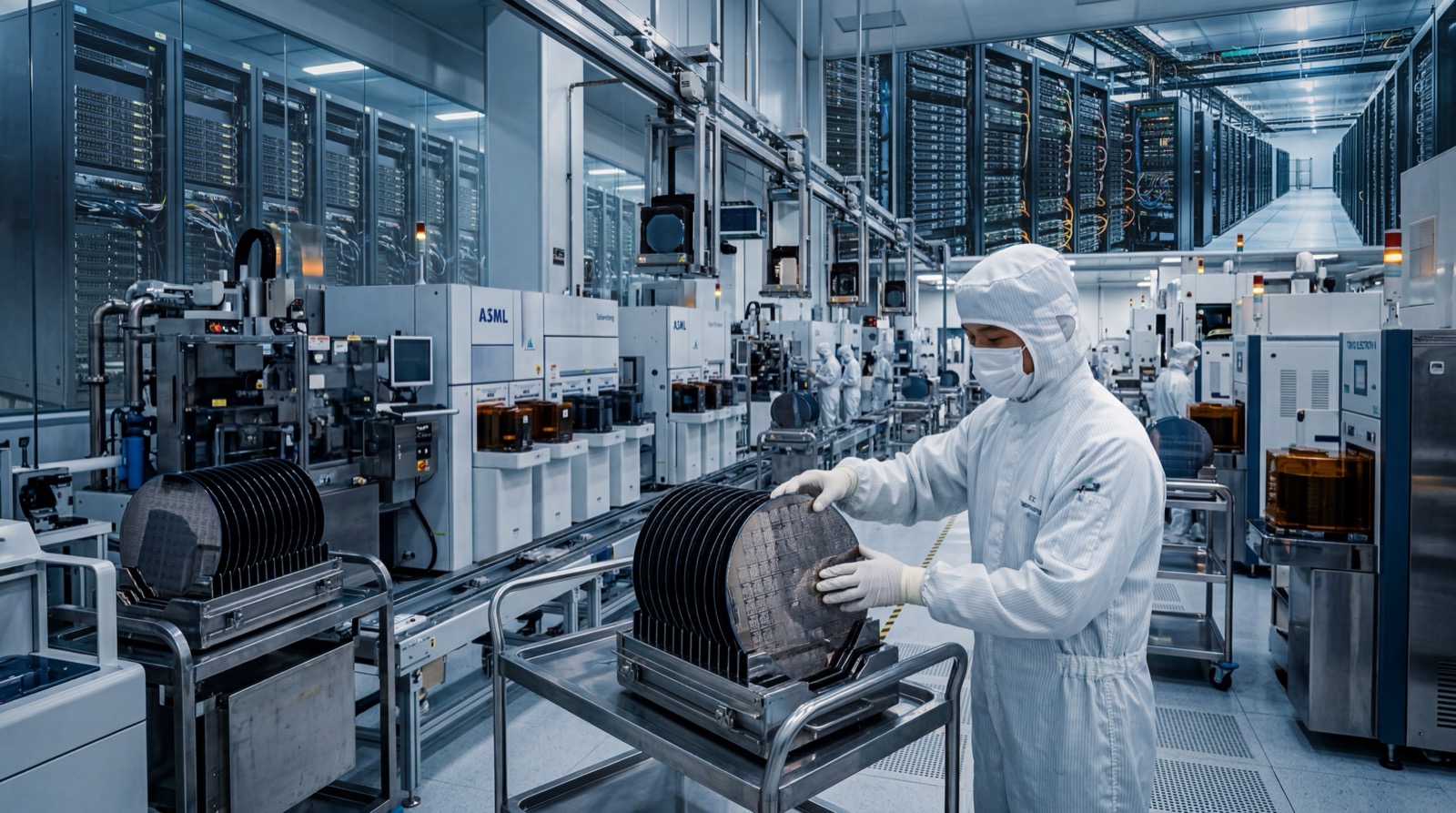
China’s chip industry is expanding faster than expected as AI demand pushes manufacturers to add capacity and begins tightening supplies of raw materials and high-end components across the semiconductor chain. Reuters reported from SEMICON China on March 25 that China’s 22nm-to-40nm capacity share is projected by SEMI China President Lily Feng to reach 42% of global output by 2028, up from 37% in 2026. The significance is broader than a single capacity statistic: the AI buildout is no longer straining only advanced accelerators, but also the mature-node and equipment ecosystem on which much of China’s industrial, automotive and lower-cost computing stack still depends.
The new capacity target makes the China story more concrete
China’s semiconductor expansion has often been described in general terms: more investment, more state backing, and more urgency after export controls. The Reuters report from SEMICON China gave that trend a sharper number. Feng said China’s share of global 22nm-to-40nm capacity is expected to rise to 42% by 2028, versus 37% in 2026. That matters because mature nodes are not a residual corner of the industry. They remain central to power management chips, microcontrollers, display drivers, many automotive components and a long list of industrial electronics that still move on older but highly relevant processes.
The phrasing from Reuters also matters. The report did not describe China’s industry as simply growing. It said growth was coming faster than expected because the global AI infrastructure race is lifting demand across more of the semiconductor stack. That is a more consequential frame for an English-language audience. It suggests that China’s expansion is not only a policy story or a catch-up story. It is also becoming part of the supply response to a worldwide AI buildout that needs far more than top-end GPUs.
SEMI’s own event framing supports that interpretation. In its pre-show material for SEMICON China 2026, the industry group highlighted AI, IC manufacturing technology and supply-chain opportunities as central themes of the event. That does not by itself prove that every segment is booming equally, but it does show that the industry’s main trade platform is now treating AI and manufacturing capacity as linked issues rather than separate conversations.
The pressure is spreading beyond advanced AI chips
The most important point in the Reuters story is easy to miss if readers focus only on the 42% number. The report said the AI boom is beginning to strain supplies of raw materials and high-end components. In other words, the bottleneck story is moving outward. For the past two years, most global discussion around AI hardware has focused on the scarcity of advanced GPUs, high-bandwidth memory and cutting-edge packaging. What the China capacity story adds is that demand is now also tightening the broader production base behind less glamorous but still essential chips and manufacturing inputs.
That wider squeeze is visible in independent industry reporting. TrendForce reported on March 13 that Nexchip, China’s third-largest foundry, plans to raise foundry prices by 10% from June, following similar price pressure at SMIC and Hua Hong as mature-node supply tightens. TrendForce said Nexchip is simultaneously expanding capacity, with a Phase IV project designed to add a 12-inch line capable of supporting 40nm and 28nm logic, CIS and OLED processes. The combination is notable: even as new lines are being built, pricing is still moving up because demand and input costs are rising quickly enough to absorb more supply.
Astute Group described the same pattern in broader industry terms. Its March analysis said price inflation is spreading across mature-node foundry services as utilisation rates rise and costs move higher. Citing earlier reporting around Chinese foundries, Astute noted that SMIC had raised prices on some lines by around 10%, while SMIC’s utilisation reached 95.8% and Hua Hong’s topped 100% in prior disclosures. These are not the numbers of a market with abundant slack. They point to a part of the industry where pricing power is returning because customers still need dependable legacy-node output.
China’s equipment appetite suggests this is not a short-lived burst
The equipment side is one reason the story should not be read as a one-quarter anomaly. SEMI said global semiconductor equipment sales are projected to reach $133 billion in 2025, $145 billion in 2026 and $156 billion in 2027. More important for this article’s thesis, SEMI said continued capacity build-out in China is contributing meaningfully to wafer-fab-equipment demand and that China is expected to remain the largest regional market for such tools. That does not mean every announced project will translate cleanly into profitable output. It does mean the expansion is backed by a capital-spending cycle large enough to shape global industry planning.
That spending pattern also explains why mature nodes deserve more attention in AI coverage. Not every part of the AI buildout requires bleeding-edge process technology. Power delivery, industrial controllers, connectivity components, display interfaces and many support chips still rely on older geometries. If China is scaling those nodes aggressively while global AI infrastructure absorbs more materials, components and engineering attention, then the supply chain effect can become broader and more persistent than the market expected.
PwC’s 2026 semiconductor outlook reinforces that point from a strategic angle. The report argues that China continues to add capacity in mature logic and memory even under export-control pressure, with companies such as SMIC and YMTC still expanding. That is an important caveat to the simplistic idea that controls alone freeze the entire sector. They do constrain leading-edge ambitions, but they can also push more investment toward segments where China can still gain scale, especially when AI demand makes those segments commercially more valuable.
The right frame is industry acceleration, not triumphalism
There is still a reason to keep the language disciplined. The source pack behind this story is strong enough for a Reuters-led trend piece, but not for a triumphalist claim that the entire global market has suddenly re-ranked itself around China. Same-day independent English-language follow-up remained relatively thin, and some of the most detailed supply-and-pricing evidence comes from industry outlets rather than a second wave of major international newsrooms. That means the safest editorial move is to write this as a solid industry acceleration story with cross-checks, not as an all-out declaration that China has already solved every constraint in the chip chain.
That more careful framing is also the more interesting one. The real shift is not that China has suddenly replaced the global leaders at advanced nodes. It is that AI demand is making mature-node capacity, raw materials and manufacturing inputs more valuable at the same moment China is expanding aggressively in those areas. When those two forces overlap, China’s role in the semiconductor system starts to look less peripheral to the AI boom and more embedded within it.
The export-control backdrop sharpens the point. Under a tighter technology regime, China’s most scalable response is not always to match the most advanced players node for node. It is often to add capacity where demand is real, customers are numerous and the rest of the supply chain still depends on steady output. Mature-node expansion therefore becomes more than an industrial-policy fallback. It becomes a way to capture leverage inside a global market that is being stretched by AI from multiple directions at once.
What changed, and what could happen next
What changed this week is that the China chip story gained a clearer quantitative center. Reuters supplied the new 42%-by-2028 capacity projection from SEMI China, while TrendForce and Astute showed that mature-node price pressure and utilisation are already running high enough to support the supply-strain thesis. Together, those signals make it harder to treat China’s capacity build-out as background noise. The expansion is becoming visible in the same conversation as AI demand, costs and supply bottlenecks.
What could happen next is more complicated than a simple capacity victory lap. If equipment spending stays elevated and China continues to scale mature-node output, the country could strengthen its role in the parts of the semiconductor market that remain essential to automotive electronics, industrial systems and lower-cost AI infrastructure. But if raw materials, high-end components and legacy-node pricing keep tightening, downstream manufacturers may find that the AI buildout is making even older-process chips more expensive and strategically sensitive. That would mean the AI supply crunch is no longer only a story about advanced computing scarcity. It would also be a story about who can secure the broader manufacturing base required to support the next wave of semiconductor demand.
Related coverage
- Alibaba Unveils XuanTie C950, a RISC-V CPU Built for Agentic AI
- Huawei’s Atlas 350 Turns China’s AI Chip Push Into a Direct Challenge to Nvidia’s H20
- China’s Gallium and Germanium Exports to Japan Fall to Zero While Rare-Earth Magnet Shipments Rise
Sources
-
Reuters — AI boom accelerates China’s chip industry growth as demand strains supply chain
– https://www.reuters.com/business/autos-transportation/ai-boom-accelerates-chinas-chip-industry-growth-demand-strains-supply-chain-2026-03-25/
– Key takeaway: Reports from SEMICON China that China’s chip industry is growing faster than expected as AI demand strains supplies of raw materials and high-end components, and cites Lily Feng’s projection that China’s 22nm-to-40nm capacity share could reach 42% by 2028 versus 37% in 2026. -
SEMI — SEMICON China 2026 to Highlight Strategic Opportunities in the Era of AI and Trillion-Dollar Market Growth
– https://www.semi.org/en/semi-press-release/semicon-china-2026-to-highlight-strategic-opportunities-in-the-era-of-ai-and-trillion-dollar-market-growth
– Key takeaway: Sets the official event backdrop, linking AI, IC manufacturing and supply-chain themes at SEMICON China 2026. -
SEMI — Global Semiconductor Equipment Sales Projected to Reach a Record of $156 Billion in 2027, SEMI Reports
– https://www.semi.org/en/semi-press-release/global-semiconductor-equipment-sales-projected-to-reach-a-record-of-156-billion-dollars-in-2027-semi-reports
– Key takeaway: Provides the equipment-spending forecast and says continued capacity build-out in China is contributing meaningfully to wafer-fab-equipment demand. -
TrendForce — China’s No.3 Foundry Nexchip to Hike Prices 10% from June, Following SMIC, Hua Hong
– https://www.trendforce.com/news/2026/03/13/news-chinas-no-3-foundry-nexchip-to-hike-prices-10-from-june-following-smic-as-mature-node-supply-tightens/
– Key takeaway: Adds independent industry evidence that mature-node supply is tightening, prices are rising and capacity expansion is continuing at the same time. -
PwC — Semiconductor and beyond 2026
– https://www.pwc.com/gx/en/industries/technology/pwc-semiconductor-and-beyond-2026-full-report.pdf
– Key takeaway: Supplies the longer-range context that China is still expanding mature logic and memory capacity despite export controls.